Kirjojen hintavertailu – 12 903 725 kirjaa ja 27 kauppaa
Kirjailija
Charlotte MacKenzie
Kirjat ja teokset yhdessä paikassa: 14 kirjaa, julkaisuja vuosilta 1993–2024, suosituimpiin kuuluu Mary Broad the documentary. Vertaile teosten hintoja ja tarkista saatavuus suomalaisista kirjakaupoista.
Cornwall and the peace explores individual choices in Georgian Cornwall. Living in Georgian Cornwall. Choosing not to leave. Leaving home in Georgian Cornwall. Choosing whether or not to return. Lodging in Georgian Penzance. Travelling with relations. Travelling alone. Choices interwoven with individual identities and circumstances over time. It focuses partly on life in Penzance during the brief interlude, from March 1802 to May 1803, in the quarter century of wars between Britain and France. And draws on Charlotte MacKenzie's extensive archival research on Georgian Cornwall.
This book explores relationships between historical individuals and Cornish legends. The Cornish folklorists. How the Bront s' novels were influenced by Cornish folk tales and other stories of their aunt Elizabeth Branwell. The women whose lives were affected by men on whom the legend of 'Cruel Coppinger' may have been based. When and how the Cornish woman Mary Broad's experiences were reinvented to create the legendary Mary Bryant. The choice of subjects make it clear that 'legends' is not used here to only refer to folk lore.
Mary Ann Parker was the first European woman to publish a travel memoir of New South Wales. After travelling with her husband, Captain John Parker of HMS Gorgon. Mary Ann Parker's family origins are revealed here for the first time.
This book explores the lives of women writers connected with Cornwall during the Georgian era. All were published authors. Cornwall influenced the writing of the Bront s through their mother's Cornish relations. Many of the Bront s' completed novels were set in the Georgian era. The lives and writing of twelve women who are less well known than the Bront s are rediscovered here. Individual chapters focus on Catherine Phillips, Elizabeth Trefusis, Anne Batten Cristall, Eliza Fenwick, Thomasin Dennis, and Charlotte Champion Pascoe. Alongside consideration of the published writing and lives of Dorothy Enys, Blanche Lean, Jane Taylor, Ann Thomas, Jane Louisa Willyams, and Anna Maria Wood. The purpose of this book is to unforget these women's lives and writing, and what it can tell us about Cornwall's history, culture, and literary traditions.
More has been written about smugglers than merchants in eighteenth century Cornwall. Yet Cornish merchants led and organised Cornwall's eighteenth century trade including smuggling. This book places Cornwall's merchants in the context of their social and family relationships, commerce and credit, politics, communications, know-how, culture, and faiths. It is a story of women as well as men. It looks at Cornwall's participation in transatlantic trade including the eighteenth century slave trade.
This book tells the life story for the first time of the eighteenth-century Cornish mariner Captain Joseph Banfield. It includes a transcript of Joseph Banfield's memoir. Banfield's memoir can be compared with published writings of other transatlantic slave trade captains including abolitionists. Banfield also worked on whalers and a variety of merchant trading ships completing Atlantic and Mediterranean voyages in over forty years at sea. His experiences can be compared with those of other eighteenth-century Cornish mariners. Readers interested in the history of the transatlantic slave trade, eighteenth-century maritime history, and the history of Cornwall will all find items of interest in this book.
This book reveals the history of the Ellis family in Cornwall through ten generations from Elizabethan times to the first world war. The earlier generations farmed in west Cornwall. Initially trading as victuallers and merchants the family later established the Helston and Hayle breweries. It is a useful reference source for family and local historians.
This local history outlines the origins and histories of the Ellis breweries at Helston and Hayle. It includes histories of Cornish 'locals' as many of the inns, pubs, and hotels associated with the Ellis breweries are in business today. It is a useful reference source for local and family historians.
Through an examination of the fascinating lives and careers of a series of nineteenth-century "mad-doctors," Masters of Bedlam provides a unique perspective on the creation of the modern profession of psychiatry, taking us from the secret and shady practices of the trade in lunacy, through the utopian expectations that were aroused by the lunacy reform movement, to the dismal realities of the barracks-asylums--those Victorian museums of madness within which most nineteenth-century alienists found themselves compelled to practice. Across a century that spans the period from an unreformed Bedlam to the construction of a post-Darwinian bio-psychiatry centered on the new Maudsley Hospital, from a therapeutics of bleeding, purging, and close confinement through the era of moral treatment and nonrestraint to a fin-de-siecle degenerationism and despair, men claiming expertise in the treatment of mental disorder sought to construct a collective identity as trustworthy and scientifically qualified professionals. This fascinating series of biographies answers the question: How successful were they in creating such a new identity?. Drawing on an extensive array of sources, the authors vividly re-create the often colorful and always eventful lives of these seven "masters of bedlam." Sensitive to the idiosyncrasies and peculiarities of each man's personal biography, the authors replace hagiographical ac-counts of the great men who founded modern psychiatry with fully rounded portraits of their struggles and successes, their achievements and limitations. In the process Masters of Bedlam provides an extremely subtle and nuanced portrait of the efforts of successive generations of alienists to carve out a popular and scientific respect for their specialty, and reminds us repeatedly of the complexities of nineteenth-century developments in the field of psychiatry. Originally published in 1996. The Princeton Legacy Library uses the latest print-on-demand technology to again make available previously out-of-print books from the distinguished backlist of Princeton University Press. These editions preserve the original texts of these important books while presenting them in durable paperback and hardcover editions. The goal of the Princeton Legacy Library is to vastly increase access to the rich scholarly heritage found in the thousands of books published by Princeton University Press since its founding in 1905.
Through an examination of the fascinating lives and careers of a series of nineteenth-century "mad-doctors," Masters of Bedlam provides a unique perspective on the creation of the modern profession of psychiatry, taking us from the secret and shady practices of the trade in lunacy, through the utopian expectations that were aroused by the lunacy reform movement, to the dismal realities of the barracks-asylums--those Victorian museums of madness within which most nineteenth-century alienists found themselves compelled to practice. Across a century that spans the period from an unreformed Bedlam to the construction of a post-Darwinian bio-psychiatry centered on the new Maudsley Hospital, from a therapeutics of bleeding, purging, and close confinement through the era of moral treatment and nonrestraint to a fin-de-siecle degenerationism and despair, men claiming expertise in the treatment of mental disorder sought to construct a collective identity as trustworthy and scientifically qualified professionals. This fascinating series of biographies answers the question: How successful were they in creating such a new identity?. Drawing on an extensive array of sources, the authors vividly re-create the often colorful and always eventful lives of these seven "masters of bedlam." Sensitive to the idiosyncrasies and peculiarities of each man's personal biography, the authors replace hagiographical ac-counts of the great men who founded modern psychiatry with fully rounded portraits of their struggles and successes, their achievements and limitations. In the process Masters of Bedlam provides an extremely subtle and nuanced portrait of the efforts of successive generations of alienists to carve out a popular and scientific respect for their specialty, and reminds us repeatedly of the complexities of nineteenth-century developments in the field of psychiatry. Originally published in 1996. The Princeton Legacy Library uses the latest print-on-demand technology to again make available previously out-of-print books from the distinguished backlist of Princeton University Press. These editions preserve the original texts of these important books while presenting them in durable paperback and hardcover editions. The goal of the Princeton Legacy Library is to vastly increase access to the rich scholarly heritage found in the thousands of books published by Princeton University Press since its founding in 1905.
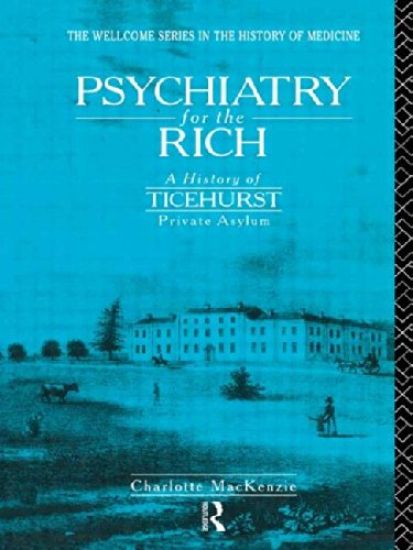
The madhouse often figures prominently in popular conceptions of the nineteenth century, yet little is known about the realities of private institutions. In Psychiatry for the Rich, Charlotte MacKenzie examines the history of the asylum at Ticehurst in Sussex to explore the social history of madness and the impact of politics and popular opinion. She details the backgrounds of the patients, their own descriptions of the asylum as well as changes in the institution through the lunacy reforms and developments in medical theory. Challenging many of the accepted views of the Victorian asylum, Money, Medicine and Madness is the most revealing account of the trade in lunacy in the nineteenth century.
The madhouse often figures prominently in popular conceptions of the nineteenth century, yet little is known about the realities of private institutions. In Psychiatry for the Rich, Charlotte MacKenzie examines the history of the asylum at Ticehurst in Sussex to explore the social history of madness and the impact of politics and popular opinion. She details the backgrounds of the patients, their own descriptions of the asylum as well as changes in the institution through the lunacy reforms and developments in medical theory. Challenging many of the accepted views of the Victorian asylum, Money, Medicine and Madness is the most revealing account of the trade in lunacy in the nineteenth century.