Kirjojen hintavertailu – 12 859 818 kirjaa ja 27 kauppaa

Kirjailija

Chris Frith

Kirjat ja teokset yhdessä paikassa: 8 kirjaa, julkaisuja vuosilta 2003–2023, suosituimpiin kuuluu Making up the Mind. Vertaile teosten hintoja ja tarkista saatavuus suomalaisista kirjakaupoista.

8 kirjaa

Kirjojen julkaisuvuodet: 2003–2023.

What Makes Us Social?

What Makes Us Social?

Chris Frith; Uta Frith

MIT PRESS LTD
2023
nidottu

Halvin toimitettuna 77,90 €

A deep dive into the social mind-brain, examining the processes we share with other social animals and illuminating those that are uniquely human. What Makes Us Social? is a scholarly but accessible exploration of the underlying processes that make humans the most social species on the planet. Chris and Uta Frith, pioneers in the field of cognitive neuroscience, review the many forms of social behavior that we humans share with other animals and examine the special form that only humans possess, including its dark side. These uniquely human abilities allow us to reflect on our behavior and share these reflections with other people, which in turn enables us to reason why we do things and to exert some control over our automatic behaviors. As a result, we can learn cooperatively with others and create and value cultural artifacts that survive through the generations. Going beyond how we come to know ourselves and understand the mind of others, Frith and Frith investigate how we adapt mutually to make social interactions work. This book stands out in its application of a computational framework--one that lies at the intersection of psychology and artificial intelligence--to key concepts of social cognition, such as empathy, trust, group identity, and reputation management. Ultimately, What Makes Us Social? is a profound examination of the ways we communicate, cooperate, share, and compete with other humans and how these capabilities define us as a species.
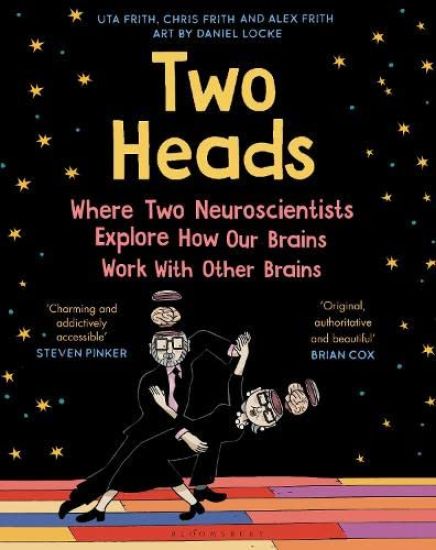
Two Heads: A Graphic Exploration of How Our Brains Work with Other Brains
This "charming and addictively accessible introduction to neuroscience" (Steven Pinker) takes us on a highly entertaining tour through the wonders and mysteries of the human brain--from a renowned husband-and-wife team of cognitive neuroscientists. Professors and husband-and-wife team Uta and Chris Frith have pioneered major studies of brain disorders throughout their nearly fifty-year career. Here, in this "pleasing mix of wonder, genial humor, and humility" (Kirkus Reviews, starred review), they tell the compelling story of the birth of neuroscience and their paradigm-shifting discoveries across areas as wide-ranging as autism and schizophrenia research, and new frontiers of social cognition including diversity, prejudice, confidence, collaboration, and empathy. Working with their son Alex Frith and artist Daniel Locke, the Friths delve into a wide range of complex concepts and explain them with humor and clarity. You'll learn what it means to be a "social species," explore what happens when we gather in groups, and discover how people behave in pairs--when we're pitted against each other, versus when we work together. Is it better to surround yourself with people who are similar to yourself, or different? And, are two heads really better than one? Highly original and ingeniously illustrated, Two Heads is a "magical book... and] a fantastically fun way to learn about the brain, the mind, and the lives of two of the world's most brilliant scientists" (Sarah-Jayne Blakemore, author of Inventing Ourselves).
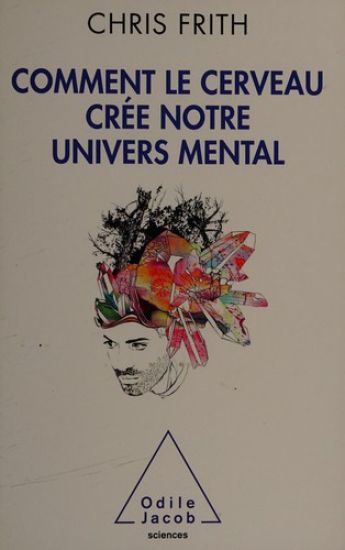
How the Brain Creates Our Mental World / Comment le cerveau crée notre univers mental
Chris Frith is Professor in Neuropsychology at the Wellcome Trust Centre for Neuroimaging at University College London. Inside our heads there is an amazing labour-saving device, more effective than the latest computer. The brain frees us from the everyday tasks of moving about in the world around us, allowing us to concentrate on the things that are most important to us: our relations with others. However, the self that is engaged in this social world is also a construction of the brain. It is the brain that enables us to share our mental life with the people around us. This book reviews the experimental studies that'show how the brain creates our mental world. Using evidence from brain imaging, psychological experiments and studies with patients, Chris Frith, one of the world's leading neuroscientists, gives a complete picture of how the mied functions.- "...a fascinating guided tour through the elusive interface between mied and brain written by a pioneer in the field. The author's obvious passion for the subject shines through every page." "V. S. Ramachandran"- "Chris Frith is well known for his extremely clear thinking on very complex psychological matters, such as ... how we perceive, act, choose, remember, and feel, which are now being revolutionized by brain imaging. In Making up the Mied, he brings all this together in a most accessible and enjoyable way." "Oliver Sacks"
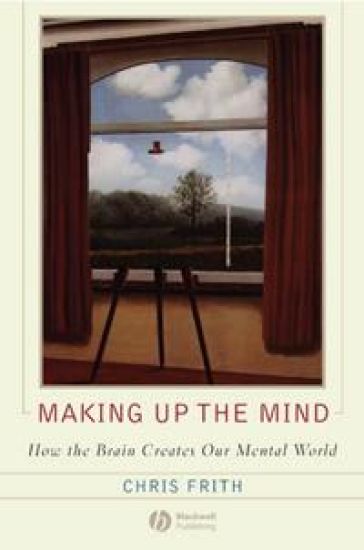
Making up the Mind

Making up the Mind

Chris Frith

Wiley-Blackwell (an imprint of John Wiley Sons Ltd)
2007
nidottu

Halvin toimitettuna 40,80 €

Written by one of the world’s leading neuroscientists, Making Up the Mind is the first accessible account of experimental studies showing how the brain creates our mental world. Uses evidence from brain imaging, psychological experiments and studies of patients to explore the relationship between the mind and the brain Demonstrates that our knowledge of both the mental and physical comes to us through models created by our brain Shows how the brain makes communication of ideas from one mind to another possible
Making up the Mind

Making up the Mind

Chris Frith

Wiley-Blackwell (an imprint of John Wiley Sons Ltd)
2007
sidottu
Written by one of the world’s leading neuroscientists, Making Up the Mind is the first accessible account of experimental studies showing how the brain creates our mental world. Uses evidence from brain imaging, psychological experiments and studies of patients to explore the relationship between the mind and the brain Demonstrates that our knowledge of both the mental and physical comes to us through models created by our brain Shows how the brain makes communication of ideas from one mind to another possible
The Unity of Consciousness

The Unity of Consciousness

Chris Frith

Oxford University Press
2003
sidottu
Consciousness has many elements, from sensory experiences such as vision, audition, and bodily sensation, to nonsensory aspects such as volition, emotion, memory, and thought. The apparent unity of these elements is striking; all are presented to us as experiences of a single subject, and all seem to be contained within a unified field of experience. But this apparent unity raises many questions. How do diverse systems in the brain co-operate to produce a unified experience? Are there conditions under which this unity breaks down? Is conscious experience really unified at all? In recent years, these questions have been addressed by researchers in many fields, including, neurophysiologists and computational modellers, neuropsychology, cognitive psychology, and philosophy. With chapters from some of the leading thinkers on consciousness, this is a thought-provoking book that attempts to answer some of the big questions. Contributors include - Chris Frith, David Chalmers, Guilio Tononi, Anne Treisman, Andrew Young, Sydney Shoemaker, Glyn Humphreys, Rodney Cotterill, Zoltan Dienes, Susan Hurley, Randall O'Reilly, Andreas Engel, Pierre Perruchet, Catherine Tallon-Baudry, and Francisco Varela.
Schizophrenia

Schizophrenia

Chris Frith; Eve C. Johnstone

Oxford University Press
2003
nidottu

Halvin toimitettuna 18,90 €

Schizophrenia is the archetypal form of madness. Schizophrenia is a common disorder and has a devastating effect on sufferers and their families-patients typically hear voices in their heads and hold bizarre beliefs. The schizophrenic patient presented to the public in sensational press reports and lurid films bears little resemblance to reality of the illness. This book describes what schizophrenia is really like, how the illness progresses, and the treatments that have been applied. It also summarizes the most up-to-date knowledge available about the biological bases of this disorder. Finally it attempts to give some idea of what it is like to have schizophrenia and what this disorder tells us about the relationship between mind and brain. ABOUT THE SERIES: The Very Short Introductions series from Oxford University Press contains hundreds of titles in almost every subject area. These pocket-sized books are the perfect way to get ahead in a new subject quickly. Our expert authors combine facts, analysis, perspective, new ideas, and enthusiasm to make interesting and challenging topics highly readable.