Kirjojen hintavertailu – 12 859 828 kirjaa ja 27 kauppaa

Kirjailija

Chris Impey

Kirjat ja teokset yhdessä paikassa: 11 kirjaa, julkaisuja vuosilta 2010–2023, suosituimpiin kuuluu Humble Before the Void. Vertaile teosten hintoja ja tarkista saatavuus suomalaisista kirjakaupoista.

11 kirjaa

Kirjojen julkaisuvuodet: 2010–2023.

Worlds without End

Worlds without End

Chris Impey

MIT PRESS LTD
2023
sidottu
The science of finding habitable planets beyond our solar system and the prospects for establishing human civilization away from our ever-less-habitable planetary home. Planet Earth, it turns out, may not be the best of all possible worlds—and lately humanity has been carelessly depleting resources, decimating species, and degrading everything needed for life. Meanwhile, human ingenuity has opened up a vista of habitable worlds well beyond our wildest dreams of outposts on Mars. Worlds without End is an expertly guided tour of this thrilling frontier in astronomy: the search for planets with the potential to host life. With the approachable style that has made him a leading interpreter of astronomy and space science, Chris Impey conducts readers across the vast, fast-developing field of astrobiology, surveying the dizzying advances carrying us ever closer to the discovery of life beyond Earth—and the prospect of humans living on another planet. Since the first exoplanet, or planet beyond our solar system, was discovered in 1995, over 4,000 more have been pinpointed, including hundreds of Earth-like planets, many of them habitable, detected by the Kepler satellite. With a view spanning astronomy, planetary science, geology, chemistry, and biology, Impey provides a state-of-the-art account of what’s behind this accelerating progress, what’s next, and what it might mean for humanity’s future. The existential threats that we face here on Earth lend urgency to this search, raising the question: Could space be our salvation? From the definition of habitability to the changing shape of space exploration—as it expands beyond the interests of government to the pursuits of private industry—Worlds without End shows us the science, on horizons near and far, that may hold the answers.
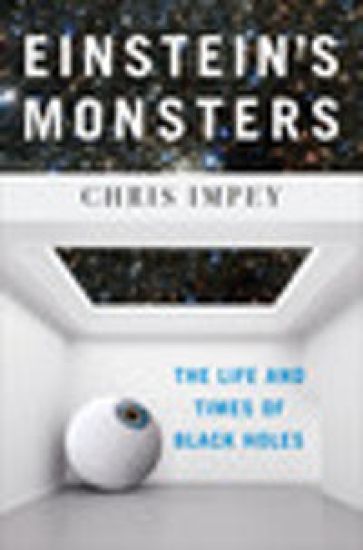
Einstein's Monsters

Einstein's Monsters

Chris Impey

WW NORTON CO
2019
nidottu
Black holes are the most extreme objects in the universe, yet every galaxy harbours a black hole at its centre. In Einstein’s Monsters, Chris Impey builds on this profound discovery to explore questions at the cutting edge of cosmology, such as what happens if you travel into a black hole and whether the galaxy or its black hole came first. Impey chronicles the role black holes have played in theoretical physics. He then describes the phenomena that scientists have witnessed while observing black holes: dozens of stars swarming around the dark object at the centre of our galaxy; black holes performing gravitational waltzes with normal stars; the cymbal clash of two black holes colliding, releasing ripples in spacetime. Einstein’s Monsters is the incredible story of one of the most enigmatic entities in nature.
Einstein's Monsters

Einstein's Monsters

Chris Impey

WW Norton Co
2018
sidottu

Halvin toimitettuna 30,30 €

Black holes are the most extreme objects in the universe, yet every galaxy harbours a black hole at its centre. In Einstein’s Monsters, Chris Impey builds on this profound discovery to explore questions at the cutting edge of cosmology, such as what happens if you travel into a black hole and whether the galaxy or its black hole came first. Impey chronicles the role black holes have played in theoretical physics. He then describes the phenomena that scientists have witnessed while observing black holes: dozens of stars swarming around the dark object at the centre of our galaxy; black holes performing gravitational waltzes with normal stars; the cymbal clash of two black holes colliding, releasing ripples in spacetime. Einstein’s Monsters is the incredible story of one of the most enigmatic entities in nature.
Beyond

Beyond

Chris Impey

WW Norton Co
2016
nidottu
With plans to launch hotels into orbit and experiments in suspending and reanimating life for ultra-long-distance travel, private companies and entrepreneurs have outpaced NASA as the leaders in the new space race. With accessible prose and relentless curiosity, Chris Impey reports on China’s plan to launch its own space station by 2020, proves that humans could survive on Mars and unveils cutting-edge innovations such as the space elevators poised to replace rockets at a fraction of the cost. Setting mankind’s urge towards exploration in the context of all human history and space travel thus far, he shows that the present-day scientists mapping billions of Earth-like exo-planets are the descendants of the first humans to venture out of Africa. We must forge ahead, argues Beyond, because exploration is in our DNA.
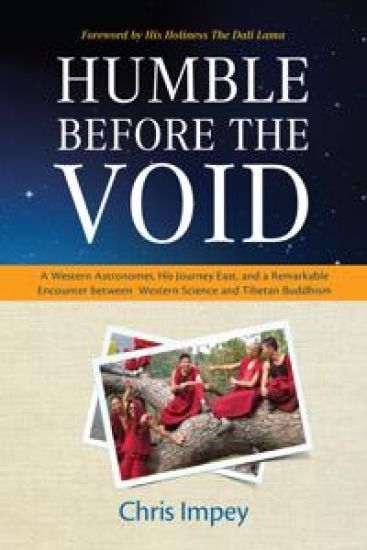
Humble Before the Void

Humble Before the Void

Chris Impey; Lama Dalai

TEMPLETON FOUNDATION PRESS,U.S.
2015
pokkari
“This book will provide readers with a greater awareness of the spirit of curiosity and inquiry that lies at the heart of the Buddhist tradition, as well as the fruitfulness of maintaining active communication between the Buddhist and scientific commu­nities.” -from the Foreword by His Holiness the Dalai Lama In Humble before the Void, Impey, a noted astronomer, educator, and author gives us a thor­oughly absorbing and engaging account of his journey to Northern India to teach in the first-ever “Science for Monks” leadership program. The pro­gram was initiated by His Holiness the Dalai Lama to introduce science into the Tibetan Buddhist monastic tradition. In a vivid and compelling narrative, Impey intro­duces us to a group of exiled Tibetan monks whose charm, tenacity and unbridled enthusiasm for learning is infectious. Impey marvels not only at their enthusiasm, but at their tireless diligence that allows the monks to painstakingly build intri­cate sand mandalas-that can be swept away in an instant. He observes them as they meticulously count galaxies and notes how their enthusiasm and diligence stands in contrast to many American students who are frequently turned off by sci­ence’s inability to deliver easy, immediate payoffs. Because the Buddhist monks have had a limited science education, Impey must devise creative pedagogy. His new students immediately take to his inspired teaching methods, whether it’s the use of balloons to demonstrate the Hubble expansion or donning an Einstein mask to explain the theory of relativity. Humble before the Void also recounts Impey’s experiences outside the classroom, from the monks’ eagerness to engage in pick-up basket­ball games and stream episodes of hip American sitcoms to the effects on his relationship with the teenage son who makes the trip with him. Moments of profound serenity and beauty in the Himalayas are contrasted with the sorrow of learning that other monks have set themselves on fire to protest the Chinese oppression in Tibet. At the end of the three week program, both the monks and Impey have gained a valuable edu­cation. While the monks have a greater under­standing and appreciation of science, Impey has acquired greater self- knowledge and a deeper understanding of the nature of learning and teaching in the East and West. This understand­ing leads to a renewed enthusiasm for making his topic come alive for others.
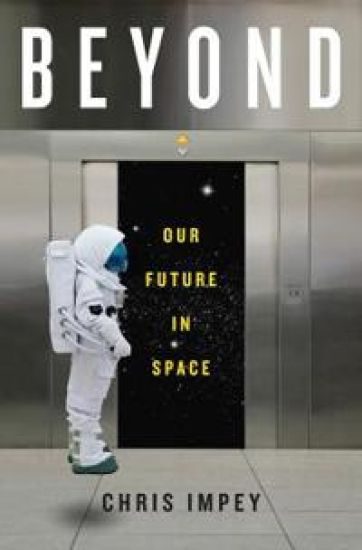
Beyond

Beyond

Chris Impey

WW Norton Co
2015
sidottu
With plans to launch hotels into orbit and experiments in suspending and reanimating life for ultra-long-distance travel, private companies and entrepreneurs have outpaced NASA as the leaders in the new space race. With accessible prose and relentless curiosity, Chris Impey reports on China’s plan to launch its own space station by 2020, proves that humans could survive on Mars and unveils cutting-edge innovations such as the space elevators poised to replace rockets at a fraction of the cost. Setting mankind’s urge towards exploration in the context of all human history and space travel thus far, he shows that the present-day scientists mapping billions of Earth-like exo-planets are the descendants of the first humans to venture out of Africa. We must forge ahead, argues Beyond, because exploration is in our DNA.
How It Began

How It Began

Chris Impey

WW Norton Co
2013
nidottu
In this vibrant, eye-opening tour of milestones in the history of our universe, Chris Impey guides us through space and time, leading us from the familiar sights of the night sky to the dazzlingly strange aftermath of the Big Bang. What if we could look into space and see not only our place in the universe but also how we came to be here? As it happens, we can. Because it takes time for light to travel, we see more and more distant regions of the universe as they were in the successively greater past. Impey uses this concept—"look-back time"—to take us on an intergalactic tour that is simultaneously out in space and back in time. Performing a type of cosmic archaeology, Impey brilliantly describes the astronomical clues that scientists have used to solve fascinating mysteries about the origins and development of our universe. The milestones on this journey range from the nearby to the remote: we travel from the Moon, Jupiter, and the black hole at the heart of our galaxy all the way to the first star, the first ray of light, and even the strange, roiling conditions of the infant universe, an intense and volatile environment in which matter was created from pure energy. Impey gives us breathtaking visual descriptions and also explains what each landmark can reveal about the universe and its history. His lucid, wonderfully engaging scientific discussions bring us to the brink of modern cosmology and physics, illuminating such mind-bending concepts as invisible dimensions, timelessness, and multiple universes. A dynamic and unforgettable portrait of the cosmos, How It Began will reward its readers with a deeper understanding of the universe we inhabit as well as a renewed sense of wonder at its beauty and mystery.
How It Ends

How It Ends

Chris Impey

WW Norton Co
2011
nidottu
Most of us are aware of our own mortality, but few among us know what science, with insights yielded from groundbreaking new research, has to say about endings on a larger scale. Enter astronomer Chris Impey, who chronicles the death of the whole shebang: individual, species, bio- sphere, Earth, Sun, Milky Way, and, finally, the entire universe. With a healthy dose of humor, How It Ends illuminates everything from the technologies of human life extension and the evolutionary arms race between microbes and men to the inescapable dimming of the Sun and the ultimate “big rip,” giving us a rare glimpse into a universe without us.
The Living Cosmos

The Living Cosmos

Chris Impey

Cambridge University Press
2011
pokkari
Considering the development of life on Earth, the existence of life in extreme environments and the potential for life elsewhere in the Universe, this book gives a fascinating insight into our place in the Universe. Chris Impey leads the reader through the history, from the Copernican revolution to the emergence of the field of astrobiology – the study of life in the cosmos. He examines how life on Earth began, exploring its incredible variety and the extreme environments in which it can survive. Finally, Impey turns his attention to our Solar System and the planets beyond, discussing whether there may be life elsewhere in the Universe. Written in non-technical language, this book is ideal for anyone wanting to know more about astrobiology and how it is changing our views of life and the Universe. An accompanying website available at www.cambridge.org/9780521173841 features podcasts, articles and news stories on astrobiology.
How It Ends

How It Ends

Chris Impey

WW Norton Co
2010
sidottu
Although we may try to keep it tucked at the back of our minds, most of us are aware of our own mortality. But few among us know what science, with the help of insights yielded from groundbreaking new research, has to say about death on a larger scale. Enter astronomer Chris Impey, who chronicles the death of the whole shebang: individual, species, biosphere, earth, sun, Milky Way, and, finally, the entire universe. With a healthy dose of humor, How It Ends illuminates everything from the technologies of human life extension and the evolutionary arms race between microbes and men to the inescapable dimming of the sun and the ultimate “big rip,” giving us a rare glimpse into a universe without us.