Kirjojen hintavertailu – 12 903 724 kirjaa ja 27 kauppaa

Kirjailija

Chris van Hoof

Kirjat ja teokset yhdessä paikassa: 7 kirjaa, julkaisuja vuosilta 2007–2019, suosituimpiin kuuluu Biopotential Readout Circuits for Portable Acquisition Systems. Vertaile teosten hintoja ja tarkista saatavuus suomalaisista kirjakaupoista.

7 kirjaa

Kirjojen julkaisuvuodet: 2007–2019.

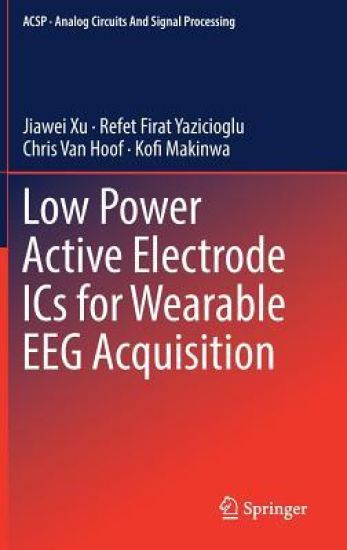
Low Power Active Electrode ICs for Wearable EEG Acquisition

Low Power Active Electrode ICs for Wearable EEG Acquisition

Jiawei Xu; Refet Firat Yazicioglu; Chris Van Hoof; Kofi Makinwa

Springer International Publishing AG
2019
nidottu
This book presents fundamental requirements, electrical specification, and parameter tradeoffs of wearable EEG acquisition circuits, especially those compatible with dry electrodes for user-friendly recordings. The authors introduce active electrode, the most promising solution for dry electrodes-based EEG measurement. This architectural concept has been combined with various, innovative circuit design techniques to illustrate structured IC design methodologies for high performance EEG recording. This book also gives examples on the design, implementation and evaluation of three generations of active electrode ICs.

Analog-and-Algorithm-Assisted Ultra-low Power Biosignal Acquisition Systems

Analog-and-Algorithm-Assisted Ultra-low Power Biosignal Acquisition Systems

Venkata Rajesh Pamula; Chris Van Hoof; Marian Verhelst

Springer Nature Switzerland AG
2019
sidottu
This book discusses the design and implementation aspects of ultra-low power biosignal acquisition platforms that exploit analog-assisted and algorithmic approaches for power savings. The authors describe an approach referred to as “analog-and-algorithm-assisted” signal processing. This enables significant power consumption reductions by implementing low power biosignal acquisition systems, leveraging analog preprocessing and algorithmic approaches to reduce the data rate very early in the signal processing chain. They demonstrate savings for wearable sensor networks (WSN) and body area networks (BAN), in the sensors’ stimulation power consumption, as well in the power consumption of the digital signal processing and the radio link. Two specific implementations, an adaptive sampling electrocardiogram (ECG) acquisition and a compressive sampling (CS) photoplethysmogram (PPG) acquisition system, are demonstrated. First book to present the so called, “analog-and-algorithm-assisted” approaches for ultra-low power biosignal acquisition and processing platforms;Covers the recent trend of “beyond Nyquist rate” signal acquisition and processing in detail, including adaptive sampling and compressive sampling paradigms;Includes chapters on compressed domain feature extraction, as well as acquisition of photoplethysmogram, an emerging optical sensing modality, including compressive sampling based PPG readout with embedded feature extraction;Discusses emerging trends in sensor fusion for improving the signal integrity, as well as lowering the power consumption of biosignal acquisition systems.
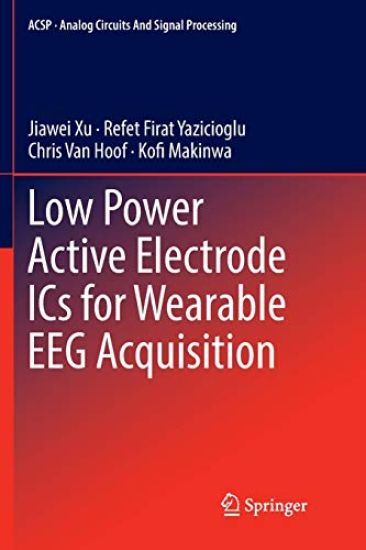
Low Power Active Electrode ICs for Wearable EEG Acquisition

Low Power Active Electrode ICs for Wearable EEG Acquisition

Jiawei Xu; Refet Firat Yazicioglu; Chris Van Hoof; Kofi Makinwa

Springer International Publishing AG
2018
sidottu
This book presents fundamental requirements, electrical specification, and parameter tradeoffs of wearable EEG acquisition circuits, especially those compatible with dry electrodes for user-friendly recordings. The authors introduce active electrode, the most promising solution for dry electrodes-based EEG measurement. This architectural concept has been combined with various, innovative circuit design techniques to illustrate structured IC design methodologies for high performance EEG recording. This book also gives examples on the design, implementation and evaluation of three generations of active electrode ICs.
Ultra Low Power Capacitive Sensor Interfaces

Ultra Low Power Capacitive Sensor Interfaces

Wouter Bracke; Robert Puers; Chris Van Hoof

Springer
2010
nidottu
The increasing performance of smart microsystems merging sensors, signal processing and wireless communication promises to have a pervasive impact during the coming decade. These autonomous microsystems nd applications in sport evaluation, health care, environmental monitoring and automotive s- tems. They gather data from the physical world, convert them to electrical form, compensate for interfering variables or non-linearities, and either act - rectly on them or transfer it to other systems. Most often, these sensor systems are developed for a speci c application. This approach leads to a high rec- rent design cost. A generic front-end architecture, where only the sensors and the microcontroller software are customized to the selected application, would reduce the costs signi cantly. This work presents a new generic architecture for autonomous sensor nodes. The modular design methodology provides a exible way to build a complete sensor interface out of con gurable blocks. The settings of these blocks can be optimized according to the varying needs of the application. Furthermore, the system can easily be expanded with new building blocks. The modular system is illustrated in a Generic Sensor Interface Chip (GSIC) for capa- tive sensors. Many con guration settings adapt the interface to a broad range of applications. The GSIC is optimized for ultra low power consumption. It achieves an ON-state current consumption of 40? A.
Biopotential Readout Circuits for Portable Acquisition Systems

Biopotential Readout Circuits for Portable Acquisition Systems

Refet Firat Yazicioglu; Chris van Hoof; Robert Puers

Springer
2010
nidottu
Biopotential Readout Circuits for Portable Acquisition Systems describes one of the main building blocks of such miniaturized biomedical signal acquisition systems. The focus of this book is on the implementation of low-power and high-performance integrated circuit building blocks that can be used to extract biopotential signals from conventional biopotential electrodes. New instrumentation amplifier architectures are introduced and their design is described in detail. These amplifiers are used to implement complete acquisition demonstrator systems that are a stepping stone towards practical miniaturized and low-power systems.
Biopotential Readout Circuits for Portable Acquisition Systems

Biopotential Readout Circuits for Portable Acquisition Systems

Refet Firat Yazicioglu; Chris van Hoof; Robert Puers

Springer-Verlag New York Inc.
2008
sidottu
Biopotential Readout Circuits for Portable Acquisition Systems describes one of the main building blocks of such miniaturized biomedical signal acquisition systems. The focus of this book is on the implementation of low-power and high-performance integrated circuit building blocks that can be used to extract biopotential signals from conventional biopotential electrodes. New instrumentation amplifier architectures are introduced and their design is described in detail. These amplifiers are used to implement complete acquisition demonstrator systems that are a stepping stone towards practical miniaturized and low-power systems.
Ultra Low Power Capacitive Sensor Interfaces

Ultra Low Power Capacitive Sensor Interfaces

Wouter Bracke; Robert Puers; Chris Van Hoof

Springer-Verlag New York Inc.
2007
sidottu
The increasing performance of smart microsystems merging sensors, signal processing and wireless communication promises to have a pervasive impact during the coming decade. These autonomous microsystems nd applications in sport evaluation, health care, environmental monitoring and automotive s- tems. They gather data from the physical world, convert them to electrical form, compensate for interfering variables or non-linearities, and either act - rectly on them or transfer it to other systems. Most often, these sensor systems are developed for a speci c application. This approach leads to a high rec- rent design cost. A generic front-end architecture, where only the sensors and the microcontroller software are customized to the selected application, would reduce the costs signi cantly. This work presents a new generic architecture for autonomous sensor nodes. The modular design methodology provides a exible way to build a complete sensor interface out of con gurable blocks. The settings of these blocks can be optimized according to the varying needs of the application. Furthermore, the system can easily be expanded with new building blocks. The modular system is illustrated in a Generic Sensor Interface Chip (GSIC) for capa- tive sensors. Many con guration settings adapt the interface to a broad range of applications. The GSIC is optimized for ultra low power consumption. It achieves an ON-state current consumption of 40? A.