Kirjojen hintavertailu – 12 903 735 kirjaa ja 27 kauppaa

Kirjailija

Chris W. Bonneau

Kirjat ja teokset yhdessä paikassa: 5 kirjaa, julkaisuja vuosilta 2005–2015, suosituimpiin kuuluu Strategic Behavior and Policy Choice on the U.S. Supreme Court. Vertaile teosten hintoja ja tarkista saatavuus suomalaisista kirjakaupoista.

5 kirjaa

Kirjojen julkaisuvuodet: 2005–2015.

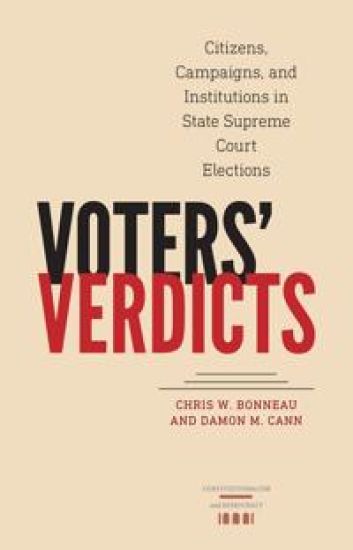
Voters' Verdicts

Voters' Verdicts

Chris W. Bonneau; Damon M. Cann

University of Virginia Press
2015
sidottu
In Voters’ Verdicts, Chris Bonneau and Damon Cann address contemporary concerns with judicial elections by investigating factors that influence voters’ decisions in the election of state supreme court judges. Bonneau and Cann demonstrate that the move to nonpartisan elections, while it depresses political participation, does little to mute the effects of partisanship and ideology. The authors note the irony that judicial elections, often faulted for politicizing the legal process, historically represented an attempt to correct the lack of accountability in the selection of judges by appointment, since unlike appointive systems, the judicial elections are at least transparent. This comprehensive study rests on a broad evidentiary base that spans numerous states and a variety of electoral systems. Bonneau and Cann use the first national survey of voters in state supreme court elections paired with novel laboratory experiments to evaluate the influence of incumbency and other ballot cues on voters’ decisions. Data-rich and analytically tight, this provocative volume shows why voters decide to participate in elections and who they choose to vote for.
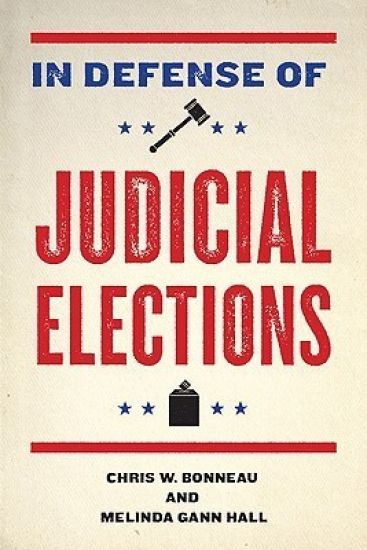
In Defense of Judicial Elections

In Defense of Judicial Elections

Chris W. Bonneau; Melinda Gann Hall

Routledge
2009
sidottu
One of the most contentious issues in politics today is the propriety of electing judges. Ought judges be independent of democratic processes in obtaining and retaining their seats, or should they be subject to the approval of the electorate and the processes that accompany popular control? While this debate is interesting and often quite heated, it usually occurs without reference to empirical facts--or at least accurate ones. Also, empirical scholars to date have refused to take a position on the normative issues surrounding the practice. Bonneau and Hall offer a fresh new approach. Using almost two decades of data on state supreme court elections, Bonneau and Hall argue that opponents of judicial elections have made—and continue to make—erroneous empirical claims. They show that judicial elections are efficacious mechanisms that enhance the quality of democracy and create an inextricable link between citizens and the judiciary. In so doing, they pioneer the use of empirical data to shed light on these normative questions and offer a coherent defense of judicial elections. This provocative book is essential reading for anyone interested in the politics of judicial selection, law and politics, or the electoral process. Part of the Controversies in Electoral Democracy and Representation series edited by Matthew J. Streb.
In Defense of Judicial Elections

In Defense of Judicial Elections

Chris W. Bonneau; Melinda Gann Hall

Routledge
2009
nidottu
One of the most contentious issues in politics today is the propriety of electing judges. Ought judges be independent of democratic processes in obtaining and retaining their seats, or should they be subject to the approval of the electorate and the processes that accompany popular control? While this debate is interesting and often quite heated, it usually occurs without reference to empirical facts--or at least accurate ones. Also, empirical scholars to date have refused to take a position on the normative issues surrounding the practice. Bonneau and Hall offer a fresh new approach. Using almost two decades of data on state supreme court elections, Bonneau and Hall argue that opponents of judicial elections have made—and continue to make—erroneous empirical claims. They show that judicial elections are efficacious mechanisms that enhance the quality of democracy and create an inextricable link between citizens and the judiciary. In so doing, they pioneer the use of empirical data to shed light on these normative questions and offer a coherent defense of judicial elections. This provocative book is essential reading for anyone interested in the politics of judicial selection, law and politics, or the electoral process. Part of the Controversies in Electoral Democracy and Representation series edited by Matthew J. Streb.
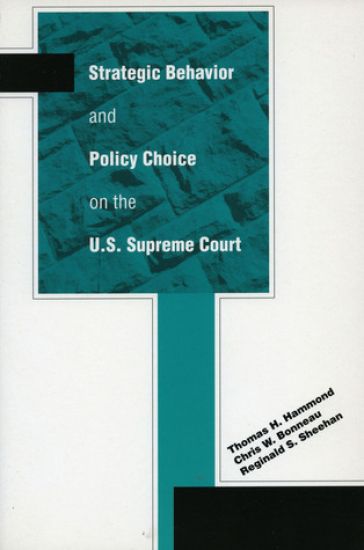
Strategic Behavior and Policy Choice on the U.S. Supreme Court

Strategic Behavior and Policy Choice on the U.S. Supreme Court

Thomas H. Hammond; Chris W. Bonneau; Reginald S. Sheehan

Stanford University Press
2005
sidottu
Despite several decades of research on Supreme Court decision-making by specialists in judicial politics, there is no good answer to a key question: if each justice's behavior on the Court were motivated solely by some kind of "liberal" or "conservative" ideology, what patterns should be expected in the Court's decision-making practices and in the Court's final decisions? It is only when these patterns are identified in advance that political scientists will be able to empirically evaluate theories which assert that the justices' behavior is motivated by the pursuit of their personal policy preferences. This book provides the first comprehensive and integrated model of how strategically rational Supreme Court justices should be expected to behave in all five stages of the Court's decision-making process. The authors' primary focus is on how each justice's wish to gain as desirable a final opinion as possible will affect his or her behavior at each stage of the decision-making process.
Strategic Behavior and Policy Choice on the U.S. Supreme Court

Strategic Behavior and Policy Choice on the U.S. Supreme Court

Thomas H. Hammond; Chris W. Bonneau; Reginald S. Sheehan

Stanford University Press
2005
pokkari
Despite several decades of research on Supreme Court decision-making by specialists in judicial politics, there is no good answer to a key question: if each justice's behavior on the Court were motivated solely by some kind of "liberal" or "conservative" ideology, what patterns should be expected in the Court's decision-making practices and in the Court's final decisions? It is only when these patterns are identified in advance that political scientists will be able to empirically evaluate theories which assert that the justices' behavior is motivated by the pursuit of their personal policy preferences. This book provides the first comprehensive and integrated model of how strategically rational Supreme Court justices should be expected to behave in all five stages of the Court's decision-making process. The authors' primary focus is on how each justice's wish to gain as desirable a final opinion as possible will affect his or her behavior at each stage of the decision-making process.