Kirjojen hintavertailu – 12 859 828 kirjaa ja 27 kauppaa
Kirjailija
Chris Watkins
Kirjat ja teokset yhdessä paikassa: 11 kirjaa, julkaisuja vuosilta 2000–2026, suosituimpiin kuuluu The Drag Gospel of Queer Jesus. Vertaile teosten hintoja ja tarkista saatavuus suomalaisista kirjakaupoista.
Rescuing biblical language from misuse by those who would persecute queerness and subjugate the natural world, The Drag Gospel of Queer Jesus contemporizes and enlivens Biblical mysteries, exploring queer/trans identities and Florida ecologies through poetic forms (both received and invented) as often as through free verse. Simultaneously playful and serious, like the best drag performances, these poems nod equally and as often to the work of RuPaul or Marsha P. Johnson as to William Shakespeare or the author(s) of Genesis. Meanwhile, as the poems point to the artificial constructions of gender, they also embrace the (queer) natural world.
This specially curated collection features five reviews of current and key research on fruit losses and waste. The first chapter reviews the magnitude of losses and waste of fruit and vegetables as well as key issues in estimating losses. It provides a detailed assessment of the main causes of losses and waste together with strategies for their prevention. The second chapter assesses the adoption of new, non-destructive technologies as a way of measuring harvest maturity and improving sorting operations to minimise the risk of product loss and waste. The third chapter outlines the importance of harvest management of apples and considers the importance of various factors associated with fruit physiology, maturation and ripening to reduce losses. The fourth chapter reviews existing research in the preservation of fruit quality and reduction of post-harvest damage and loss by adopting suitable technologies and knowledge during post-harvest operation, storage management, transportation and marketing of mango fruit. The final chapter explores the advantages and disadvantages of cultivating ripening-impaired tomato mutants. It describes how controlling tomato diseases in both pre- and postharvest operations can help avoid fruit losses.
This practical A4 pack contains activities and ideas for teachers and students to learn more about learning. Learning about Learningis a practical way of teaching important and neglected theories of learning. The idea is that if teachers and students learn about what learning is and how it happens they understand a greater range of learning possibilities and approaches and improve their learning and teaching skills.
`The book is at once accessible, evidence-based, practical and eminently readable... Readers will find in this book a treasury of learners' voices guiding us towards the goal of more effective learning in classrooms' - International Network for School Improvement `This book promotes an ambitious and inspiring conception of meaningful pedagogy and works to applaud those teachers who are determined to reflect upon, enquire into, and then facilitate ''effective learning''. A coherent and structured case is made for the primacy of ''learning'' over ''work'' - Learning & Teaching Update This book addresses an important, and too seldom addressed issue: learning. Not teaching, not performance, not "work": this book really is about learning, what makes learning effective and how it may be promoted in classrooms. The authors take the context of the classroom seriously, not only because of its effects on teachers and pupils, but because classrooms are notorious as contexts which change little. Rather than providing yet more tips, they offer real thinking and evidence based on what we know about how classrooms change. Four major dimensions of promoting effective learning in classrooms are examined in depth: Active Learning; Collaborative Learning; Learner-driven Learning and Learning about Learning. Evidence from practising teachers in the form of case studies and examples, and evidence from international research in the form of useful ideas and frameworks is included.
`The book is at once accessible, evidence-based, practical and eminently readable... Readers will find in this book a treasury of learners' voices guiding us towards the goal of more effective learning in classrooms' - International Network for School Improvement `This book promotes an ambitious and inspiring conception of meaningful pedagogy and works to applaud those teachers who are determined to reflect upon, enquire into, and then facilitate ''effective learning''. A coherent and structured case is made for the primacy of ''learning'' over ''work'' - Learning & Teaching Update This book addresses an important, and too seldom addressed issue: learning. Not teaching, not performance, not "work": this book really is about learning, what makes learning effective and how it may be promoted in classrooms. The authors take the context of the classroom seriously, not only because of its effects on teachers and pupils, but because classrooms are notorious as contexts which change little. Rather than providing yet more tips, they offer real thinking and evidence based on what we know about how classrooms change. Four major dimensions of promoting effective learning in classrooms are examined in depth: Active Learning; Collaborative Learning; Learner-driven Learning and Learning about Learning. Evidence from practising teachers in the form of case studies and examples, and evidence from international research in the form of useful ideas and frameworks is included.
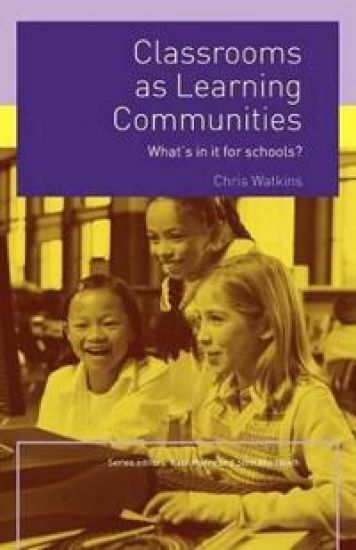
In classrooms that operate as learning communities, the social and learning purposes advance together through all participants being involved and engaged in building knowledge. This book demonstrates a new way of seeing and managing classrooms through:an integration of what's best in learning and what's best in the social life of classroomsa vision of the role of the teacher that is more creative and more related to the commitments of teachersa more connected view of schools in contrast to the mechanistic view that currently dominatesan answer to the short-term performance pressures of politicians - better performance. The practice and vision of classrooms that operate as learning communities is presented clearly and encourages teachers to take steps towards building a more effective classroom with the aspects of learning communities they choose.
In classrooms that operate as learning communities, the social and learning purposes advance together through all participants being involved and engaged in building knowledge. This book demonstrates a new way of seeing and managing classrooms through:an integration of what's best in learning and what's best in the social life of classroomsa vision of the role of the teacher that is more creative and more related to the commitments of teachersa more connected view of schools in contrast to the mechanistic view that currently dominatesan answer to the short-term performance pressures of politicians - better performance. The practice and vision of classrooms that operate as learning communities is presented clearly and encourages teachers to take steps towards building a more effective classroom with the aspects of learning communities they choose.
Today's schools are subject to increasing demand and constraint; their work is more complex and fast changing than ever before; politicians and press demand quick fixes. This book paints the picture of a new integrity for our schools as they face a challenging future. Themes addressed include:* schools as places of learning and integrity* the curriculum* family, child and intercultural perspectives* community relations* policy and governance. The authors demonstrate how a connected approach is necessary if schools are to hold themselves together and play a key role in working with young people to construct a future.
Today's schools are subject to increasing demand and constraint; their work is more complex and fast changing than ever before; politicians and press demand quick fixes. This book paints the picture of a new integrity for our schools as they face a challenging future. Themes addressed include:* schools as places of learning and integrity* the curriculum* family, child and intercultural perspectives* community relations* policy and governance. The authors demonstrate how a connected approach is necessary if schools are to hold themselves together and play a key role in working with young people to construct a future.
This practical A4 pack contains activities and ideas for teachers and students to learn more about learning. Learning about Learningis a practical way of teaching important and neglected theories of learning. The idea is that if teachers and students learn about what learning is and how it happens they understand a greater range of learning possibilities and approaches and improve their learning and teaching skills.
`Certainly worth reading in order to be reminded of some positive reasons for entering the teaching profession: to value the process of education as much as the content, to view children holistically and to consider schools as places of learning for all' - British Journal of Special Education Behaviour difficulties in our schools will not go away, but they can be significantly reduced. This book makes available to practitioners and students the frameworks and ideas which will help them minimize behaviour difficulty in school. The authors address three important levels: the school, the classroom and the individual. At each level, they show how to identify and analyze patterns of difficulty, and then identify methods for improvement. Improving School Behaviour has been written in order to bring to readers useful approaches founded in a comprehensive range of useful international research, and in years of experience in working with schools. It is a mine of helpful ideas and practical approaches. This is not recipe book, or a source of quick fixes or favourite theories. The authors: · challenge simplified rhetoric about school behaviour · help practitioners identify real areas and effective methods for improvement. · identify the shortcomings of much conventional wisdom about improving behaviour, · show how to implement practical, evidence-based alternatives which can lead to improved results. Improving School Behaviour is an essential resource for all those who are not afraid to improve. It is suitable for use in settings for all age-ranges.