Kirjojen hintavertailu – 12 859 819 kirjaa ja 27 kauppaa
Kirjailija
Christian B. Lang
Kirjat ja teokset yhdessä paikassa: 6 kirjaa, julkaisuja vuosilta 2009–2025, suosituimpiin kuuluu Haben Sie eines gesehen?. Vertaile teosten hintoja ja tarkista saatavuus suomalaisista kirjakaupoista.
Die Idee, dass Materie aus Atomen, kleinsten Teilchen, besteht, geht bereits auf die griechischen Naturphilosophen der Antike zurück. Seitdem wurde sie kontinuierlich weiterentwickelt und blickt auf eine schier unglaubliche Erfolgsgeschichte zurück. Der Weg, den die Teilchenphysik dabei zurückgelegt hat, ist ebenso spannend wie unterhaltsam. Von der Entdeckung der Fermionen und weiterer seltsamer Teilchen, von den ersten Teilchenbeschleunigern bis zum CERN, von der Quantenfeldtheorie zu den Erfolgen des Standardmodells der Teilchenphysik – Christian Lang und Leopold Mathelitsch laden Sie ein, diesen Weg mit einem Rucksack voller köstlicher Anekdoten und humorvoller Insider-Informationen gemeinsam zu beschreiten.
Die dritte Auflage dieses gut eingeführten Standardwerkes gibt einen Gesamtüberblick über die Mathematik für Studierende der Physik. Es macht die angehenden Physikerinnen und Physiker mit den für sie wichtigsten mathematischen Konzepten vertraut und vermittelt damit möglichst schnell eine entsprechende Geläufigkeit in ihrer Anwendung. Die Methoden der Mathematik werden aus der physikalischen Sichtweise und mit dem Blick auf Anwendungen dargestellt. Auf mathematisch exakte Weise wird der Fokus auf Methodik und Beispiele gelegt, wobei zu Gunsten der Verständlichkeit und Übersicht auf viele Beweise verzichtet wird. Auch der gängige Einsatz von Computern in der Physik wird durch Einschübe berücksichtigt, in denen sowohl auf Numerik wie auch auf algebraische Methoden eingegangen wird. Durch die Erläuterung anhand von Beispielaufgaben ist das Buch auch für das Selbststudium gut geeignet. Viele Übungsaufgaben, deren vollständige Lösungswege über das Internet abfragbar sind, regendazu an, das Gelernte zu überprüfen und dabei das Verständnis zu vertiefen. Als Vorlesungsunterlage entspricht das Buch einer dreisemestrigen Vorlesung mit Übungen. Das vorliegende Buch richtet sich primär an Studierende der Physik in den ersten Semestern, aber auch andere Naturwissenschaftler werden mit diesem Buch einen nützlichen Helfer zur Hand haben! In der dritten Auflage wurden die Grafiken und der Text überarbeitet und zum Teil erweitert, um die Verständlichkeit zu erhöhen.
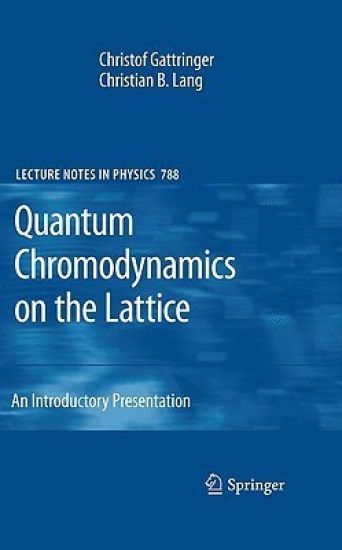
Quantum chromodynamics (QCD) is the fundamental quantum ?eld theory of quarks and gluons. In order to discuss it in a mathematically well-de?ned way, the theory has to be regularized. Replacing space-time by a Euclidean lattice has proven to be an e?cient approach which allows for both theor- ical understanding and computational analysis. Lattice QCD has become a standard tool in elementary particle physics. Asthetitlealreadysays:thisbookisintroductory! Thetextisintendedfor newcomerstothe?eld,servingasastartingpoint. Wesimplywantedtohavea bookwhichwecanputintothehandsofanadvancedstudentfora?rstreading on lattice QCD. This imaginary student brings as a prerequisite knowledge of higher quantum mechanics, some continuum quantum ?eld theory, and basic facts of elementary particle physics phenomenology. In view of the wealth of applications in current research the topics p- sented here are limited and we had to make some painful choices. We discuss QCD but omit most other lattice ?eld theory applications like scalar th- ries, gauge-Higgs models, or electroweak theory. Although we try to lead the reader up to present day understanding, we cannot possibly address all on- ing activities, in particular concerning the role of QCD in electroweak theory. Subjects like glueballs, topological excitations, and approaches like chiral p- turbation theory are mentioned only brie?y. This allows us to cover the other topics quite explicitly, including detailed derivations of key equations. The ?eld is rapidly developing. The proceedings of the annual lattice conferences provide information on newer directions and up-to-date results.
Quantum chromodynamics (QCD) is the fundamental quantum ?eld theory of quarks and gluons. In order to discuss it in a mathematically well-de?ned way, the theory has to be regularized. Replacing space-time by a Euclidean lattice has proven to be an e?cient approach which allows for both theor- ical understanding and computational analysis. Lattice QCD has become a standard tool in elementary particle physics. Asthetitlealreadysays:thisbookisintroductory! Thetextisintendedfor newcomerstothe?eld,servingasastartingpoint. Wesimplywantedtohavea bookwhichwecanputintothehandsofanadvancedstudentfora?rstreading on lattice QCD. This imaginary student brings as a prerequisite knowledge of higher quantum mechanics, some continuum quantum ?eld theory, and basic facts of elementary particle physics phenomenology. In view of the wealth of applications in current research the topics p- sented here are limited and we had to make some painful choices. We discuss QCD but omit most other lattice ?eld theory applications like scalar th- ries, gauge-Higgs models, or electroweak theory. Although we try to lead the reader up to present day understanding, we cannot possibly address all on- ing activities, in particular concerning the role of QCD in electroweak theory. Subjects like glueballs, topological excitations, and approaches like chiral p- turbation theory are mentioned only brie?y. This allows us to cover the other topics quite explicitly, including detailed derivations of key equations. The ?eld is rapidly developing. The proceedings of the annual lattice conferences provide information on newer directions and up-to-date results.