

Kirjailija
Christian de Duve
Kirjat ja teokset yhdessä paikassa: 8 kirjaa, julkaisuja vuosilta 1955–2019, suosituimpiin kuuluu Hormone und ihre Wirkungsweise. Vertaile teosten hintoja ja tarkista saatavuus suomalaisista kirjakaupoista.
8 kirjaa
Kirjojen julkaisuvuodet: 1955–2019.
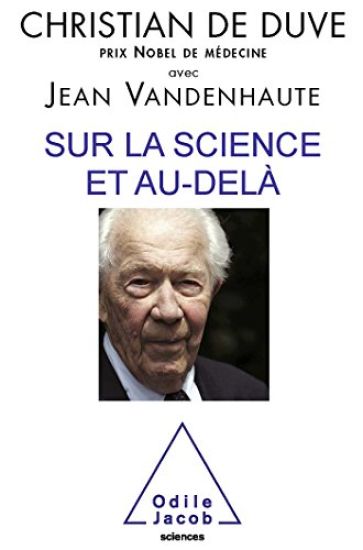
On Science and Other Matters / Sur la science et au-delà
Christian de Duve; Jean Vandenhaute
Odile Jacob
2013
nidottu
Christian De Duve was awarded the Nobel Prize in Medicine, in 1974. He was a professor at the Catholic University of Louvain and at New York's Rockefeller University. He is notably the author of De J sus J sus... en passant par Darwin, G n tique du p ch originel, A l' coute du vivant and, in 2013, of Sept vies en une, all published by Editions Odile Jacob. He died in May 2013. In this lengthy final interview the late Christian De Duve, a leading figure in modern biology and a prominent humanist, stepped beyond the boundaries of science to examine, clearly and directly, some of the major issues of our times. Whether his statements are spontaneous or the fruit of long reflection, his ideas are always pertinent and illuminating. 'I was a scientist. Only later did I ask myself the questions that everyone asks themselves. I had time to think them through and I tried to do so as a rational, free person, endeavouring to impart the result of my reflection with rigour and intellectual honesty, ' said De Duve.- The retrospective - and also prospective - view on the world of scientific research, by a Nobel Prize laureate in Medicine.- This is a moving, personal book, the result of a life dedicated to science.- The final, posthumously published ideas of Christian De Duve, who died in May 2013.
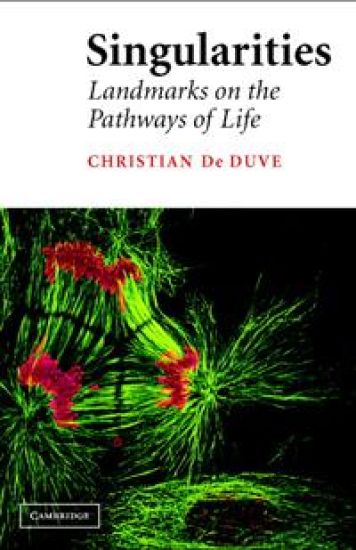
Erwin Schrödinger's What is Life? published 60 years ago, influenced much of the development of molecular biology. In this new book Christian De Duve, Nobel Laureate and pioneer of modern cell biology, presents a contemporary response to this classic, providing a sophisticated consideration of the key steps or bottlenecks that constrain the origins and evolution of life. De Duve surveys the entire history of life, including insights into the conditions that may have led to its emergence. He uses as landmarks the many remarkable singularities along the way, such as the single ancestry of all living beings, the universal genetic code, and the monophyletic origin of eukaryotes. The book offers a brief guided tour of biochemistry and phylogeny, from the basic molecular building blocks to the origin of humans. Each successive singularity is introduced in a sequence paralleling the hypothetical development of features and conditions on the primitive earth, explaining how and why each transition to greater complexity occurred.
In just a half century, humanity has made an astounding leap in its understanding of life. Now, one of the giants of biological science, Christian de Duve, discusses what we've learned in this half century, ranging from the tiniest cells to the future of our species and of life itself. With wide-ranging erudition, de Duve takes us on a dazzling tour of the biological world, beginning with the invisible workings of the cell, the area in which he won his Nobel Prize. He describes how the first cells may have arisen and suggests that they may have been like the organisms that exist today near deep-sea hydrothermal vents. Contrary to many other scientists, he argues that life was bound to arise and that it probably only took millennia--maybe tens of thousands of years--to move from rough building blocks to the first organisms possessing the basic properties of life. With equal authority, De Duve examines topics such as the evolution of humans, the origins of consciousness, the development of language, the birth of science, and the origin of emotion, morality, altruism, and love. He concludes with his conjectures on the future of humanity--for instance, we may evolve, perhaps via genetic engineering, into a new species--and he shares his personal thoughts about God and immortality. In Life Evolving, one of our most eminent scientists sums up what he has learned about the nature of life and our place in the universe. An extraordinarily wise and humane volume, it will fascinate readers curious about the world around them and about the impact of science on philosophy and religion.
Looking at the stars at night, we have all wondered where we have come from and why we are here. Our Cosmic Origins traces the remarkable story of the emergence of life and intelligence right through the complex evolutionary history of the Universe. Armand Delsemme weaves together a rich tapestry of science, bringing together cosmology, astronomy, geology, biochemistry and biology in this wide-ranging book. In following the complex, chronological story, we discover how the first elements formed in the early Universe, how stars and planets were born, how the first bacteria evolved towards a plethora of plants and animals, and how the coupling of the eye and brain led to the development of self-awareness and, ultimately, intelligence. Professor Delsemme concludes with the tantalising suggestion that the existence of alien life and intelligence is likely, and examines our chances of contacting it. This provocative book provides the general reader with an accessible and wide-ranging account of how life evolved on Earth and how likely it is to exist elsewhere in the Universe.
Looking at the stars at night, we have all wondered where we have come from and why we are here. Our Cosmic Origins traces the remarkable story of the emergence of life and intelligence right through the complex evolutionary history of the Universe. Armand Delsemme weaves together a rich tapestry of science, bringing together cosmology, astronomy, geology, biochemistry and biology in this wide-ranging book. In following the complex, chronological story, we discover how the first elements formed in the early Universe, how stars and planets were born, how the first bacteria evolved towards a plethora of plants and animals, and how the coupling of the eye and brain led to the development of self-awareness and, ultimately, intelligence. Professor Delsemme concludes with the tantalising suggestion that the existence of alien life and intelligence is likely, and examines our chances of contacting it. This provocative book provides the general reader with an accessible and wide-ranging account of how life evolved on Earth and how likely it is to exist elsewhere in the Universe.
Is the emergence of life on Earth the result of a single chance event or combination of lucky accidents, or is it the outcome of biochemical forces woven into the fabric of the universe? And if inevitable, what are these forces, and how do they account not only for the origin of life but also for its evolution toward increasing complexity? Vital Dust is a ground-breaking history of life on Earth, a history that only someone of Chrisitian de Duve's stature and erudition could have written.
Hormone und ihre Wirkungsweise
G. Koller; H. E. Voss; H. Tuchmann-Duplessis; Christian de Duve; C. Martius; W. Dirscherl; Hj. Staudinger; H. J. Hübener
Springer-Verlag Berlin and Heidelberg GmbH Co. K
1955
nidottu