Kirjojen hintavertailu – 12 903 725 kirjaa ja 27 kauppaa

Kirjailija

Christian Rauh

Kirjat ja teokset yhdessä paikassa: 6 kirjaa, julkaisuja vuosilta 2007–2016, suosituimpiin kuuluu A Responsive Technocracy?. Vertaile teosten hintoja ja tarkista saatavuus suomalaisista kirjakaupoista.

6 kirjaa

Kirjojen julkaisuvuodet: 2007–2016.

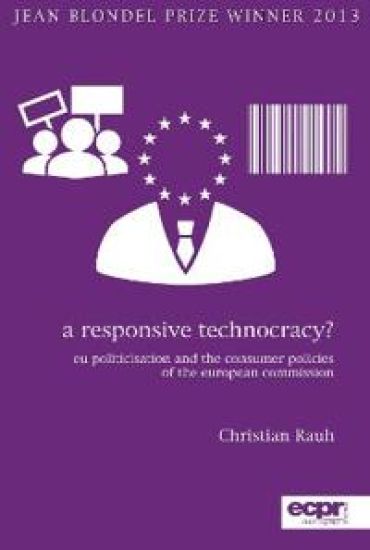
A Responsive Technocracy?

A Responsive Technocracy?

Christian Rauh

ECPR Press
2016
nidottu
This book challenges the common image of the European Commission as an insulated technocracy immune to political pressures. Based on an innovative combination of public opinion, protest and media data, it first demonstrates that European integration has become increasingly politicised since the 1990s. Against this background, the Commission is now much more concerned about the public appeal of its policies. That, however, challenges and contradicts the well-worn patterns of supranational regulation in Europe. Rauh systematically compares 17 legislative drafting processes in consumer policy between 1999 and 2009. Based on first-hand insider accounts of involved officials, his analysis indicates that the Commission's policy choices indeed become more consumer friendly under higher levels of public awareness. While this improves the democratic quality of European decision-making, the book also reveals an enhanced conflict potential within the Commission and beyond which threatens to undermine the efficiency of legislative decision-making in the EU.
A Responsive Technocracy?

A Responsive Technocracy?

Christian Rauh

ECPR Press
2016
sidottu
This book challenges the common image of the European Commission as an insulated technocracy immune to political pressures. Based on an innovative combination of public opinion, protest and media data, it first demonstrates that European integration has become increasingly politicised since the 1990s. Against this background, the Commission is now much more concerned about the public appeal of its policies. That, however, challenges and contradicts the well-worn patterns of supranational regulation in Europe. Rauh systematically compares 17 legislative drafting processes in consumer policy between 1999 and 2009. Based on first-hand insider accounts of involved officials, his analysis indicates that the Commission's policy choices indeed become more consumer friendly under higher levels of public awareness. While this improves the democratic quality of European decision-making, the book also reveals an enhanced conflict potential within the Commission and beyond which threatens to undermine the efficiency of legislative decision-making in the EU.
Which Policy for Europe?

Which Policy for Europe?

Miriam Hartlapp; Julia Metz; Christian Rauh

Oxford University Press
2014
sidottu
The European Commission is at the center of the European Union's political system. Within its five-year terms each Commission proposes up to 2000 binding legal acts and therefore crucially shapes EU policy, which in turn impacts on the daily lives of more than 500 million European citizens. However, despite the Commissions key role in setting the agenda for European decision making, little is known about its internal dynamics when preparing legislation. This book provides a problem-driven, theoretically-founded, and empirically rich treatment of the so far still understudied process of position-formation inside the European Commission. It reveals that various internal political positions prevail and that the role of power and conflict inside the European Commission is essential to understanding its policy proposals. Opening the 'black box' of the Commission, the book identifies three ideal types of internal position-formation. The Commission is motivated by technocratic problem-solving, by competence-seeking utility maximization or ideologically-motivated policyseeking. Specifying conditions that favor one logic over the others, the typology furthers understanding of how the EU system functions and provides novel explanations of EU policies with substantial societal implications.