Kirjojen hintavertailu – 12 859 828 kirjaa ja 27 kauppaa

Kirjailija

Christine Buci-Glucksmann

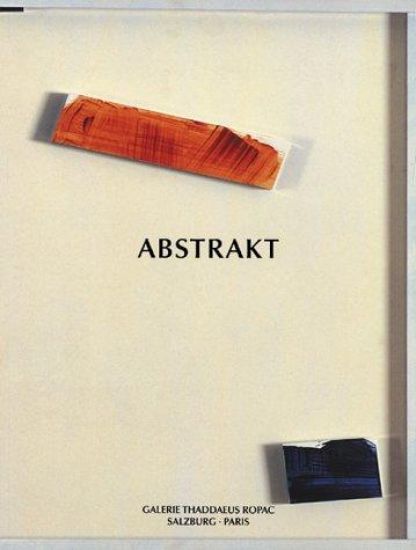
Kirjat ja teokset yhdessä paikassa: 7 kirjaa, julkaisuja vuosilta 1994–2014, suosituimpiin kuuluu Abstrakt. Vertaile teosten hintoja ja tarkista saatavuus suomalaisista kirjakaupoista.

7 kirjaa

Kirjojen julkaisuvuodet: 1994–2014.

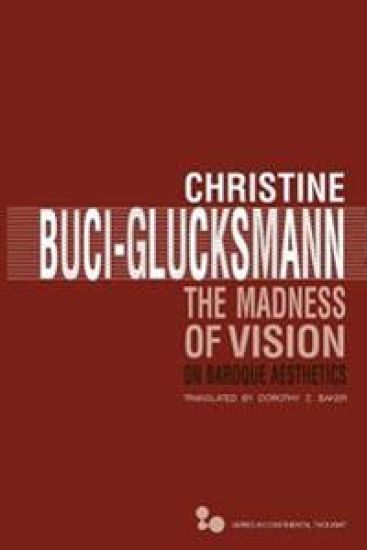
The Madness of Vision

The Madness of Vision

Christine Buci-Glucksmann

Ohio University Press
2014
pokkari
Christine Buci-Glucksmann's The Madness of Vision is one of the most influential studies in phenomenological aesthetics of the baroque. Integrating the work of Merleau-Ponty with Lacanian psychoanalysis, Renaissance studies in optics, and twentieth-century mathematics, the author asserts the materiality of the body and world in her aesthetic theory. All vision is embodied vision, with the body and the emotions continually at play on the visual field. Thus vision, once considered a clear, uniform, and totalizing way of understanding the material world, actually dazzles and distorts the perception of reality. In each of the nine essays that form The Madness of Vision Buci-Glucksmann develops her theoretical argument via a study of a major painting, sculpture, or influential visual image—Arabic script, Bettini's "The Eye of Cardinal Colonna," Bernini's Saint Teresa and his 1661 fireworks display to celebrate the birth of the French dauphin, Caravaggio's Judith Beheading Holofernes, the Paris arcades, and Arnulf Rainer's self-portrait, among others—and deftly crosses historical, national, and artistic boundaries to address Gracián's El Criticón; Monteverdi's opera Orfeo; the poetry of Hafiz, John Donne, and Baudelaire; as well as baroque architecture and Anselm Kiefer's Holocaust paintings. In doing so, Buci-Glucksmann makes the case for the pervasive influence of the baroque throughout history and the continuing importance of the baroque in contemporary arts.
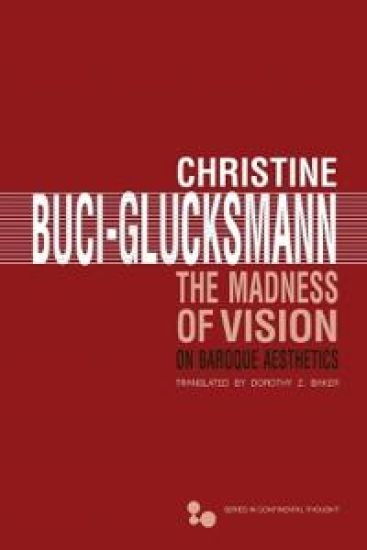
The Madness of Vision

The Madness of Vision

Christine Buci-Glucksmann

Ohio University Press
2013
sidottu
Christine Buci-Glucksmann's The Madness of Vision is one of the most influential studies in phenomenological aesthetics of the baroque. Integrating the work of Merleau-Ponty with Lacanian psychoanalysis, Renaissance studies in optics, and twentieth-century mathematics, the author asserts the materiality of the body and world in her aesthetic theory. All vision is embodied vision, with the body and the emotions continually at play on the visual field. Thus vision, once considered a clear, uniform, and totalizing way of understanding the material world, actually dazzles and distorts the perception of reality. In each of the nine essays that form The Madness of Vision Buci-Glucksmann develops her theoretical argument via a study of a major painting, sculpture, or influential visual image—Arabic script, Bettini's "The Eye of Cardinal Colonna," Bernini's Saint Teresa and his 1661 fireworks display to celebrate the birth of the French dauphin, Caravaggio's Judith Beheading Holofernes, the Paris arcades, and Arnulf Rainer's self-portrait, among others—and deftly crosses historical, national, and artistic boundaries to address Gracián's El Criticón; Monteverdi's opera Orfeo; the poetry of Hafiz, John Donne, and Baudelaire; as well as baroque architecture and Anselm Kiefer's Holocaust paintings. In doing so, Buci-Glucksmann makes the case for the pervasive influence of the baroque throughout history and the continuing importance of the baroque in contemporary arts.
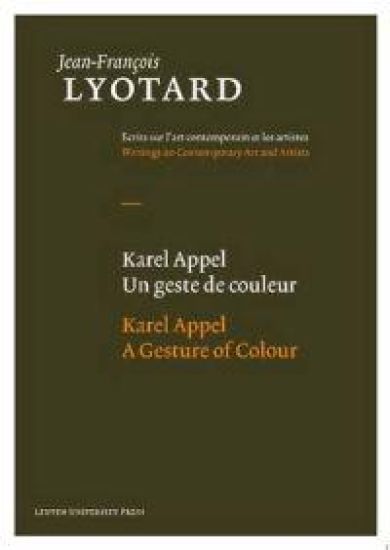
Karel Appel, A Gesture of Colour

Karel Appel, A Gesture of Colour

Jean-François Lyotard; Christine Buci-Glucksmann

Leuven University Press
2009
sidottu
Epilogue by Christine Buci-GlucksmannKarel Appel. A Gesture of Colour is the first of a series of six volumes, bringing together the most important writings of Jean-François Lyotard (1924 - 1998) on contemporary art and artists. The book he devoted to the art of Karel Appel (1921 - 2006) is doubtlessly one of the most complete and inspired texts of all the writings included in the series. Neither the original French manuscript nor the English translation have ever been published, and their presentation face to face should constitute a considerable plus. In this book, Lyotard presents Karel Appel's "matterism" as an offer of presence, presence deferred - it is the visual where every predicate is suspended, the visual touched, "gesture" of colour more than property of colour, appearance at the edge of the abyss. Christine Buci-Glucksmann's epilogue indicates the position of Karel Appel. A Gesture of Colour within the whole of Lyotard's writings on art, considering equally the philosopher's subsequent work. Winner of the Plantin Moretus Prize 2010 for the best designed book in the category textbooks and academic publications Photo Credits: Van Looveren & Princen
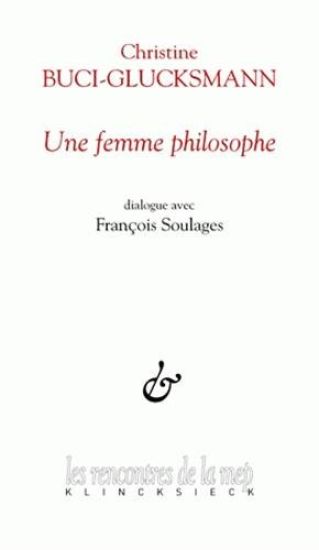
Une Femme Philosophe: Dialogue Avec Francois Soulages

Une Femme Philosophe: Dialogue Avec Francois Soulages

Christine Buci-Glucksmann

Klincksieck
2008
nidottu
L'ephemere est-il melancolique ou post-melancolique, leger ou nietzscheen ? C'est en ces termes que s'ouvre le dialogue entre Francois Soulages et Christine Buci-Glucksmann qui se deploie comme un voyage philosophique dans l'oeuvre. Reinterpretant la modernite a travers la mondialisation, les arts du virtuels et tous les passages entre Orient et Occident d'une pensee ornementale post-coloniale, un tel voyage deplace les frontieres etablies. Car, partout, une meme philosophie de l'immanence se construit avec son esthetique fluide, sa stylistique et son amour des beautes blessees . Au fil des questions, le plus theorique s'enracine dans le plus intime: Orient infantile, tournant politique de 1968, ou sejour au Japon. Car une meme question traverse ce dialogue: Qu'est-ce que philosopher au feminin, dans un monde livre aux exclusions et aux violences permanentes ?
Baroque Reason

Baroque Reason

Christine Buci-Glucksmann

SAGE Publications Ltd
1994
sidottu
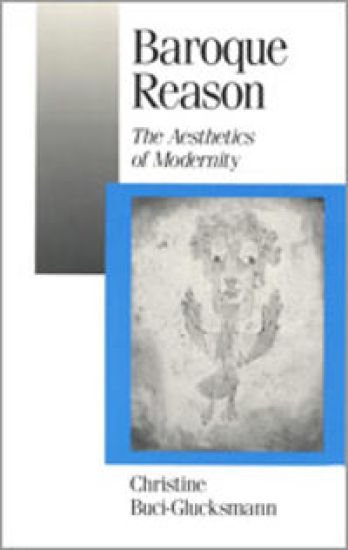
In this fascinating book, Christine Buci-Glucksmann explores the condition of modernity - alienation, melancholy, nostalgia - through the works of a number of writers and philosophers, including the social and aesthetic philosophy of Walter Benjamin. The author examines Baudelaire's haunting image of the city and its profound effect on conceptions of modernity. She goes on to consider how such influential figures as Nietzsche, Adorno, Musil, Barthes and Lacan constitute a baroque paradigm, united by their allegorical style, their conflation of aesthetics with ethics and their subject matter - death, catastrophe, sexuality, myth, the female. In her exegesis of these fundamental themes Buci-Glucksmann proposes an epistemology beyond postmodernism. This extraordinary exposition of a baroque reason for modernity sheds new light on a number of themes central to modern social theory.
Baroque Reason

Baroque Reason

Christine Buci-Glucksmann

SAGE Publications Ltd
1994
nidottu
In this fascinating book, Christine Buci-Glucksmann explores the condition of modernity - alienation, melancholy, nostalgia - through the works of a number of writers and philosophers, including the social and aesthetic philosophy of Walter Benjamin. The author examines Baudelaire's haunting image of the city and its profound effect on conceptions of modernity. She goes on to consider how such influential figures as Nietzsche, Adorno, Musil, Barthes and Lacan constitute a baroque paradigm, united by their allegorical style, their conflation of aesthetics with ethics and their subject matter - death, catastrophe, sexuality, myth, the female. In her exegesis of these fundamental themes Buci-Glucksmann proposes an epistemology beyond postmodernism. This extraordinary exposition of a baroque reason for modernity sheds new light on a number of themes central to modern social theory.