Kirjojen hintavertailu – 12 903 735 kirjaa ja 27 kauppaa

Kirjailija

Christoph Lütge

Kirjat ja teokset yhdessä paikassa: 12 kirjaa, julkaisuja vuosilta 2007–2024, suosituimpiin kuuluu Wirtschaftsethik. Vertaile teosten hintoja ja tarkista saatavuus suomalaisista kirjakaupoista.

Nimi esiintyy myös muodoissa: Christoph Lutge

12 kirjaa

Kirjojen julkaisuvuodet: 2007–2024.

Product, Process and Plant Design Using Subcritical and Supercritical Fluids for Industrial Application
This book describes cutting edge technology using supercritical fluids for the production of foodstuffs, medicals, and polymers. It illustrates the importance and use of basic data for design and operation at industrial scale units. The book's authors have several decades of experience of applied research on how to develop large scale industrial units. It provides readers complete insight in design and operation of industrial high pressure process plants. The book is written so it may be understood for people (with?) little or no background on high pressure process technology. It will provide information on how some foodstuffs, medicals, polymers are produced using high pressure technologies. The book demonstrates the importance of fundamental data, how to measure them and how to apply them to design industrial plants. At the same time, it also serves as a textbook for students.
Wirtschaftsethik in realistischer Perspektive
Gerade in schwierigen Zeiten ist eine realistische Perspektive auf Wirtschaft und Ethik wichtig. Gerade wenn viele Menschen Illusionen nachhängen, besteht die Gefahr, dass zentrale Antworten auf wirtschaftsethische Grundfragen der Marktwirtschaft in Vergessenheit geraten oder ganz verlorengehen. Christoph Lütge behandelt solche Grundfragen wie jene nach Gerechtigkeit oder Wettbewerb, widmet sich aber auch neuen Problemstellungen wie etwa: Welchen Stellenwert haben experimentelle Forschungen für die Ethik? Welche wirtschaftsethischen Fragen stellen sich im Zuge der Digitalisierung sowie der künstlichen Intelligenz? Welche ethischen Herausforderungen bringt das autonome Fahren mit sich? Entlang solher und weiterer Fragestellungen wird aufgezeigt, was eine realistische Wirtschaftsethik zu klassischen und aktuellen gesellschaftlichen Debatten beitragen kann.
Product, Process and Plant Design Using Subcritical and Supercritical Fluids for Industrial Application
This book describes cutting edge technology using supercritical fluids for the production of foodstuffs, medicals, and polymers. It illustrates the importance and use of basic data for design and operation at industrial scale units. The book's authors have several decades of experience of applied research on how to develop large scale industrial units. It provides readers complete insight in design and operation of industrial high pressure process plants. The book is written so it may be understood for people (with?) little or no background on high pressure process technology. It will provide information on how some foodstuffs, medicals, polymers are produced using high pressure technologies. The book demonstrates the importance of fundamental data, how to measure them and how to apply them to design industrial plants. At the same time, it also serves as a textbook for students.

Business Ethics

Business Ethics

Christoph Lutge; Matthias Uhl

Oxford University Press
2021
sidottu
This is an open access title available under the terms of a CC BY-NC-ND 4.0 International licence. It is free to read on the Oxford Academic platform and offered as a free PDF download from OUP and selected open access locations. In an increasingly globalized world, business ethics continues to gain importance as a field of study. This book provides a comprehensive overview of the essential concepts of business ethics related to the economy as a whole, as well as more closely understood corporate ethics related to the individual company. In contrast to more casuistic works on the topic, special emphasis is placed on a coherent theoretical foundation that puts economic analysis tools at the centre of the consideration. Both classical and experimental economic approaches and results are called upon. The importance of often-neglected dilemma structures and the resulting implications for an ethics of the modern age are given wide scope, while special attention is also paid to the value of empirical research for business ethics. A substantial portion of the book is devoted to corporate ethics and explores issues that encompass corporate responsibility in the context of compliance, corporate social responsibility, corporate citizenship, and creating shared value. This is intended to provide students and academics with an aid in the theoretical classification of the variety of concepts that often coexist incoherently in contemporary debate. As the topic has evolved, it has extended far beyond narrow disciplinary boundaries. This book is intended for students in the social sciences, particularly economics, business, and psychology, as well as the computer sciences, engineering, and the natural sciences.
An Introduction to Ethics in Robotics and AI

An Introduction to Ethics in Robotics and AI

Christoph Bartneck; Christoph Lütge; Alan Wagner; Sean Welsh

Springer Nature Switzerland AG
2020
nidottu

Halvin toimitettuna 31,90 €

This open access book introduces the reader to the foundations of AI and ethics. It discusses issues of trust, responsibility, liability, privacy and risk. It focuses on the interaction between people and the AI systems and Robotics they use. Designed to be accessible for a broad audience, reading this book does not require prerequisite technical, legal or philosophical expertise. Throughout, the authors use examples to illustrate the issues at hand and conclude the book with a discussion on the application areas of AI and Robotics, in particular autonomous vehicles, automatic weapon systems and biased algorithms. A list of questions and further readings is also included for students willing to explore the topic further.
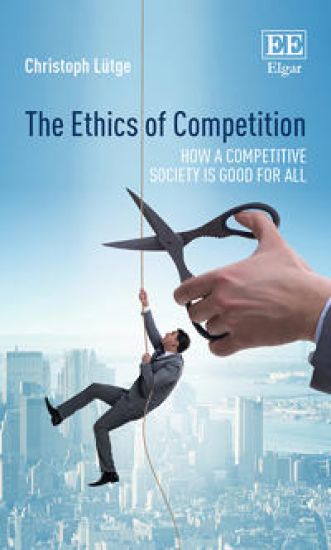
The Ethics of Competition

The Ethics of Competition

Christoph Lütge

Edward Elgar Publishing Ltd
2019
sidottu
Countering the claims that competition contradicts and undermines ethical thought processes and actions, Christoph Lütge successfully argues that competition and ethics do not necessarily have to oppose one another. He highlights how intensified competition can in fact work in favour of ethical goals, and that many criticisms of competition stem from an out-dated understanding of how modern societies and economies function. Illustrating this view with examples from ecology, healthcare and education, the author calls for a more entrepreneurial spirit in analysing the relationship between competition and ethics. This book delivers important arguments for the ethics of innovation, using a combination of theoretical and practical evidence to support it. Researchers and scholars of economics, business, philosophy and politics will greatly benefit from the fresh interdisciplinary perspectives and thorough exploration of the complex relationship between modern competition and ethics.
Wirtschaftsethik ohne Illusionen

Wirtschaftsethik ohne Illusionen

Christoph Lütge

Mohr Siebeck
2012
nidottu
Sowohl die wissenschaftliche als auch die öffentliche Diskussion über die Beziehungen zwischen Wirtschaft und Ethik werden von zahlreichen Illusionen beherrscht: Ethik sei als Mäßigung zu verstehen, Moral könne sich dauerhaft gegen Anreize behaupten, der Wettbewerb müsse gezähmt werden, eine Gesellschaft benötige gemeinsame Werte, unsere sozialen Systeme könnten so wie bisher weiterbestehen und einige andere mehr. Christoph Lütge wendet sich gegen solche Illusionen und zeigt Möglichkeiten einer realistischen Wirtschaftsethik unter modernen Bedingungen auf. Die hier vorliegenden Beiträge spannen den Bogen von Grundlagenfragen der Ethik über Anwendungsprobleme der Wirtschaftsethik bis hin zu ethischen Problemen des Internets.
Was hält eine Gesellschaft zusammen?

Was hält eine Gesellschaft zusammen?

Christoph Lütge

Mohr Siebeck
2007
sidottu
Viele Sozialphilosophen und Ethiker behaupten, dass eine moderne Gesellschaft nicht allein durch allseitige Befolgung ihrer Regeln stabil bleiben kann. Prominente Theoretiker wie J. Habermas, J. Rawls, D. Gauthier oder R. Rorty vertreten die Ansicht, dass die Bürger einer modernen Gesellschaft über zusätzliche anthropologische Eigenschaften verfügen müssen, die hier als moralische Mehrwerte bezeichnet werden. Beispiele sind Werte und Tugenden, eine rationale Motivation oder ein funktionierender Gerechtigkeitssinn. Christoph Lütge untersucht die Tragfähigkeit dieser moralischen Mehrwerte im Zeitalter der Globalisierung. Die Frage ist zum einen, ob moralische Mehrwerte hinreichend sind, d.h. ob sie gegen Erosion durch systematische (Fehl-) Anreize gefeit sind. Zum anderen wird untersucht, ob moralische Mehrwerte für gesellschaftliche Stabilität notwendig sind. Beide Fragen werden letztlich verneint. Keine der untersuchten anthropologischen Eigenschaften kann damit die Grundlage für Normativität in der globalisierten Welt abgeben. Diesem zunächst negativen Ergebnis stellt Christoph Lütge jedoch ein positives zur Seite: Der Ansatz der Ordnungsethik baut für die Stabilität von Gesellschaften nicht auf Eigenschaften von Menschen, sondern auf Merkmale von Situationen und deren Rahmenbedingungen (Ordnungen). Er liefert damit die Grundlage für eine nicht-anthropologisch begründete Normativität, die voraussetzungsärmer ist und im Zeitalter der Globalisierung eher auf kulturübergreifende Zustimmung rechnen kann.