Kirjojen hintavertailu – 12 903 725 kirjaa ja 27 kauppaa

Kirjailija

Christopher Cannon

Kirjat ja teokset yhdessä paikassa: 11 kirjaa, julkaisuja vuosilta 1999–2024, suosituimpiin kuuluu Small Talk. Vertaile teosten hintoja ja tarkista saatavuus suomalaisista kirjakaupoista.

11 kirjaa

Kirjojen julkaisuvuodet: 1999–2024.

Small Talk

Small Talk

Christopher Cannon

Christopher Cannon
2022
pokkari
How do you approach initiating a conversation? With an engaging subject, do the words come quickly and naturally? Or do you stumble and stammer, increasing your anxiety? Communication is critical in human beings. Communication is what distinguishes us, from our oldest ancestors, who initially employed sign language before having the capacity to construct languages, to the contemporary day, with all of its social etiquette and conventions. It is also necessary for developing trust, relationships, obtaining what we want and need, and just having fun. Small Talk is a book that will help you develop your conversational skills by providing tips on: The fundamental guidelines for small chatHow to Improve Your Social SkillsBegin a discussionMaking contact with someoneIncreasing your self-assuranceSix steps to making your dream a realityAnd much more... The ability to strike up a conversation with someone in a social context, at business, or in public is a valuable talent that we should all aim towards. You can accomplish it in less time than you think using Small Talk. Scroll up and click Add to Cart to get your copy right now
From Literacy to Literature

From Literacy to Literature

Christopher Cannon

Oxford University Press
2021
nidottu
The first lessons we learn in school can stay with us all our lives, but this was nowhere more true than in the last decades of the fourteenth century when grammar-school students were not only learning to read and write, but understanding, for the first time, that their mother tongue, English, was grammatical. The efflorescence of Ricardian poetry was not a direct result of this change, but it was everywhere shaped by it. This book characterizes this close connection between literacy training and literature, as it is manifest in the fine and ambitious poetry by Gower, Langland and Chaucer, at this transitional moment. This is also a book about the way medieval training in grammar (or grammatica) shaped the poetic arts in the Middle Ages fully as much as rhetorical training. It answers the curious question of what language was used to teach Latin grammar to the illiterate. It reveals, for the first time, what the surviving schoolbooks from the period actually contain. It describes what form a 'grammar school' took in a period from which no school buildings or detailed descriptions survive. And it scrutinizes the processes of elementary learning with sufficient care to show that, for the grown medieval schoolboy, well-learned books functioned, not only as a touchstone for wisdom, but as a knowledge so personal and familiar that it was equivalent to what we would now call 'experience'.

From Literacy to Literature: England, 1300-1400

From Literacy to Literature: England, 1300-1400

Christopher Cannon

Oxford University Press
2016
sidottu
The first lessons we learn in school can stay with us all our lives, but this was nowhere more true than in the last decades of the fourteenth century when grammar-school students were not only learning to read and write, but understanding, for the first time, that their mother tongue, English, was grammatical. The efflorescence of Ricardian poetry was not a direct result of this change, but it was everywhere shaped by it. This book characterizes this close connection between literacy training and literature, as it is manifest in the fine and ambitious poetry by Gower, Langland and Chaucer, at this transitional moment. This is also a book about the way medieval training in grammar (or grammatica) shaped the poetic arts in the Middle Ages fully as much as rhetorical training. It answers the curious question of what language was used to teach Latin grammar to the illiterate. It reveals, for the first time, what the surviving schoolbooks from the period actually contain. It describes what form a 'grammar school' took in a period from which no school buildings or detailed descriptions survive. And it scrutinizes the processes of elementary learning with sufficient care to show that, for the grown medieval schoolboy, well-learned books functioned, not only as a touchstone for wisdom, but as a knowledge so personal and familiar that it was equivalent to what we would now call 'experience'.

Management of Acute Coronary Syndromes

Management of Acute Coronary Syndromes

Eli Gelfand; Christopher Cannon

John Wiley Sons Inc
2009
sidottu
Acute Coronary Syndrome covers the spectrum of clinical conditions ranging from unstable angina to non-ST elevation myocardial infarction and ST elevation myocardial infarction. These life-threatening disorders are a major cause of emergency medical care, hospitalization and mortality. Management of Acute Coronary Syndromes is designed to provide busy clinicians with a comprehensive guide to the investigation, diagnosis and treatment of these syndromes. It encompasses the latest technologies, including the use of biomarkers and non-invasive imaging procedures. For each condition, the reader is taken through all of the therapeutic options available; in each case the indications and contraindications are evaluated in the light of the latest clinical trials. Potential complications are dealt with in a similar fashion, permitting the reader to anticipate and manage problems as they arise. The authors also present evidence-based recommendations for long-term care of at-risk patients, encompassing pharmacologic therapies and lifestyle management. The book concludes with a comprehensive collection of appendices that include treatment algorithms, risk scores and a summary of the latest management guidelines. Management of Acute Coronary Syndromes is the most up to date and comprehensive evidence-based guide to managing acute coronary syndromes, in a compact and usable format. It will be of interest to busy specialist physicians in cardiovascular medicine, cardiac and vascular surgery, and critical care, as well as primary care physicians and hospitalists who care for patients with these syndromes.
Middle English Literature

Middle English Literature

Christopher Cannon

Polity Press
2008
nidottu
This book provides a boldly original account of Middle English literature from the Norman Conquest to the beginning of the sixteenth century. It argues that these centuries are, in fundamental ways, the momentous period in our literary history, for they are the long moment in which the category of literature itself emerged as English writing began to insist, for the first time, that it floated free of any social reality or function. This book also charts the complex mechanisms by which English writing acquired this power in a series of linked close readings of both canonical and more obscure texts. It encloses those readings in five compelling accounts of much broader cultural areas, describing, in particular, the productive relationship of Middle English writing to medieval technology, insurgency, statecraft and cultural place, concluding with an in depth account of the particular arguments, emphases and techniques English writers used to claim a wholly new jurisdiction for their work. Both this history and its readings are everywhere informed by the most exciting developments in recent Middle English scholarship as well as literary and cultural theory. It serves as an introduction to all these areas as well as a contribution, in its own right, to each of them.
Middle English Literature

Middle English Literature

Christopher Cannon

Polity Press
2008
sidottu
This book provides a boldly original account of Middle English literature from the Norman Conquest to the beginning of the sixteenth century. It argues that these centuries are, in fundamental ways, the momentous period in our literary history, for they are the long moment in which the category of literature itself emerged as English writing began to insist, for the first time, that it floated free of any social reality or function. This book also charts the complex mechanisms by which English writing acquired this power in a series of linked close readings of both canonical and more obscure texts. It encloses those readings in five compelling accounts of much broader cultural areas, describing, in particular, the productive relationship of Middle English writing to medieval technology, insurgency, statecraft and cultural place, concluding with an in depth account of the particular arguments, emphases and techniques English writers used to claim a wholly new jurisdiction for their work. Both this history and its readings are everywhere informed by the most exciting developments in recent Middle English scholarship as well as literary and cultural theory. It serves as an introduction to all these areas as well as a contribution, in its own right, to each of them.
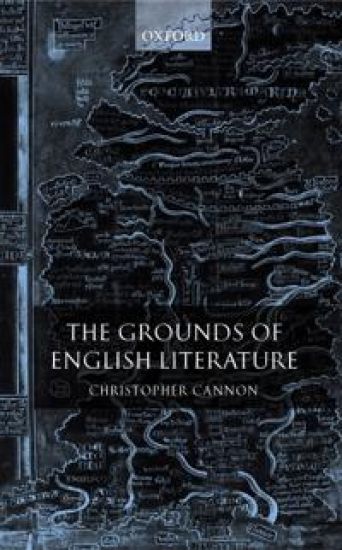
The Grounds of English Literature

The Grounds of English Literature

Christopher Cannon

Oxford University Press
2007
nidottu
The centuries just after the Norman Conquest are the forgotten period of English literary history. In fact, the years 1066-1300 witnessed an unparalleled ingenuity in the creation of written forms, for this was a time when almost every writer was unaware of the existence of other English writing. In a series of detailed readings of the more important early Middle English works, Cannon shows how the many and varied texts of the period laid the foundations for the project of English literature. This richness is for the first time given credit in these readings by means of an innovative theory of literary form that accepts every written shape as itself a unique contribution to the history of ideas. This theory also suggests that the impoverished understanding of literature we now commonly employ is itself a legacy of this early period, an attribute of the single form we have learned to call 'romance'. A number of reading methods have lately taught us to be more generous in our understandings of what literature might be, but this book shows us that the very variety we now strive to embrace anew actually formed the grounds of English literature-a richness we only lost when we forgot how to recognize it.
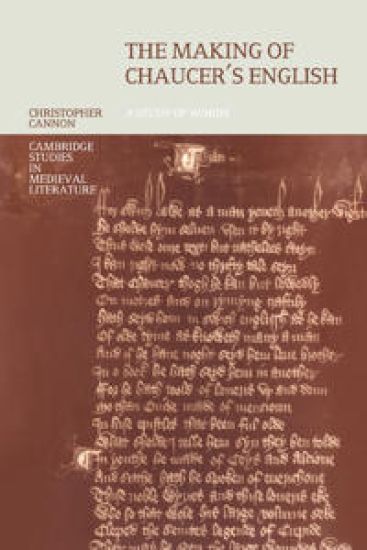
The Making of Chaucer's English

The Making of Chaucer's English

Christopher Cannon

Cambridge University Press
2005
pokkari
The Making of Chaucer's English undertakes a substantial reappraisal of the place Chaucer's English occupies in the history of the English language and the language of English literature. It attacks the widespread presumption that Chaucer invented literary English and argues instead that Chaucer's English is generally traditional. It shows that Chaucer's linguistic innovation was as much performance as fact, but it also traces the linguistic strategies that made (and make) the performance of 'originality' so believable. It also includes a valuable history of every word Chaucer uses. The book also interrogates the theory and methodology of historicising languages, so even as it explores how Chaucer's words matter, it also questions why these particular words have acquired such importance for poets and scholars alike for 600 years.
The Grounds of English Literature

The Grounds of English Literature

Christopher Cannon

Oxford University Press
2004
sidottu
The centuries just after the Norman Conquest are the forgotten period of English literary history. In fact, the years 1066-1300 witnessed an unparalleled ingenuity in the creation of written forms, for this was a time when almost every writer was unaware of the existence of other English writing. In a series of detailed readings of the more important early Middle English works, Cannon shows how the many and varied texts of the period laid the foundations for the project of English literature. This richness is for the first time given credit in these readings by means of an innovative theory of literary form that accepts every written shape as itself a unique contribution to the history of ideas. This theory also suggests that the impoverished understanding of literature we now commonly employ is itself a legacy of this early period, an attribute of the single form we have learned to call 'romance'. A number of reading methods have lately taught us to be more generous in our understandings of what literature might be, but this book shows us that the very variety we now strive to embrace anew actually formed the grounds of English literature-a richness we only lost when we forgot how to recognize it.
The Making of Chaucer's English

The Making of Chaucer's English

Christopher Cannon

Cambridge University Press
1999
sidottu
The Making of Chaucer's English undertakes a substantial reappraisal of the place Chaucer's English occupies in the history of the English language and the language of English literature. It attacks the widespread presumption that Chaucer invented literary English and argues instead that Chaucer's English is generally traditional. It shows that Chaucer's linguistic innovation was as much performance as fact, but it also traces the linguistic strategies that made (and make) the performance of 'originality' so believable. It also includes a valuable history of every word Chaucer uses. The book also interrogates the theory and methodology of historicising languages, so even as it explores how Chaucer's words matter, it also questions why these particular words have acquired such importance for poets and scholars alike for 600 years.