Kirjojen hintavertailu – 12 859 826 kirjaa ja 27 kauppaa

Kirjailija

Christopher Harding

Kirjat ja teokset yhdessä paikassa: 26 kirjaa, julkaisuja vuosilta 2007–2026, suosituimpiin kuuluu Die kürzeste Geschichte Japans. Vertaile teosten hintoja ja tarkista saatavuus suomalaisista kirjakaupoista.

26 kirjaa

Kirjojen julkaisuvuodet: 2007–2026.

Regulating Cartels in Europe

Regulating Cartels in Europe

Christopher Harding; Julian Joshua

Oxford University Press
2010
sidottu
One of the most contentious and high-profile aspects of EU competition law and policy has been the regulation of those serious competition or antitrust violations now often referred to as 'hard core cartels'. Such cartel activity typically involves large and powerful corporate producers and traders operating across Europe and beyond, and comprise practices such as price fixing, bid rigging, market sharing, and limiting production in order to ensure 'market stability' and maintain and increase profits. There is little disagreement now, in terms of competition theory and policy at both international and national levels, regarding the damaging effect of such trading practices on public and consumer interests, and such cartels have been subject to increasing condemnation in the legal process of regulating and protecting competition. Harding and Joshua provide a critical evaluation of the way in which European-level regulation has evolved to deal with the activities of such anti-competitive business cartels. They trace the historical development of cartel regulation in Europe, comparing the more pragmatic and empirical approaches favoured in Europe with the more dogmatic and uncompromising American policy on cartels. In particular, the work considers critically the move towards the use of fully fledged criminal proceedings in this area of legal control, examining evolving aspects of enforcement policy such as the use of leniency programmes and the deployment of a range of criminal law and other sanctions. This new edition of the work covers emerging themes and arguments in the discipline, including the judicial review of decisions against cartels, the criminological and legal basis of the criminalisation of cartel conduct, and the range and effectiveness of sanctions used in response to cartel activity.
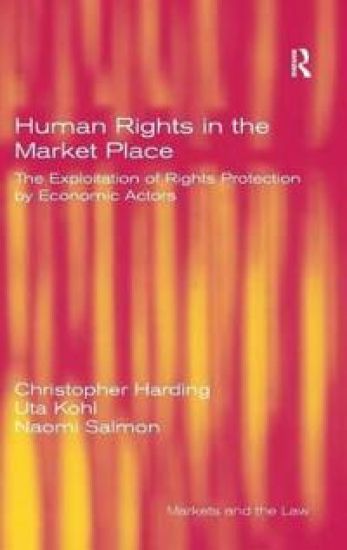
Human Rights in the Market Place

Human Rights in the Market Place

Christopher Harding; Uta Kohl

Ashgate Publishing Limited
2008
sidottu
The ideology of human rights protection has gained considerable momentum during the second half of the twentieth century at both national and international level and appears to be an effective lever for bringing about legal change. This book analyzes this strategy in economic and commercial policy and considers the transportation of the 'public law' discourse of basic human rights protection into the 'commercial law' context of economic policy, business activity and corporate behaviour. The volume will prove indispensable for anyone interested in human rights, international law, and business and commercial law.
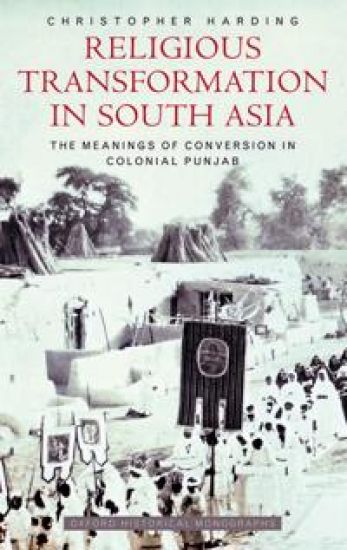
Religious Transformation in South Asia

Religious Transformation in South Asia

Christopher Harding

Oxford University Press
2008
sidottu
In the last decades of the nineteenth century, urgent and unprecedented demands among oppressed peoples in colonial India drove what came to be called 'mass conversion movements' towards a range of Christian denominations, launching a revolution in South Asia's two thousand-year Christian history. For all the scale, drama, and lasting controversy of a movement that approached half a million members in Punjab alone by the end of the 1930s, much actually depended upon a varied range of tempestuous local relationships between converts and mission personnel, based upon uncertain and constantly evolving terms. Making extensive use of Protestant Evangelical and newly-uncovered Catholic mission sources, Religious Transformation in South Asia explores those relationships to reveal what lay behind the great diversity of social and religious aspirations of converts and mission personnel. In this highly accessible study, Christopher Harding overturns the one-dimensional Christian missions of popular imagination by analysing the way that social class, theological training, culture, motivation, and personality produced an extraordinary range of presentations of 'Christianity' in late colonial Punjab. Punjabi converts themselves were animated by a similarly broad spectrum of expectations and pressures, communicated through informal social networks and representing a brand of subaltern consciousness and resistance rarely considered by mainstream Indian historiography. These internal dynamics produced a first generation of rural Punjabi Christianity that was locally variable, highly fluid, and conflict-ridden-testament to the ways in which the meanings of conversion were contested by all sides in an encounter with far-reaching implications for the future of Christianity and religious identity in India and Pakistan.

Criminal Enterprise

Criminal Enterprise

Christopher Harding

Willan Publishing
2007
sidottu
This is a study of agency in the field of criminal liability, considering the respective roles of individuals and organisations and the allocation of criminal responsibility to these different kinds of actor. The issue of criminal responsibility, which is informed by both the sociological analysis of conduct and by ethical considerations of responsibility, provides an important and revealing focus for discussion. Criminal Enterprise analyses criminal responsibility through three main types of organisation: corporate actors in the field of business activity, states and governments, and delinquent or criminal organisations; each of which is of contemporary significance. This analysis focuses on three particular issues: the theory of individual and corporate (or organisational) responsibilitythe attribution of legal personality, as a particular form of identity, in theory and across jurisdictions and legal ordersthe internal practice and operation of complex organisations and corporate actors and how an understanding of this sociology of organisations should be used in the construction of legal agency in the field of criminal law.