Kirjojen hintavertailu – 12 903 724 kirjaa ja 27 kauppaa

Kirjailija

Christopher Harvie

Kirjat ja teokset yhdessä paikassa: 14 kirjaa, julkaisuja vuosilta 1991–2016, suosituimpiin kuuluu The Road to Home Rule. Vertaile teosten hintoja ja tarkista saatavuus suomalaisista kirjakaupoista.

14 kirjaa

Kirjojen julkaisuvuodet: 1991–2016.

The Rise of Regional Europe

The Rise of Regional Europe

Christopher Harvie

Routledge
2016
sidottu
In the 1970s and 1980s there was a steady transfer of power in mainland Europe to new, powerful regional authorities and these, in their turn, started to build up a new form of intra-European co-operation. With the acceleration of European integration, the rise of the multinational firm and new media and transport technologies, the traditional defence-based nation-states are under threat. In this challenging study, Christopher Harvie alters the ways in which we have traditionally surveyed the European past by setting the positive and negative aspects of the present European situation in their historical context. He reappraises the actors of `national' politics, the persistence of types of civic and internationalist discourse and finally looks at the transactions which have created `bourgeois regionalism', and its implications for the future of Europe. Harvie argues that we are only beginning to realise the shift in consciousness, as well as in politics and administration, that an integrated Europe will involve.
No Gods and Precious Few Heroes

No Gods and Precious Few Heroes

Christopher Harvie

Edinburgh University Press
2016
nidottu
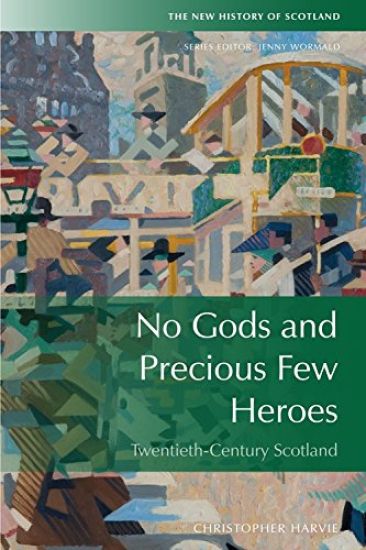
This is a colourful and stimulating history of modern Scotland. Christopher Harvie brings his inimitable vision to a history of modern Scotland epitomised by political and social change, in what he sees as 'recuperation' through change. This introductory history takes Scotland through two world wars and subsequent social exhaustion, through the re energising adjustments loosely referred to as 'the sixties' to a final endgame of Union versus Independence. The novel structure of Harvie's history mirrors that of a grand engineering project, or a structure as complex as the Forth Railway Bridge: 'three periods of change rendered as towers, and two great cantilevered arches of life in common, over which day to day life proceeds'. This is a final narrative of 'Union versus Independence'. It thematically rebuilts chapters: Economy/Society/Politics/Culture. The '60s' is reinterpreted.
No Gods and Precious Few Heroes

No Gods and Precious Few Heroes

Christopher Harvie

Edinburgh University Press
2016
sidottu
A colourful and stimulating history of modern ScotlandThis introductory history takes Scotland through two world wars and subsequent social exhaustion, through the re-energising adjustments loosely referred to as 'the sixties' to a final endgame of Union versus Independence. The novel structure of Harvie's history mirrors that of a grand engineering project, or a structure as complex as the Forth Railway Bridge: 'three periods of change rendered as towers, and two great cantilevered arches of life-in-common, over which day-to-day life proceeds'. Key Features:A final narrative of 'Union versus Independence'Thematically rebuilt chapters: Economy/Society/Politics/CultureThe '60s' reinterpretedFrom the APF (JW to ammend)'When No Gods and Precious Few Heroes first appeared in 1981 Paul Addison, in the English Historical Review, called Christopher Harvie's book 'a masterly synthesis of the most important political, economic social and cultural developments in Scotland's recent past, written too with great wit and style.' Updated in 1987, after two further editions in 1996 and 2000 comes this near- total refashioning. 'Starting and finishing in melodrama', its much-travelled author, after living with politics and media in Europe, assesses the new parliamentary state against thirty-five turbulent, vertiginous years. Narrative and episodes shift from squaddies in Iraq camps to working mothers reclaiming civic life from failing religion and big crime. Traceable all-too -often to an untended past, the demand for 'love patience and power to absolve those tormented' might at last through most unusual politics be getting to it
Scotland: A Short History

Scotland: A Short History

Christopher Harvie

Oxford University Press
2014
nidottu
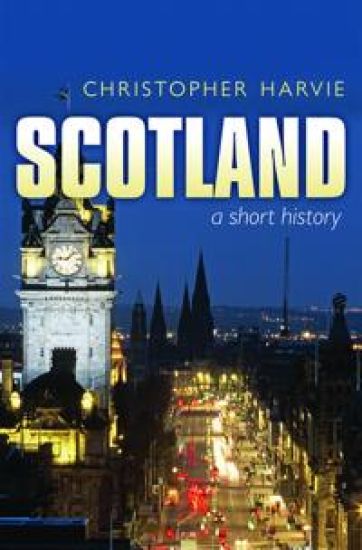
Christopher Harvie, one of Scotland's leading historians and political writers, takes a long view of Scotland: its land, people, and culture. Scotland: A History sweeps from the earliest settlements to the new Parliament of 1999 and beyond. It describes the unique multi-ethnic kingdom which emerged from the Dark Ages, the small, proud nation manoeuvring among the great powers of medieval Europe, and the radical reformation which forced a compromise with its mighty southern neighbour. Harvie follows Scotland's tense partnership with England for over 400 years, through dual monarchy and union, enlightenment and empire, industrialization and de-industrialization. First published over a decade ago, this new edition has been extended - at both ends - to include recent discoveries about Scotland's early pre-historic settlements, through to a new final chapter covering the history, politics, and economics of the country under the Holyrood Parliament - and the background to the controversy over the Independence Referendum of 2014.
A Floating Commonwealth

A Floating Commonwealth

Christopher Harvie

Oxford University Press
2012
nidottu
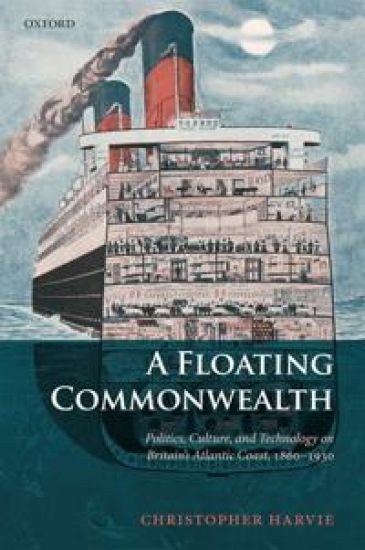
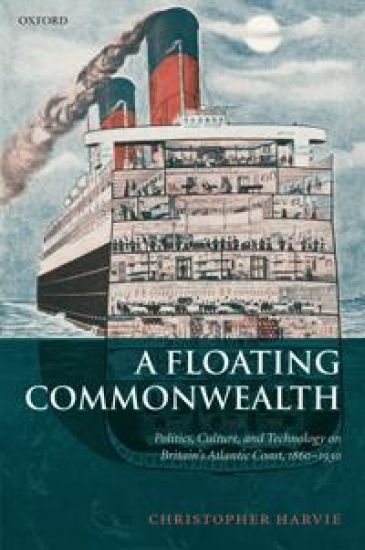
Christopher Harvie offers a new portrait of society and identity in high industrial Britain by focusing on the sea as connector, not barrier. Atlantic and 'inland sea' together, Harvie argues, created a 'floating commonwealth' of port cities and their hinterlands whose interaction, both with one another and with nationalist and imperial politics, created an intense political and cultural synergy. At a technical level, this produced the freight steamer and the efficient types of railways which opened up the developing world, as well as the institutions of international finance and communications in the age of 'telegrams and anger'. And ultimately, the resources of the Atlantic cities, their shipyards and works, enabled Britain to win withstand the test of the First World War. Meanwhile, as Harvie shows, the continuous attempt to make sense of an ever-changing material reality also stimulated the discourses on which social criticism and literary modernism were based, from Carlyle to James Joyce - although the ultimate outcome, of slump and emigration, would leave enduring problems in the years to come.
Broonland

Broonland

Christopher Harvie

Verso Books
2010
nidottu
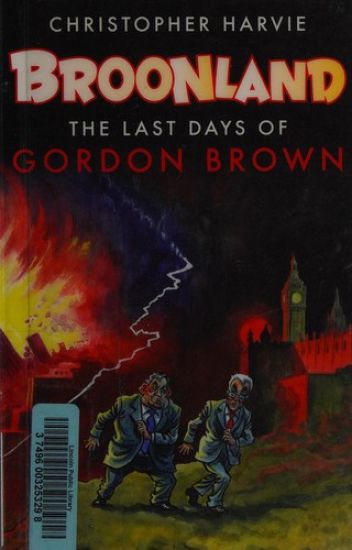
How did the intellectually intimidating, industrious architect of the New Labour project become its maligned and feckless undertaker? In this scathing, witty indictment of Gordon Brown's tenure as prime minister, Christopher Harvie says goodbye to Broon by exploring the Britain New Labour helped create. It is a place where the gap between rich and poor grows ever wider and manufacturing has been replaced by 'retail, entertainment and recreation' (for which read shopping, gambling and drinking). Now that the casino economy has veered wildly out of control, and our public utilities and industries have been auctioned to the highest bidder, Broonland is both an essential anatomy of a country on the brink of collapse and a caustic, darkly funny portrait of a decade that took Britain from boom through bust to busted.
A Floating Commonwealth

A Floating Commonwealth

Christopher Harvie

Oxford University Press
2008
sidottu
Christopher Harvie offers a new portrait of society and identity in high industrial Britain by focusing on the sea as connector, not barrier. Atlantic and 'inland sea' together, Harvie argues, created a 'floating commonwealth' of port cities and their hinterlands whose interaction, both with one another and with nationalist and imperial politics, created an intense political and cultural synergy. At a technical level, this produced the freight steamer and the efficient types of railways which opened up the developing world, as well as the institutions of international finance and communications in the age of 'telegrams and anger'. And ultimately, the resources of the Atlantic cities, their shipyards and works, enabled Britain to win withstand the test of the First World War. Meanwhile, as Harvie shows, the continuous attempt to make sense of an ever-changing material reality also stimulated the discourses on which social criticism and literary modernism were based, from Carlyle to James Joyce - although the ultimate outcome, of slump and emigration, would leave enduring problems in the years to come.
Scotland and Nationalism

Scotland and Nationalism

Christopher T. Harvie; Christopher Harvie

Routledge
2004
sidottu
Scotland and Nationalism provides an authoritative survey of Scottish social and political history from 1707 to the present day. Focusing on political nationalism in Scotland, Christopher Harvie examines why this nationalism remained apparently in abeyance for two and a half centuries, and why it became so relevant in the second half of the twentieth century. This fourth edition brings the story and historiography of Scottish society and politics up-to-date. Additions also include a brand new biographical index of key personalities, along with a glossary of nationalist groups.
Scotland and Nationalism

Scotland and Nationalism

Christopher T. Harvie; Christopher Harvie

Routledge
2004
nidottu
Scotland and Nationalism provides an authoritative survey of Scottish social and political history from 1707 to the present day. Focusing on political nationalism in Scotland, Christopher Harvie examines why this nationalism remained apparently in abeyance for two and a half centuries, and why it became so relevant in the second half of the twentieth century. This fourth edition brings the story and historiography of Scottish society and politics up-to-date. Additions also include a brand new biographical index of key personalities, along with a glossary of nationalist groups.
Nineteenth-Century Britain

Nineteenth-Century Britain

Christopher Harvie; Colin Matthew

Oxford University Press
2000
nidottu

Halvin toimitettuna 18,90 €

First published as part of the best-selling The Oxford Illustrated History of Britain, Christopher Harvie and Colin Matthew's Very Short Introduction to Nineteenth-Century Britain is a sharp but subtle account of remarkable economic and social change and an even more remarkable political stability. Britain in 1789 was overwhelmingly rural, agrarian, multilingual, and almost half Celtic. By 1914, when it faced its greatest test since the defeat of Napoleon, it was largely urban and English. Christopher Harvie and Colin Matthew show the forces behind Britain's rise to its imperial zenith, and the continuing tensions within the nations and classes of the 'union state'. ABOUT THE SERIES: The Very Short Introductions series from Oxford University Press contains hundreds of titles in almost every subject area. These pocket-sized books are the perfect way to get ahead in a new subject quickly. Our expert authors combine facts, analysis, perspective, new ideas, and enthusiasm to make interesting and challenging topics highly readable.
The Road to Home Rule

The Road to Home Rule

Christopher Harvie; Peter Jones

Polygon at Edinburgh University Press
1999
nidottu
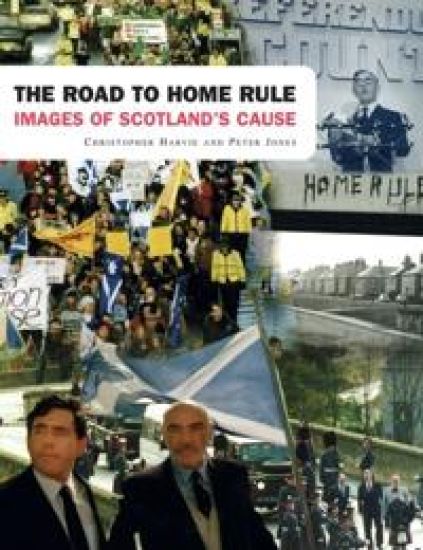
When the Scottish Parliament sat in Edinburgh for the first time in nearly three hundred years it was the climax of Europe's most peaceable and legalistic national movement. But dull it wasn't. In war and peace, from Empire to Europe, through the rise and fall of industry, the cause of self-government has been endlessly reinvented and remodelled, sometimes surviving more as a poetic fashion rather than as a political campaign. But it got there in the end. The Road To Home Rule documents not just the demonstrations, the party politics and international upheavals which swept the Scottish cause along - and all too frequently adrift - during the twentieth century, but also shows how it swam in the tides of social change and cultural inspiration. From Keir Hardie's and William Gladstone's promises to Tony Blair's and Donald Dewar's delivery, via a route populated by the larger-than-life characters and ideas of Hugh MacDiarmid, Winnie Ewing, Michael Forsyth, round the milestones and millstones of Conventions, Covenants, Wee Magic Stanes and Bravehearts - all Scottish life is there. With a core essay by the historian Christopher Harvie and the political correspondent Peter Jones, the book's 100 illustrations cast a cool eye on the grandeurs and miseries encountered on the long way to Holyrood. Key Features: *Highly illustrated with 150 black and white photographs, cartoons and other images *Substantial captions to place the images in context *Written by two 'names': Chris Harvie is a well-known Scottish historian and Peter Jones is a well-regarded journalist *A fascinating and entertaining story of the road to home rule
The Rise of Regional Europe

The Rise of Regional Europe

Christopher Harvie

Routledge
1993
nidottu
In the 1970s and 1980s there was a steady transfer of power in mainland Europe to new, powerful regional authorities and these, in their turn, started to build up a new form of intra-European co-operation. With the acceleration of European integration, the rise of the multinational firm and new media and transport technologies, the traditional defence-based nation-states are under threat. In this challenging study, Christopher Harvie alters the ways in which we have traditionally surveyed the European past by setting the positive and negative aspects of the present European situation in their historical context. He reappraises the actors of `national' politics, the persistence of types of civic and internationalist discourse and finally looks at the transactions which have created `bourgeois regionalism', and its implications for the future of Europe. Harvie argues that we are only beginning to realise the shift in consciousness, as well as in politics and administration, that an integrated Europe will involve.