Kirjojen hintavertailu – 12 859 827 kirjaa ja 27 kauppaa

Kirjailija

Christopher Hughes

Kirjat ja teokset yhdessä paikassa: 25 kirjaa, julkaisuja vuosilta 1997–2025, suosituimpiin kuuluu The Time Loop Chronicles. Vertaile teosten hintoja ja tarkista saatavuus suomalaisista kirjakaupoista.

25 kirjaa

Kirjojen julkaisuvuodet: 1997–2025.

Kripke

Kripke

Christopher Hughes

Oxford University Press
2006
nidottu
Saul Kripke, in a series of classic writings of the 1960s and 1970s, changed the face of metaphysics and philosophy of language. Christopher Hughes offers a careful exposition and critical analysis of Kripke's central ideas about names, necessity, and identity. He clears up some common misunderstandings of Kripke's views on rigid designation, causality and reference, the necessary and the contingent, the a posteriori and the a priori. Through his engagement with Kripke's ideas Hughes makes a significant contribution to ongoing debates on, inter alia, the semantics of natural kind terms, the nature of natural kinds, the essentiality of origin and constitution, the relative merits of 'identitarian' and counterpart-theoretic accounts of modality, and the identity or otherwise of mental types and tokens with physical types and tokens. No specialist knowledge in either the philosophy of language or metaphysics is presupposed; Hughes's book will be valuable for anyone working on the ideas which Kripke made famous in the philosophy world.

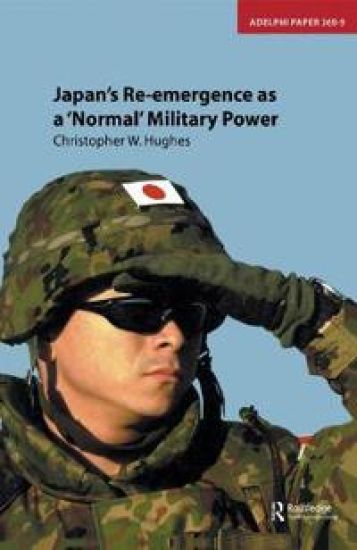
Japan's Re-emergence as a 'Normal' Military Power

Japan's Re-emergence as a 'Normal' Military Power

Christopher Hughes

Oxford University Press Inc
2004
nidottu
Is Japan re-emerging as a normal, or even a great, military power in regional and global security affairs? This Adelphi Paper assesses the overall trajectory of Japan's security policy over the last decade, and the impact of a changing Japanese military posture on the stability of East Asia. The paper examines Japan's evolving security debate, set against the background of a shifting international environment and domestic policymaking system; the status of Japan's national military capabilities and constitutional prohibitions; post-Cold War developments in the US Japan alliance; and Japan's role in multilateral regional security dialogue, UN PKO, and US-led coalitions of the willing. It concludes that Japan is undoubtedly moving along the trajectory of becoming a more assertive military power, and that this trend has been accelerated post-9/11. Japan is unlikely, though, to channel its military power through greatly different frameworks than at present. Japan will opt for the enhanced, and probably inextricable, integration of its military capabilities into the US Japan alliance, rather than pursuing options for greater autonomy or multilateralism. Japan's strengthened role as the defensive shield for the offensive sword of US power projection will only serve to bolster US military hegemony in East Asia and globally.
Kripke

Kripke

Christopher Hughes

Clarendon Press
2004
sidottu
Saul Kripke, in a series of classic writings of the 1960s and 1970s, changed the face of metaphysics and philosophy of language. Christopher Hughes offers a careful exposition and critical analysis of Kripke's central ideas about names, necessity, and identity. He clears up some common misunderstandings of Kripke's views on rigid designation, causality and reference, the necessary and the contingent, the a posteriori and the a priori. Through his engagement with Kripke's ideas Hughes makes a significant contribution to ongoing debates on, inter alia, the semantics of natural kind terms, the nature of natural kinds, the essentiality of origin and constitution, the relative merits of 'identitarian' and counterpart-theoretic accounts of modality, and the identity or otherwise of mental types and tokens with physical types and tokens. No specialist knowledge in either the philosophy of language or metaphysics is presupposed; Hughes's book will be valuable for anyone working on the ideas which Kripke made famous in the philosophy world.

Taiwan and Chinese Nationalism

Taiwan and Chinese Nationalism

Christopher Hughes

Routledge
1997
sidottu
For China, Taiwan is next in line to be unified with the People's Republic after Hong Kong in 1997. China's claim on Taiwan is of great importance to the politics of Chinese Nationalism, and is central to the dynamics of power in this most volatile of regions. The democratic challenge from Taiwan is very potent and its status and identity within the international community is crucial to its survival. Taiwan and Chinese Nationalism explores how Taiwan's status has come to be a symbol for the legitimacy of the Chinese regime in the evolution of Chinese nationalism. It also demonstrates how this view has been challenged by demands for democratization in Taiwan. The KMT regime is shown to have allowed sovereignty to be practised by the population of the island while maintaining the claim that it is a part of China. The result is a "post-nationalist" identity for the island in an intermediate state between independence and unification with the PRC.