Kirjojen hintavertailu – 12 903 735 kirjaa ja 27 kauppaa

Kirjailija

Christopher K. Wikle

Kirjat ja teokset yhdessä paikassa: 4 kirjaa, julkaisuja vuosilta 2011–2019, suosituimpiin kuuluu Bayesian Hierarchical Space-Time Models with Application to Significant Wave Height. Vertaile teosten hintoja ja tarkista saatavuus suomalaisista kirjakaupoista.

4 kirjaa

Kirjojen julkaisuvuodet: 2011–2019.

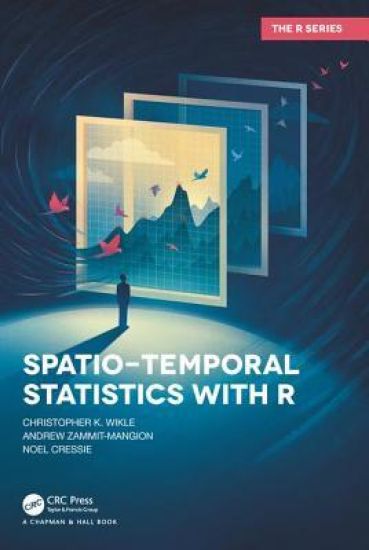
Spatio-Temporal Statistics with R

Spatio-Temporal Statistics with R

Christopher K. Wikle; Andrew Zammit-Mangion; Noel Cressie

CRC Press
2019
sidottu

Halvin toimitettuna 72,20 €

The world is becoming increasingly complex, with larger quantities of data available to be analyzed. It so happens that much of these "big data" that are available are spatio-temporal in nature, meaning that they can be indexed by their spatial locations and time stamps. Spatio-Temporal Statistics with R provides an accessible introduction to statistical analysis of spatio-temporal data, with hands-on applications of the statistical methods using R Labs found at the end of each chapter. The book:Gives a step-by-step approach to analyzing spatio-temporal data, starting with visualization, then statistical modelling, with an emphasis on hierarchical statistical models and basis function expansions, and finishing with model evaluationProvides a gradual entry to the methodological aspects of spatio-temporal statisticsProvides broad coverage of using R as well as "R Tips" throughout. Features detailed examples and applications in end-of-chapter LabsFeatures "Technical Notes" throughout to provide additional technical detail where relevantSupplemented by a website featuring the associated R package, data, reviews, errata, a discussion forum, and moreThe book fills a void in the literature and available software, providing a bridge for students and researchers alike who wish to learn the basics of spatio-temporal statistics. It is written in an informal style and functions as a down-to-earth introduction to the subject. Any reader familiar with calculus-based probability and statistics, and who is comfortable with basic matrix-algebra representations of statistical models, would find this book easy to follow. The goal is to give as many people as possible the tools and confidence to analyze spatio-temporal data.
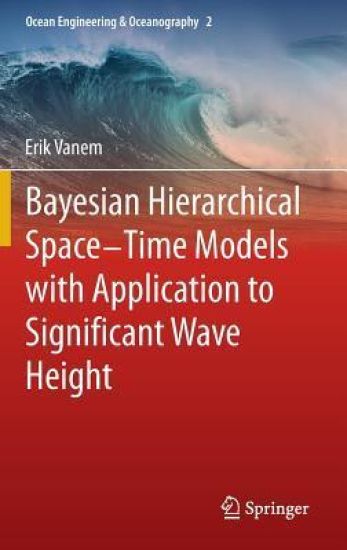
Bayesian Hierarchical Space-Time Models with Application to Significant Wave Height

Bayesian Hierarchical Space-Time Models with Application to Significant Wave Height

Erik Vanem; Elzbieta Maria Bitner-Gregersen; Christopher K. Wikle

Springer-Verlag Berlin and Heidelberg GmbH Co. K
2016
nidottu
This book provides an example of a thorough statistical treatment of ocean wave data in space and time. It demonstrates how the flexible framework of Bayesian hierarchical space-time models can be applied to oceanographic processes such as significant wave height in order to describe dependence structures and uncertainties in the data. This monograph is a research book and it is partly cross-disciplinary. The methodology itself is firmly rooted in the statistical research tradition, based on probability theory and stochastic processes. However, that methodology has been applied to a problem in the field of physical oceanography, analyzing data for significant wave height, which is of crucial importance to ocean engineering disciplines. Indeed, the statistical properties of significant wave height are important for the design, construction and operation of ships and other marine and coastal structures. Furthermore, the book addresses the question of whether climate change has an effect of the ocean wave climate, and if so what that effect might be. Thus, this book is an important contribution to the ongoing debate on climate change, its implications and how to adapt to a changing climate, with a particular focus on the maritime industries and the marine environment. This book should be of value to anyone with an interest in the statistical modelling of environmental processes, and in particular to those with an interest in the ocean wave climate. It is written on a level that should be understandable to everyone with a basic background in statistics or elementary mathematics, and an introduction to some basic concepts is provided in the appendices for the uninitiated reader. The intended readership includes students and professionals involved in statistics, oceanography, ocean engineering, environmental research, climate sciences and risk assessment. Moreover, the book’s findings are relevant for various stakeholders in the maritime industries such asdesign offices, classification societies, ship owners, yards and operators, flag states and intergovernmental agencies such as the IMO.
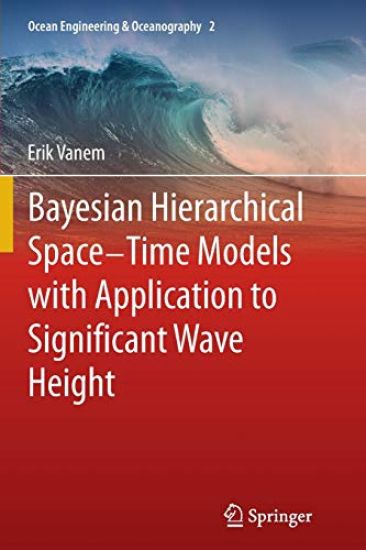
Bayesian Hierarchical Space-Time Models with Application to Significant Wave Height

Bayesian Hierarchical Space-Time Models with Application to Significant Wave Height

Erik Vanem; Elzbieta Maria Bitner-Gregersen; Christopher K. Wikle

Springer-Verlag Berlin and Heidelberg GmbH Co. K
2013
sidottu
This book provides an example of a thorough statistical treatment of ocean wave data in space and time. It demonstrates how the flexible framework of Bayesian hierarchical space-time models can be applied to oceanographic processes such as significant wave height in order to describe dependence structures and uncertainties in the data. This monograph is a research book and it is partly cross-disciplinary. The methodology itself is firmly rooted in the statistical research tradition, based on probability theory and stochastic processes. However, that methodology has been applied to a problem in the field of physical oceanography, analyzing data for significant wave height, which is of crucial importance to ocean engineering disciplines. Indeed, the statistical properties of significant wave height are important for the design, construction and operation of ships and other marine and coastal structures. Furthermore, the book addresses the question of whether climate change has an effect of the ocean wave climate, and if so what that effect might be. Thus, this book is an important contribution to the ongoing debate on climate change, its implications and how to adapt to a changing climate, with a particular focus on the maritime industries and the marine environment. This book should be of value to anyone with an interest in the statistical modelling of environmental processes, and in particular to those with an interest in the ocean wave climate. It is written on a level that should be understandable to everyone with a basic background in statistics or elementary mathematics, and an introduction to some basic concepts is provided in the appendices for the uninitiated reader. The intended readership includes students and professionals involved in statistics, oceanography, ocean engineering, environmental research, climate sciences and risk assessment. Moreover, the book’s findings are relevant for various stakeholders in the maritime industries such asdesign offices, classification societies, ship owners, yards and operators, flag states and intergovernmental agencies such as the IMO.
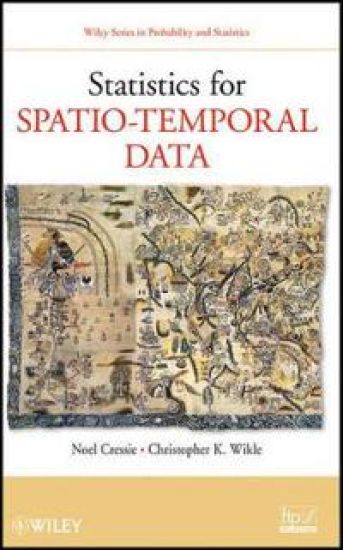
Statistics for Spatio-Temporal Data

Statistics for Spatio-Temporal Data

Noel Cressie; Christopher K. Wikle

John Wiley Sons Inc
2011
sidottu
Winner of the 2013 DeGroot Prize. A state-of-the-art presentation of spatio-temporal processes, bridging classic ideas with modern hierarchical statistical modeling concepts and the latest computational methods Noel Cressie and Christopher K. Wikle, are also winners of the 2011 PROSE Award in the Mathematics category, for the book “Statistics for Spatio-Temporal Data” (2011), published by John Wiley and Sons. (The PROSE awards, for Professional and Scholarly Excellence, are given by the Association of American Publishers, the national trade association of the US book publishing industry.) Statistics for Spatio-Temporal Data has now been reprinted with small corrections to the text and the bibliography. The overall content and pagination of the new printing remains the same; the difference comes in the form of corrections to typographical errors, editing of incomplete and missing references, and some updated spatio-temporal interpretations. From understanding environmental processes and climate trends to developing new technologies for mapping public-health data and the spread of invasive-species, there is a high demand for statistical analyses of data that take spatial, temporal, and spatio-temporal information into account. Statistics for Spatio-Temporal Data presents a systematic approach to key quantitative techniques that incorporate the latest advances in statistical computing as well as hierarchical, particularly Bayesian, statistical modeling, with an emphasis on dynamical spatio-temporal models. Cressie and Wikle supply a unique presentation that incorporates ideas from the areas of time series and spatial statistics as well as stochastic processes. Beginning with separate treatments of temporal data and spatial data, the book combines these concepts to discuss spatio-temporal statistical methods for understanding complex processes. Topics of coverage include: Exploratory methods for spatio-temporal data, including visualization, spectral analysis, empirical orthogonal function analysis, and LISAsSpatio-temporal covariance functions, spatio-temporal kriging, and time series of spatial processesDevelopment of hierarchical dynamical spatio-temporal models (DSTMs), with discussion of linear and nonlinear DSTMs and computational algorithms for their implementationQuantifying and exploring spatio-temporal variability in scientific applications, including case studies based on real-world environmental data Throughout the book, interesting applications demonstrate the relevance of the presented concepts. Vivid, full-color graphics emphasize the visual nature of the topic, and a related FTP site contains supplementary material. Statistics for Spatio-Temporal Data is an excellent book for a graduate-level course on spatio-temporal statistics. It is also a valuable reference for researchers and practitioners in the fields of applied mathematics, engineering, and the environmental and health sciences.