Kirjojen hintavertailu – 12 859 827 kirjaa ja 27 kauppaa

Kirjailija

Christopher T. Nelson

Kirjat ja teokset yhdessä paikassa: 7 kirjaa, julkaisuja vuosilta 2005–2025, suosituimpiin kuuluu Spaces of Creative Resistance. Vertaile teosten hintoja ja tarkista saatavuus suomalaisista kirjakaupoista.

7 kirjaa

Kirjojen julkaisuvuodet: 2005–2025.

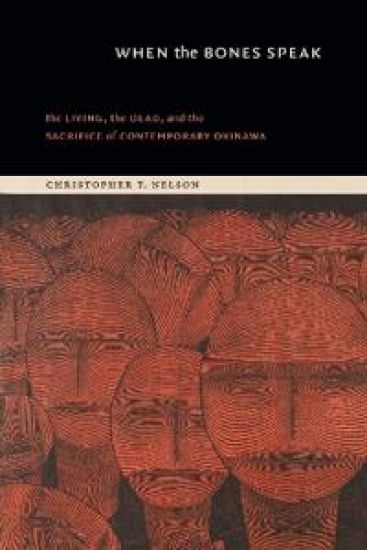
When the Bones Speak: The Living, the Dead, and the Sacrifice of Contemporary Okinawa
Haunted by the past, ordinary Okinawans struggle to live with the unbearable legacies of war, Japanese nationalism, and American imperialism. They are caught up in a web of people and practices--living and dead, visible and immaterial--that exert powerful forces often beyond their control. In When the Bones Speak, Christopher T. Nelson examines the myriad ways contemporary Okinawans experience, remember, and contest sacrifice. He attends to the voices of those who find their vocation in service to others, from shamans, fortune tellers, laborers, and artists to dead soldiers, war survivors, antiwar activists, and Christian missionaries. Nelson shows how the memories of past sacrifices, atrocities, and exploitation as well as residual trauma shape modern life in Okinawa and the possibility and hope for creative action grounded in the everyday. Offering new understandings of colonial transformation, wartime violence, and military occupation, Nelson writes from the intersection of temporalities and possibilities, where the hard finality of the past may be broken open to reveal a "not yet" that has always remained just beyond reach.
When the Bones Speak: The Living, the Dead, and the Sacrifice of Contemporary Okinawa
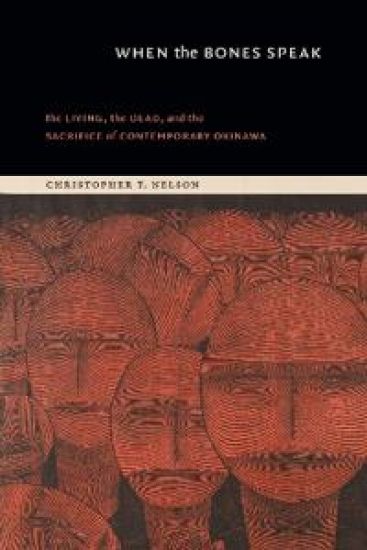
Haunted by the past, ordinary Okinawans struggle to live with the unbearable legacies of war, Japanese nationalism, and American imperialism. They are caught up in a web of people and practices-living and dead, visible and immaterial-that exert powerful forces often beyond their control. In When the Bones Speak, Christopher T. Nelson examines the myriad ways contemporary Okinawans experience, remember, and contest sacrifice. He attends to the voices of those who find their vocation in service to others, from shamans, fortune tellers, laborers, and artists to dead soldiers, war survivors, antiwar activists, and Christian missionaries. Nelson shows how the memories of past sacrifices, atrocities, and exploitation as well as residual trauma shape modern life in Okinawa and the possibility and hope for creative action grounded in the everyday. Offering new understandings of colonial transformation, wartime violence, and military occupation, Nelson writes from the intersection of temporalities and possibilities, where the hard finality of the past may be broken open to reveal a "not yet" that has always remained just beyond reach.
Spaces of Creative Resistance

Spaces of Creative Resistance

Christopher T. Nelson

RUTGERS UNIVERSITY PRESS
2025
sidottu
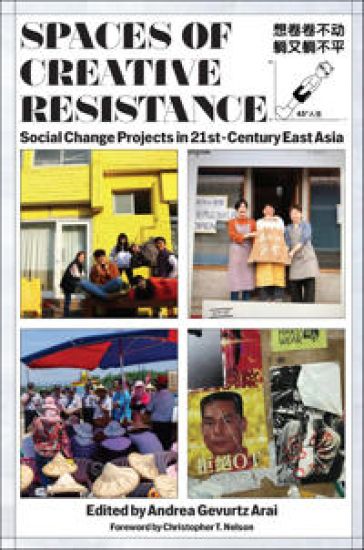
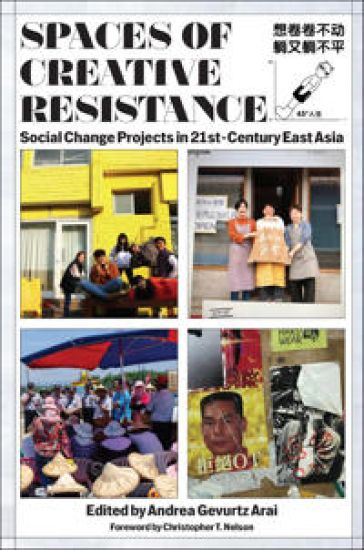
Spaces of Creative Resistance: Social Change Projects in Twenty-First-Century East Asia brings together an exciting cross-regional interdisciplinary group of scholars, scholar activists, artists, and others for a collection that addresses the last two decades' hollowing out of social connections, socioeconomic income gaps, and general precarity of life in East Asian societies. Written by authors from China, Japan, South Korea, Taiwan, and Hong Kong, each chapter is focused on people making a difference together in socially sustainable ways, particularly in the areas of gender, labor, and environments—both built and natural. These projects all constitute acts of creative resistance to neoliberal development, and each act of creative resistance demonstrates how individuals and communities across East Asia are making new worlds and lifeways in the small and everyday. Taking on larger political and economic forces that affect their lives and communities, each project and group of individuals featured here is focused on making more liveable presents and more possible futures.
Spaces of Creative Resistance

Spaces of Creative Resistance

Christopher T. Nelson

RUTGERS UNIVERSITY PRESS
2025
nidottu
Spaces of Creative Resistance: Social Change Projects in Twenty-First-Century East Asia brings together an exciting cross-regional interdisciplinary group of scholars, scholar activists, artists, and others for a collection that addresses the last two decades' hollowing out of social connections, socioeconomic income gaps, and general precarity of life in East Asian societies. Written by authors from China, Japan, South Korea, Taiwan, and Hong Kong, each chapter is focused on people making a difference together in socially sustainable ways, particularly in the areas of gender, labor, and environments—both built and natural. These projects all constitute acts of creative resistance to neoliberal development, and each act of creative resistance demonstrates how individuals and communities across East Asia are making new worlds and lifeways in the small and everyday. Taking on larger political and economic forces that affect their lives and communities, each project and group of individuals featured here is focused on making more liveable presents and more possible futures.
Dancing with the Dead

Dancing with the Dead

Christopher T. Nelson

Duke University Press
2008
pokkari
Challenging conventional understandings of time and memory, Christopher T. Nelson examines how contemporary Okinawans have contested, appropriated, and transformed the burdens and possibilities of the past. Nelson explores the work of a circle of Okinawan storytellers, ethnographers, musicians, and dancers deeply engaged with the legacies of a brutal Japanese colonial era, the almost unimaginable devastation of the Pacific War, and a long American military occupation that still casts its shadow over the islands. The ethnographic research that Nelson conducted in Okinawa in the late 1990s-and his broader effort to understand Okinawans’ critical and creative struggles-was inspired by his first visit to the islands in 1985 as a lieutenant in the U. S. Marine Corps. Nelson analyzes the practices of specific performers, showing how memories are recalled, bodies remade, and actions rethought as Okinawans work through fragments of the past in order to reconstruct the fabric of everyday life. Artists such as the popular Okinawan actor and storyteller Fujiki Hayato weave together genres including Japanese stand-up comedy, Okinawan celebratory rituals, and ethnographic studies of war memory, encouraging their audiences to imagine other ways to live in the modern world. Nelson looks at the efforts of performers and activists to wrest the Okinawan past from romantic representations of idyllic rural life in the Japanese media and reactionary appropriations of traditional values by conservative politicians. In his consideration of eisa, the traditional dance for the dead, Nelson finds a practice that reaches beyond the expected boundaries of mourning and commemoration, as the living and the dead come together to create a moment in which a new world might be built from the ruins of the old.
Dancing with the Dead

Dancing with the Dead

Christopher T. Nelson

Duke University Press
2008
sidottu
Challenging conventional understandings of time and memory, Christopher T. Nelson examines how contemporary Okinawans have contested, appropriated, and transformed the burdens and possibilities of the past. Nelson explores the work of a circle of Okinawan storytellers, ethnographers, musicians, and dancers deeply engaged with the legacies of a brutal Japanese colonial era, the almost unimaginable devastation of the Pacific War, and a long American military occupation that still casts its shadow over the islands. The ethnographic research that Nelson conducted in Okinawa in the late 1990s-and his broader effort to understand Okinawans’ critical and creative struggles-was inspired by his first visit to the islands in 1985 as a lieutenant in the U. S. Marine Corps. Nelson analyzes the practices of specific performers, showing how memories are recalled, bodies remade, and actions rethought as Okinawans work through fragments of the past in order to reconstruct the fabric of everyday life. Artists such as the popular Okinawan actor and storyteller Fujiki Hayato weave together genres including Japanese stand-up comedy, Okinawan celebratory rituals, and ethnographic studies of war memory, encouraging their audiences to imagine other ways to live in the modern world. Nelson looks at the efforts of performers and activists to wrest the Okinawan past from romantic representations of idyllic rural life in the Japanese media and reactionary appropriations of traditional values by conservative politicians. In his consideration of eisa, the traditional dance for the dead, Nelson finds a practice that reaches beyond the expected boundaries of mourning and commemoration, as the living and the dead come together to create a moment in which a new world might be built from the ruins of the old.
Assessment of 24-hour Care Options for California

Assessment of 24-hour Care Options for California

Donna O. Farley; Michael Greenberg; Christopher T. Nelson; Seth Seabury

RAND
2005
pokkari
Assesses the value of 24-hour care--an insurance plan that consolidates employers' health care benefits for work-related and non-work-related claims--as a mechanism for reducing workers' compensation costs. 450-character abstract: Proponents of a type of insurance program called 24-hour care--which would consolidate employers' health care benefits, and possibly disability benefits, for both work-related and non-work-related claims--believe that it could yield substantial workers' compensation savings for California. In this monograph, the authors present their assessment of the value of 24-hour care as a mechanism for reducing workers' compensation costs and discuss possible options for 24-hour-care model programs.