Kirjojen hintavertailu – 12 903 733 kirjaa ja 27 kauppaa

Kirjailija

Christopher Wlezien

Kirjat ja teokset yhdessä paikassa: 6 kirjaa, julkaisuja vuosilta 2009–2022, suosituimpiin kuuluu The Timeline of Presidential Elections. Vertaile teosten hintoja ja tarkista saatavuus suomalaisista kirjakaupoista.

6 kirjaa

Kirjojen julkaisuvuodet: 2009–2022.

Information and Democracy

Information and Democracy

Stuart N. Soroka; Christopher Wlezien

Cambridge University Press
2022
sidottu
Around the world, there are increasing concerns about the accuracy of media coverage. It is vital in representative democracies that citizens have access to reliable information about what is happening in government policy, so that they can form meaningful preferences and hold politicians accountable. Yet much research and conventional wisdom questions whether the necessary information is available, consumed, and understood. This study is the first large-scale empirical investigation into the frequency and reliability of media coverage in five policy domains, and it provides tools that can be exported to other areas, in the US and elsewhere. Examining decades of government spending, media coverage, and public opinion in the US, this book assesses the accuracy of media coverage, and measures its direct impact on citizens' preferences for policy. This innovative study has far-reaching implications for those studying and teaching politics as well as for reporters and citizens.
Information and Democracy

Information and Democracy

Stuart N. Soroka; Christopher Wlezien

Cambridge University Press
2022
pokkari
Around the world, there are increasing concerns about the accuracy of media coverage. It is vital in representative democracies that citizens have access to reliable information about what is happening in government policy, so that they can form meaningful preferences and hold politicians accountable. Yet much research and conventional wisdom questions whether the necessary information is available, consumed, and understood. This study is the first large-scale empirical investigation into the frequency and reliability of media coverage in five policy domains, and it provides tools that can be exported to other areas, in the US and elsewhere. Examining decades of government spending, media coverage, and public opinion in the US, this book assesses the accuracy of media coverage, and measures its direct impact on citizens' preferences for policy. This innovative study has far-reaching implications for those studying and teaching politics as well as for reporters and citizens.
The Timeline of Presidential Elections

The Timeline of Presidential Elections

Robert S. Erikson; Christopher Wlezien

University of Chicago Press
2012
sidottu
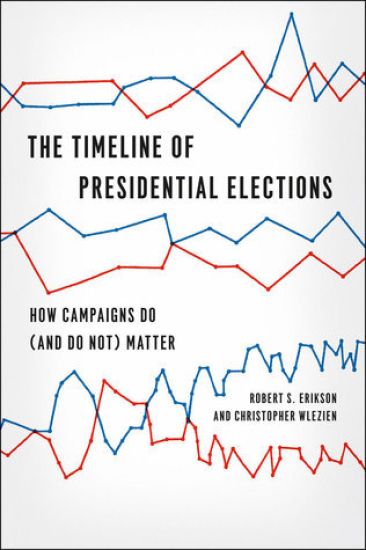
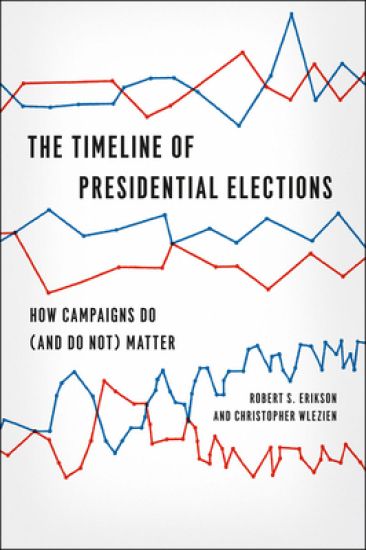
With the 2012 presidential election upon us, will voters cast their ballots for the candidates whose platforms and positions best match their own? Or will the race for the next president of the United States come down largely to who runs the most effective campaigning? It's a question those who study elections have been considering for years with no clear resolution. In "The Timeline of Presidential Elections", Robert S. Erikson and Christopher Wlezien reveal for the first time how both factors come into play. Erikson and Wlezien have amassed data from close to two thousand national polls covering every presidential election from 1952 to 2008, allowing them to see how outcomes take shape over the course of an election year. Polls from the beginning of the year, they show, have virtually no predictive power. By mid-April, when the candidates have been identified and matched in pollsters' trial heats, preferences have come into focus - and predicted the winner in eleven of the fifteen elections. But a similar process of forming favorites takes place in the last six months, during which voters' intentions change only gradually, with particular events - including presidential debates - rarely resulting in dramatic change. Ultimately, Erikson and Wlezien show that it is through campaigns that voters are made aware of - or not made aware of - fundamental factors like candidates' policy positions that determine which ticket will get their votes. In other words, fundamentals matter, but only because of campaigns. Timely and compelling, this book will force us to rethink our assumptions about presidential elections.
The Timeline of Presidential Elections – How Campaigns Do (and Do Not) Matter

The Timeline of Presidential Elections – How Campaigns Do (and Do Not) Matter

Robert S. Erikson; Christopher Wlezien

University of Chicago Press
2012
nidottu
With the 2012 presidential election upon us, will voters cast their ballots for the candidates whose platforms and positions best match their own? Or will the race for the next president of the United States come down largely to who runs the most effective campaigning? It's a question those who study elections have been considering for years with no clear resolution. In "The Timeline of Presidential Elections", Robert S. Erikson and Christopher Wlezien reveal for the first time how both factors come into play. Erikson and Wlezien have amassed data from close to two thousand national polls covering every presidential election from 1952 to 2008, allowing them to see how outcomes take shape over the course of an election year. Polls from the beginning of the year, they show, have virtually no predictive power. By mid-April, when the candidates have been identified and matched in pollsters' trial heats, preferences have come into focus - and predicted the winner in eleven of the fifteen elections. But a similar process of forming favorites takes place in the last six months, during which voters' intentions change only gradually, with particular events - including presidential debates - rarely resulting in dramatic change. Ultimately, Erikson and Wlezien show that it is through campaigns that voters are made aware of - or not made aware of - fundamental factors like candidates' policy positions that determine which ticket will get their votes. In other words, fundamentals matter, but only because of campaigns. Timely and compelling, this book will force us to rethink our assumptions about presidential elections.
Degrees of Democracy

Degrees of Democracy

Stuart N. Soroka; Christopher Wlezien

Cambridge University Press
2009
pokkari
This book develops and tests a 'thermostatic' model of public opinion and policy. The representation of opinion in policy is central to democratic theory and everyday politics. So too is the extent to which public preferences are informed and responsive to changes in policy. The coexistence of both 'public responsiveness' and 'policy representation' is thus a defining characteristic of successful democratic governance, and the subject of this book. The authors examine both responsiveness and representation across a range of policy domains in the United States, the United Kingdom, and Canada. The story that emerges is one in which representative democratic government functions surprisingly well, though there are important differences in the details. Variations in public responsiveness and policy representation responsiveness are found to reflect the 'salience' of the different domains and governing institutions - specifically, presidentialism (versus parliamentarism) and federalism (versus unitary government).
Degrees of Democracy

Degrees of Democracy

Stuart N. Soroka; Christopher Wlezien

Cambridge University Press
2009
sidottu
This book develops and tests a 'thermostatic' model of public opinion and policy. The representation of opinion in policy is central to democratic theory and everyday politics. So too is the extent to which public preferences are informed and responsive to changes in policy. The coexistence of both 'public responsiveness' and 'policy representation' is thus a defining characteristic of successful democratic governance, and the subject of this book. The authors examine both responsiveness and representation across a range of policy domains in the United States, the United Kingdom, and Canada. The story that emerges is one in which representative democratic government functions surprisingly well, though there are important differences in the details. Variations in public responsiveness and policy representation responsiveness are found to reflect the 'salience' of the different domains and governing institutions - specifically, presidentialism (versus parliamentarism) and federalism (versus unitary government).