Kirjojen hintavertailu – 12 903 724 kirjaa ja 27 kauppaa

Kirjailija

Cicero S. Vaucher

Kirjat ja teokset yhdessä paikassa: 4 kirjaa, julkaisuja vuosilta 2001–2011, suosituimpiin kuuluu Architectures for RF Frequency Synthesizers. Vertaile teosten hintoja ja tarkista saatavuus suomalaisista kirjakaupoista.

4 kirjaa

Kirjojen julkaisuvuodet: 2001–2011.

Architectures for RF Frequency Synthesizers

Architectures for RF Frequency Synthesizers

Cicero S. Vaucher

Springer-Verlag New York Inc.
2011
nidottu
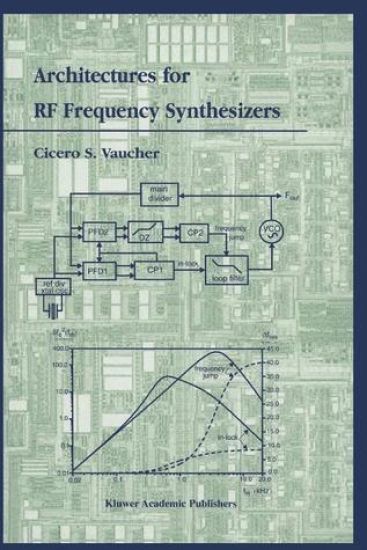
Frequency synthesizers are an essential building block of RF communication products. They can be found in traditional consumer products, in personal communication systems, and in optical communication equipment. Since frequency synthesizers are used in many different applications, different performance aspects may need to be considered in each case. The main body of the text describes a conceptual framework for analyzing the performance of PLL frequency synthesizers, and presents optimization procedures for the different performance aspects. The analysis of the PLL properties is performed with the use of the open-loop bandwidth and phase margin concepts, to enable the influence of higher-order poles to be taken into account from the beginning of the design process. The theoretical system analysis is complemented by descriptions of innovative system and building block architectures, by circuit implementations in bipolar and CMOS technologies, and by measurement results. Architectures for RF Frequency Synthesizers contains basic information for the beginner as well as in-depth knowledge for the experienced designer. It is widely illustrated with practical design examples used in industrial products.
Circuit Design for RF Transceivers

Circuit Design for RF Transceivers

Domine Leenaerts; J. van der Tang; Cicero S. Vaucher

Springer-Verlag New York Inc.
2011
nidottu
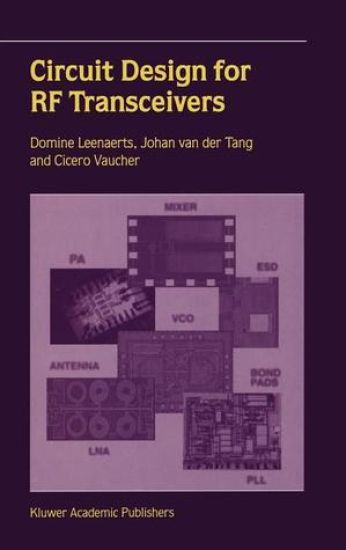
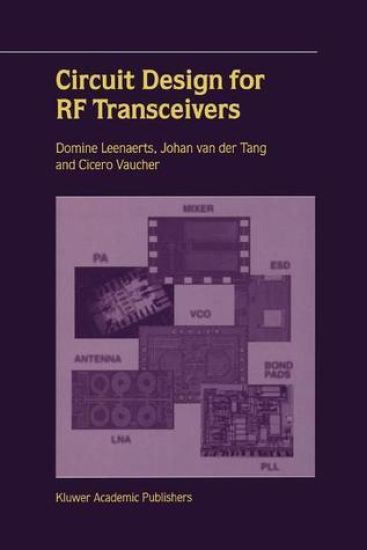
Circuit Design for RF Transceivers covers key building blocks which are needed to make an integrated transceiver for wireless and cellular applications, that is low-noise amplifiers, mixers, voltage controlled oscillators, RF power amplifiers and phase-locked loop systems. Starting from detailed RF concepts and specifications, the authors discuss the circuits in detail and provide solutions to many design problems. The circuits are implemented in a wide range of modern technology processes. Production requirements are taken into account, and measurement results are presented and discussed. Several of the presented circuits are used in IC products. The text also includes several RF technologies (for example double-poly, Silicon-on-Anything, SiGe-bipolar, RF-CMOS, etc.) and microwave design techniques, such as transmission line concepts. In addition, the problem of connecting the RF signals on-chip to the PCB and to the antenna will be discussed, including the influence of the package, ESD and bond pads. The contents of Circuit Design for RF Transceivers 2nd edition are based on research activities carried out at Philips Research. Many internal and external publications contributed to make the presented material state-of-the-art. The book is written for people who have a basic knowledge of analogue IC design. The second edition of this successful 2001 RF Circuit Design book has been updated, latest technology reviews have been added as well as several actual case studies. Due to the authors being active in industry as well as academia, this should prove to be an essential guide on RF Transceiver Design for students and engineers.
Architectures for RF Frequency Synthesizers

Architectures for RF Frequency Synthesizers

Cicero S. Vaucher

Springer-Verlag New York Inc.
2002
sidottu
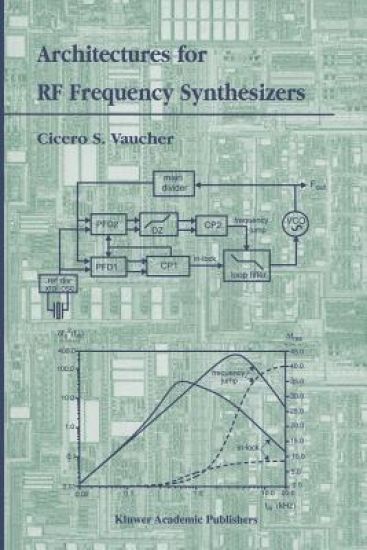
Frequency synthesizers are an essential building block of RF communication products. They can be found in traditional consumer products, in personal communication systems, and in optical communication equipment. Since frequency synthesizers are used in many different applications, different performance aspects may need to be considered in each case. The main body of the text describes a conceptual framework for analyzing the performance of PLL frequency synthesizers, and presents optimization procedures for the different performance aspects. The analysis of the PLL properties is performed with the use of the open-loop bandwidth and phase margin concepts, to enable the influence of higher-order poles to be taken into account from the beginning of the design process. The theoretical system analysis is complemented by descriptions of innovative system and building block architectures, by circuit implementations in bipolar and CMOS technologies, and by measurement results. Architectures for RF Frequency Synthesizers contains basic information for the beginner as well as in-depth knowledge for the experienced designer. It is widely illustrated with practical design examples used in industrial products.
Circuit Design for RF Transceivers

Circuit Design for RF Transceivers

Domine Leenaerts; J. van der Tang; Cicero S. Vaucher

Springer
2001
sidottu
Circuit Design for RF Transceivers covers key building blocks which are needed to make an integrated transceiver for wireless and cellular applications, that is low-noise amplifiers, mixers, voltage controlled oscillators, RF power amplifiers and phase-locked loop systems. Starting from detailed RF concepts and specifications, the authors discuss the circuits in detail and provide solutions to many design problems. The circuits are implemented in a wide range of modern technology processes. Production requirements are taken into account, and measurement results are presented and discussed. Several of the presented circuits are used in IC products. The text also includes several RF technologies (for example double-poly, Silicon-on-Anything, SiGe-bipolar, RF-CMOS, etc.) and microwave design techniques, such as transmission line concepts. In addition, the problem of connecting the RF signals on-chip to the PCB and to the antenna will be discussed, including the influence of the package, ESD and bond pads. The contents of Circuit Design for RF Transceivers 2nd edition are based on research activities carried out at Philips Research. Many internal and external publications contributed to make the presented material state-of-the-art. The book is written for people who have a basic knowledge of analogue IC design. The second edition of this successful 2001 RF Circuit Design book has been updated, latest technology reviews have been added as well as several actual case studies. Due to the authors being active in industry as well as academia, this should prove to be an essential guide on RF Transceiver Design for students and engineers.