Kirjojen hintavertailu – 12 903 725 kirjaa ja 27 kauppaa

Kirjailija

Clara Sue Kidwell

Kirjat ja teokset yhdessä paikassa: 9 kirjaa, julkaisuja vuosilta 1997–2019, suosituimpiin kuuluu A Native American Theology. Vertaile teosten hintoja ja tarkista saatavuus suomalaisista kirjakaupoista.

Nimi esiintyy myös muodoissa: Clara-Sue Kidwell

9 kirjaa

Kirjojen julkaisuvuodet: 1997–2019.

Native American Knowledge Systems

Native American Knowledge Systems

Clara-Sue Kidwell

Balestier Press
2019
pokkari
Every culture has some system of knowledge to explain its place in the world. Some of these systems are more complex than others, but each has an internal consistency based on what people have experienced. Some cultures have been characterized as "savage," or "primitive" and have been considered as inferior by other cultures. Some cultures have become highly "scientific," based on certain accepted practices of controlling their environments. This book presents examples from cultures in Mesoamerica and North America of different ways of seeing the world. These examples may inspire readers to examine their own ways of knowing. Clara Sue Kidwell has served as associate dean for program development at Bacone college in Muskogee, Oklahoma (2011-2013), director of the American Indian Center at the University of North Carolina at Chapel Hill (2007-2011), and director of the Native American Studies program and Professor of History at the University of Oklahoma in Norman (1995- 2007). Her tribal affiliations are Choctaw and Chippewa. She received Ph. D. in History of Science from the University of Oklahoma. Before joining the faculty there in 1995 she served for two years as Assistant Director of Cultural Resources at the National Museum of the American Indian, Smithsonian Institution. Her publications include Choctaws and Missionaries in Mississippi, 1818-1918, A Native American Theology, co-authored with Homer Noley and George Tinker, Native American Studies co-authored with Alan Velie, and The Choctaws in Oklahoma: From Tribe to Nation, 1855-1970.
Ruling Pine Ridge

Ruling Pine Ridge

Akim D. Reinhardt; Clara Sue Kidwell

Texas Tech Press,U.S.
2009
nidottu
Incorporating previously overlooked materials, including tribal council records, oral histories, and reservation newspapers, ""Ruling Pine Ridge"" explores the political history of South Dakotas Oglala Lakota reservation during the mid-twentieth century. Akim D. Reinhardt examines the reservations transition from the direct colonialism of the pre-1934 era to the indirect colonial policies of the controversial Indian Reorganization Act (IRA) and the advent of the tribal council governing system still in place today on Pine Ridge and on many other reservations. Reinhardt demonstrates how conflicting political values foregrounded by the new governing format led to an aggravation of social divisions on the reservation and eventually came to a head in 1973 with the occupation and siege of Wounded Knee. The siege is best understood, he claims, not as a political stunt of the American Indian Movement (AIM) but as a spontaneous, grassroots protest at least forty years in the making.
The Choctaws in Oklahoma

The Choctaws in Oklahoma

Clara Sue Kidwell; Lindsay G. Robertson

University of Oklahoma Press
2008
nidottu
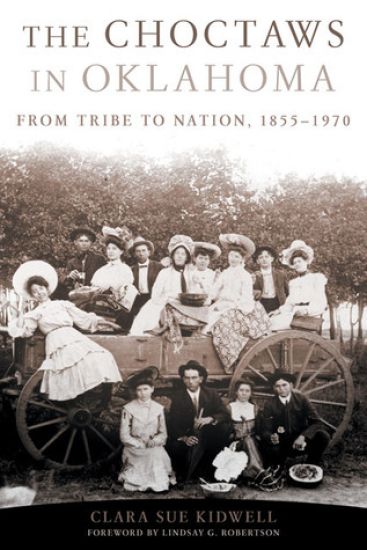
Volume 2 in the American Indian Law and Policy SeriesThe Choctaws in Oklahoma begins with the Choctaws' removal from Mississippi to Indian Territory in the 1830s and then traces the history of the tribe's subsequent efforts to retain and expand its rights and to reassert tribal sovereignty in the late twentieth century. As Clara Sue Kidwell tells it, the Choctaws' story illuminates a key point in contemporary scholarship on the history of American Indians: that they were not passive victims of colonization and did not assimilate quietly into American society. Adapting to the very structures imposed on them by their colonizers, tribal politicians quickly learned to use the rhetoric of dependency on the government, but they also demanded justice in the form of fulfillment of their treaty rights. Adroitly negotiating with the United States, the Choctaws have created the Choctaw Nation that exists today.
Ruling Pine Ridge

Ruling Pine Ridge

Akim D. Reinhardt; Clara Sue Kidwell

Texas Tech Press,U.S.
2007
sidottu
Reinhardt furnishes revealing portraits of Gerald One Feather, Dick Wilson, Russell Means; he offers a telling indictment of Pine Ridges economy. He is one of the few historians who understands the distinction DArcy McNickle made decades ago between loss and defeat. He and the late Vine Deloria, Jr. would have welcomed this volume because of its thorough research and, above all, its unflinching honesty. Writing in 1970 Deloria called for historians to bring historical consciousness to the whole Indian story. ""Ruling Pine Ridge"" achieves that goal. It will be required reading for all who care about not only the indigenous past but as well its connection to the problems of the present and the challenges of the 21st century. Peter Iverson, author of ""Din: A History of the Navajos"". Incorporating previously overlooked materials, including tribal council records, oral histories, and reservation newspapers, ""Ruling Pine Ridge"" explores the political history of South Dakotas Oglala Lakota reservation during the mid-twentieth century. Akim D. Reinhardt examines the reservations transition from the direct colonialism of the pre-1934 era to the indirect colonial policies of the controversial Indian Reorganization Act (IRA). The new federal approach to Indian politics was evident in the advent of the tribal council governing system, which is still in place today on Pine Ridge and on many other reservations. While the structure of the reservations governing body changed dramatically to reflect mainstream American cultural values, certain political equations on the reservation changed very little. In particular, despite promises to the contrary, the new reservation governments authority was still severely constrained by the Bureau of Indian Affairs. In addition, the new governing format led to an aggravation of social divisions on the reservation. Reinhardt then examines the period of 1968-1973, showing that many of the political players on the reservation had changed, and although the tribal council system was well established by this point, deep dissatisfaction with the IRA government persisted on Pine Ridge. This longstanding unhappiness came to a head in 1973, with the occupation and siege of Wounded Knee. Reinhardt demonstrates that the siege is best understood not as a political stunt of the American Indian Movement (AIM), but as a spontaneous, grassroots protest that was at least forty years in the making.
Native American Studies

Native American Studies

Clara Sue Kidwell; Alan Velie

University of Nebraska Press
2005
nidottu
This guide to Native American history and culture outlines new ways of understanding American Indian cultures in contemporary contexts. Native American Studies covers key issues such as the intimate relationship of culture to land; the nature of cultural exchange and conflict in the period after European contact; the unique relationship of Native communities with the United States government; the significance of language; the vitality of contemporary cultures; and the variety of Native artistic styles, from literature and poetry to painting and sculpture to performance arts. This thematic approach places history, culture, and intellectual production in the contexts of politics and power. Using specific examples throughout the book, the authors portray the culture of Native Americans from the viewpoints of Native people as well as from those of non-Native Americans.
Native American Studies

Native American Studies

Clara Sue Kidwell; Alan Velie

Edinburgh University Press
2005
nidottu
This guide to Native American history and culture outlines new ways of understanding American Indian cultures in contemporary contexts. The book covers the key issues of: * The intimate relationship of culture to land. * The nature of cultural contact and conflict in the period after European contact. * The unique relationship that Native communities have with the United States government. * The significance of language. * The vitality of contemporary cultures and the variety of artistic styles, from literature and poetry to painting and sculpture to performance arts. This thematic approach places history, culture and intellectual production in the contexts of politics and power. Using specific examples throughout, the culture of Native Americans is seen from the point of views of Native people as well as from the points of view of Europe and the United States. Features * New approach to the subject. * Argument shaped by interaction with Native scholars and members of Native communities. * Draws on work of historians, anthropologists, ethnographers, literary critics and art historians. * Literature survey with assessment of sources and detailed bibliography. * Includes 18 colour plates. Why not subscribe to the Journal of Transatlantic Studies? http://www.eup.ed.ac.uk/journals/content.aspx?pageId=1&journalId=12157" for details.
Native American Studies

Native American Studies

Clara Sue Kidwell; Alan Velie

Edinburgh University Press
2005
sidottu
This guide to Native American history and culture outlines new ways of understanding American Indian cultures in contemporary contexts. The book covers the key issues of: * The intimate relationship of culture to land. * The nature of cultural contact and conflict in the period after European contact. * The unique relationship that Native communities have with the United States government. * The significance of language. * The vitality of contemporary cultures and the variety of artistic styles, from literature and poetry to painting and sculpture to performance arts. This thematic approach places history, culture and intellectual production in the contexts of politics and power. Using specific examples throughout, the culture of Native Americans is seen from the point of views of Native people as well as from the points of view of Europe and the United States. Features * New approach to the subject. * Argument shaped by interaction with Native scholars and members of Native communities. * Draws on work of historians, anthropologists, ethnographers, literary critics and art historians. * Literature survey with assessment of sources and detailed bibliography. * Includes 18 colour plates. Why not subscribe to the Journal of Transatlantic Studies? http://www.eup.ed.ac.uk/journals/content.aspx?pageId=1&journalId=12157" for details.
A Native American Theology

A Native American Theology

Clara Sue Kidwell

Orbis Books (USA)
2001
nidottu
This collaborative work represents a pathbreaking exercise in Native American theology. While observing traditional categories of Christian systematic theology (Creation, Deity, Christology, etc.), each of these is reimagined consistent with Native experience, values, and worldview. At the same time the authors introduce new categories from Native thought-worlds, such as the Trickster (eraser of boundaries, symbol of ambiguity), and Land. Finally, the authors address issues facing Native Americans today, including racism, poverty, stereotyping, cultural appropriation, and religious freedom.
Choctaws and Missionaries in Mississippi, 1818-1918

Choctaws and Missionaries in Mississippi, 1818-1918

Clara Sue Kidwell

University of Oklahoma Press
1997
nidottu
The present-day Choctaw communities in central Mississippi are a tribute to the ability of the Indian people both to adapt to new situations and to find refuge against the outside world through their uniqueness. Clara Sue Kidwell, whose great-great-grandparents migrated from Mississippi to Indian Territory along the Trail of Tears in 1830, here tells the story of those Choctaws who chose not to move but to stay behind in Mississippi. As Kidwell shows, their story is closely interwoven with that of the missionaries who established the first missions in the area in 1818. While the U. S. government sought to ""civilize"" Indians through the agency of Christianity, many Choctaw tribal leaders in turn demanded education from Christian missionaries. The missionaries allied themselves with these leaders, mostly mixed-bloods; in so doing, the alienated themselves from the full-blood elements of the tribe and thus failed to achieve widespread Christian conversion and education. Their failure contributed to the growing arguments in Congress and by Mississippi citizens that the Choctaws should be move to the West and their territory opened to white settlement. The missionaries did establish literacy among the Choctaws, however, with ironic consequences. Although the Treaty of Dancing Rabbit Creek in 1830 compelled the Choctaws to move west, its fourteenth article provided that those who wanted to remain in Mississippi could claim land as individuals and stay in the state as private citizens. The claims were largely denied, and those who remained were often driven from their lands by white buyers, yet the Choctaws maintained their communities by clustering around the few men who did get title to lands, by maintaining traditional customs, and by continuing to speak the Choctaw language. Now Christian missionaries offered the Indian communities a vehicle for survival rather than assimilation.