Kirjojen hintavertailu – 12 903 725 kirjaa ja 27 kauppaa

Kirjailija

Clara Weinhardt

Kirjat ja teokset yhdessä paikassa: 3 kirjaa, julkaisuja vuosilta 2019–2024, suosituimpiin kuuluu The Unmaking of Special Rights. Vertaile teosten hintoja ja tarkista saatavuus suomalaisista kirjakaupoista.

3 kirjaa

Kirjojen julkaisuvuodet: 2019–2024.

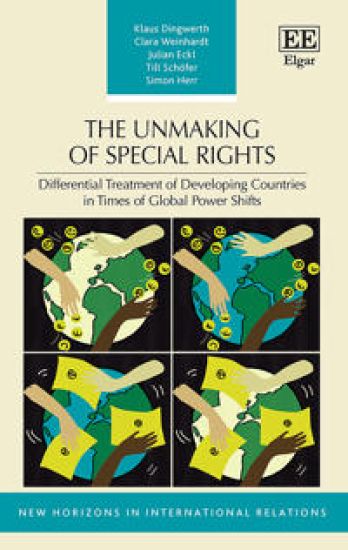
The Unmaking of Special Rights

The Unmaking of Special Rights

Klaus Dingwerth; Clara Weinhardt; Julian Eckl; Till Schöfer; Simon Herr

EDWARD ELGAR PUBLISHING LTD
2024
sidottu
In light of recent significant changes to the global order, The Unmaking of Special Rights explores an often-forgotten aspect of these power shifts: special rights for developing countries. Written by a group of esteemed experts, it analyzes when and how special rights for developing countries have evolved in the context of global power shifts. This informative book outlines how, since decolonization, several global regimes have granted ‘disadvantaged’ members exemptions, yet the rise of Brazil, India, China, and other countries has led to pressure to adjust these rights to new economic realities. Based on case studies in global trade, climate, and health governance, this groundbreaking book comparatively assesses the evolution of differential treatment across global governance, highlighting how treating all developing countries as a single group has gradually been replaced with a more nuanced approach. Chapters cover differentiated responsibilities in the climate regime, capacity, willingness and need in the health regime, and special and differential treatment in the World Trade Organization (WTO). For academics, researchers and students specializing in international economics, law and politics, international political economy, and public policy, this book will be a vital read. Providing in-depth comparative case studies, it will also be of interest to practitioners and policymakers working in international development organizations.

Negotiating Trade in Uncertain Worlds

Negotiating Trade in Uncertain Worlds

Clara Weinhardt

TAYLOR FRANCIS LTD
2021
nidottu
This book shows how a constructivist account of bargaining sheds new light on the emergence of impasse situations in international trade negotiations. It uncovers the subtle ways in which misperceptions – and the problems of overcoming them – complicate negotiations. It brings to the forefront misperceptions and sticky beliefs that complicate trade talks between the Global South and the Global North. Empirically, the book examines the recent negotiations of Economic Partnership Agreements between the European Union (EU) and West Africa (2002–2014). In doing so, it enriches the study of negotiations of development-oriented trade agreements in the context of a major North-South partnership. By exploring a constructivist perspective on game theory, the author uncovers how the repeated impasse situations followed from the different "games" both sides expected to be playing. The author shows that such misperceptions endured because they reflected deep-seated normative disagreements not only over the effects of neo-liberal trade reforms, but also over how to structure EU – Africa post-colonial trade relations in the 21st century. Comparing and contrasting both sides’ divergent perspectives helps us to see how trade negotiations are never just about economic interests, but also about the (re)negotiation of the values and ideas that structure state interaction. The book draws on a large set of qualitative primary data on EU-West Africa trade negotiations. Negotiating trade in uncertain worlds will be of great interest to students and scholars of international relations, international political economy, international trade, international negotiations, EU external relations, EU-Africa cooperation, economic diplomacy, international relations of the developing world, and North-South cooperation.
Negotiating Trade in Uncertain Worlds

Negotiating Trade in Uncertain Worlds

Clara Weinhardt

Routledge
2019
sidottu
This book shows how a constructivist account of bargaining sheds new light on the emergence of impasse situations in international trade negotiations. It uncovers the subtle ways in which misperceptions – and the problems of overcoming them – complicate negotiations. It brings to the forefront misperceptions and sticky beliefs that complicate trade talks between the Global South and the Global North. Empirically, the book examines the recent negotiations of Economic Partnership Agreements between the European Union (EU) and West Africa (2002–2014). In doing so, it enriches the study of negotiations of development-oriented trade agreements in the context of a major North-South partnership. By exploring a constructivist perspective on game theory, the author uncovers how the repeated impasse situations followed from the different "games" both sides expected to be playing. The author shows that such misperceptions endured because they reflected deep-seated normative disagreements not only over the effects of neo-liberal trade reforms, but also over how to structure EU – Africa post-colonial trade relations in the 21st century. Comparing and contrasting both sides’ divergent perspectives helps us to see how trade negotiations are never just about economic interests, but also about the (re)negotiation of the values and ideas that structure state interaction. The book draws on a large set of qualitative primary data on EU-West Africa trade negotiations. Negotiating trade in uncertain worlds will be of great interest to students and scholars of international relations, international political economy, international trade, international negotiations, EU external relations, EU-Africa cooperation, economic diplomacy, international relations of the developing world, and North-South cooperation.