Kirjojen hintavertailu – 12 903 724 kirjaa ja 27 kauppaa

Kirjailija

Claus Kiefer

Kirjat ja teokset yhdessä paikassa: 7 kirjaa, julkaisuja vuosilta 2003–2025, suosituimpiin kuuluu Gravitationswellen. Vertaile teosten hintoja ja tarkista saatavuus suomalaisista kirjakaupoista.

7 kirjaa

Kirjojen julkaisuvuodet: 2003–2025.

Quantum Gravity

Quantum Gravity

Claus Kiefer

Oxford University Press
2025
sidottu
The description of Nature in physics currently falls into two parts: the microscopic and the macroscopic. The microscopic world (molecules, atoms, particles) is described by quantum theory, whereas the macroscopic world (planets, stars, galaxies, universe) is ruled by a classical interaction - gravity - that is described by Einstein's theory of general relativity. This book describes in detail the attempts to unify quantum theory and relativity, which are essential to understanding the origin of the Universe and the final fate of black holes. The construction of a consistent quantum theory is among the most important open problems in fundamental physics. This book describes the motivation for constructing such a theory and presents the main approaches. These approaches include covariant quantization, canonical quantization (metric and loop approaches), and string theory. The book also covers the main applications, which include black holes and cosmology. This new edition includes updated content throughout, as well as further explorations of the holographic principle, unimodular gravity, quantum-gravitational correction terms, and possible observations, as these are topics that have experienced important developments since the last edition.
Gravitationswellen

Gravitationswellen

Domenico Giulini; Claus Kiefer

Springer Spektrum
2016
nidottu
100 Jahre nach Einsteins Arbeit zur Relativitätstheorie ist der Beweis für die Existenz von Gravitationswellen eine Sensation. Die angesehenen Wissenschaftler Domenico Giulini und Claus Kiefer geben in diesem essential einen kompakten Überblick über dieses Phänomen der theoretischen Physik und über die indirekten und die kürzlich gelungenen direkten Nachweise von Gravitationswellen. Vorhergesagt durch die Allgemeine Relativitätstheorie, entstehen sie in hochenergetischen astrophysikalischen Prozessen und liefern wertvolle Informationen über Supernovae und die Kollision schwarzer Löcher. Ausgehend von der ersten Detektion besitzt die Menschheit mit diesen Erkenntnissen „ein neues Fenster“ ins Universum, dass die Forschung noch lange beschäftigen wird.
Quantum Gravity

Quantum Gravity

Claus Kiefer

Oxford University Press
2012
sidottu
The search for a quantum theory of the gravitational field is one of the great open problems in theoretical physics. This book presents a self-contained discussion of the concepts, methods and applications that can be expected in such a theory. The two main approaches to its construction -- the direct quantisation of Einstein's general theory of relativity and string theory -- are covered. Whereas the first attempts to construct a viable theory for the gravitational field alone, string theory assumes that a quantum theory of gravity will be achieved only through a unification of all the interactions. However, both employ the general method of quantization of constrained systems, which is described together with illustrative examples relevant for quantum gravity. There is a detailed presentation of the main approaches employed in quantum general relativity: path-integral quantization, the background-field method and canonical quantum gravity in the metric, connection and loop formulations. The discussion of string theory centres around its quantum-gravitational aspects and the comparison with quantum general relativity. Physical applications discussed at length include the quantization of black holes, quantum cosmology, the indications of a discrete structure of spacetime, and the origin of irreversibility. This third edition contains new chapters or sections on quantum gravity phenomenology, Horava-Lifshitz quantum gravity, analogue gravity, the holographic principle, and affine quantum gravity. It will present updates on loop quantum cosmology, the LTB model, asymptotic safety, and various discrete approaches. The third edition also contains pedagogical extensions throughout the text. This book will be of interest to researchers and students working in relativity and gravitation, cosmology, quantum field theory and related topics. It will also be of interest to mathematicians and philosophers of science.
Decoherence and the Appearance of a Classical World in Quantum Theory

Decoherence and the Appearance of a Classical World in Quantum Theory

Erich Joos; H. Dieter Zeh; Claus Kiefer; Domenico J. W. Giulini; Joachim Kupsch; Ion-Olimpiu Stamatescu

Springer-Verlag Berlin and Heidelberg GmbH Co. K
2010
nidottu
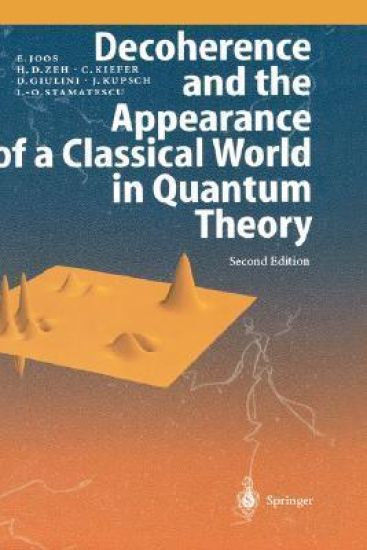
When we were preparing the first edition of this book, the concept of de­ coherence was known only to a minority of physicists. In the meantime, a wealth of contributions has appeared in the literature - important ones as well as serious misunderstandings. The phenomenon itself is now experimen­ tally clearly established and theoretically well understood in principle. New fields of application, discussed in the revised book, are chaos theory, informa­ tion theory, quantum computers, neuroscience, primordial cosmology, some aspects of black holes and strings, and others. While the first edition arose from regular discussions between the authors, thus leading to a clear" entanglement" of their otherwise quite different chap­ ters, the latter have thereafter evolved more or less independently. While this may broaden the book's scope as far as applications and methods are con­ cerned, it may also appear confusing to the reader wherever basic assumptions and intentions differ (as they do). For this reason we have rearranged the or­ der of the authors: they now appear in the same order as the chapters, such that those most closely related to the "early" and most ambitious concept of decoherence are listed first. The first three authors (Joos, Zeh, Kiefer) agree with one another that decoherence (in contradistinction to the Copen­ hagen interpretation) allows one to eliminate primary classical concepts, thus neither relying on an axiomatic concept of observables nor on a probability interpretation of the wave function in terms of classical concepts.
Decoherence and the Appearance of a Classical World in Quantum Theory

Decoherence and the Appearance of a Classical World in Quantum Theory

Erich Joos; H. Dieter Zeh; Claus Kiefer; Domenico J. W. Giulini; Joachim Kupsch; Ion-Olimpiu Stamatescu

Springer-Verlag Berlin and Heidelberg GmbH Co. K
2003
sidottu
When we were preparing the first edition of this book, the concept of de­ coherence was known only to a minority of physicists. In the meantime, a wealth of contributions has appeared in the literature - important ones as well as serious misunderstandings. The phenomenon itself is now experimen­ tally clearly established and theoretically well understood in principle. New fields of application, discussed in the revised book, are chaos theory, informa­ tion theory, quantum computers, neuroscience, primordial cosmology, some aspects of black holes and strings, and others. While the first edition arose from regular discussions between the authors, thus leading to a clear" entanglement" of their otherwise quite different chap­ ters, the latter have thereafter evolved more or less independently. While this may broaden the book's scope as far as applications and methods are con­ cerned, it may also appear confusing to the reader wherever basic assumptions and intentions differ (as they do). For this reason we have rearranged the or­ der of the authors: they now appear in the same order as the chapters, such that those most closely related to the "early" and most ambitious concept of decoherence are listed first. The first three authors (Joos, Zeh, Kiefer) agree with one another that decoherence (in contradistinction to the Copen­ hagen interpretation) allows one to eliminate primary classical concepts, thus neither relying on an axiomatic concept of observables nor on a probability interpretation of the wave function in terms of classical concepts.