Kirjailija
Clayton Crockett
Kirjat ja teokset yhdessä paikassa: 18 kirjaa, julkaisuja vuosilta 2001–2022, suosituimpiin kuuluu Deleuze Beyond Badiou. Vertaile teosten hintoja ja tarkista saatavuus suomalaisista kirjakaupoista.
18 kirjaa
Kirjojen julkaisuvuodet: 2001–2022.
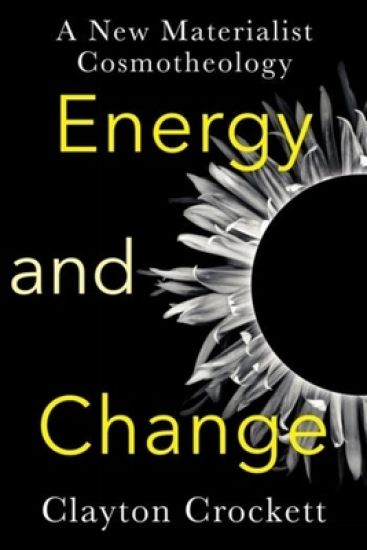
As humanity continues to consume planetary resources at an unsustainable rate, we require not only new and renewable forms of energy but also new ways of understanding energy itself. Clayton Crockett offers an innovative philosophy of energy that cuts across a number of leading-edge disciplines. Drawing from contemporary philosophies of New Materialism, non-Western traditions, and the sciences, he develops a comprehensive vision of energy as a material process spanning physics, biology, politics, ecology, and religion. Crockett argues that change is foundational to material reality, which is ceaselessly self-organizing. We can observe energy’s effects in the operations of natural selection as well as those at work in human societies. Matter and energy are not an oppositional binary; rather, they are expressions of how change functions in the universe. Ultimately, Crockett argues, we can conceive of God neither as a deity nor as a being but as the principle of change. Informed by cutting-edge theoretical discourses in thermodynamics, science studies, energy humanities, systems theory, continental philosophy, and radical theology, Energy and Change draws on theorists such as Gilles Deleuze, Catherine Malabou, Slavoj Žižek, Karen Barad, Bruno Latour, and Kojin Karatani as well as ideas about spirituality, society, and nature from Amerindian, Vodou, and Neo-Confucian traditions. A foundational work in New Materialist philosophy of religion, this book offers compelling new insights into the structure of the cosmos and our place in it.
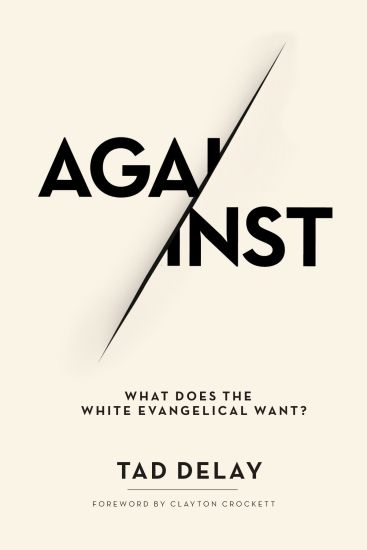
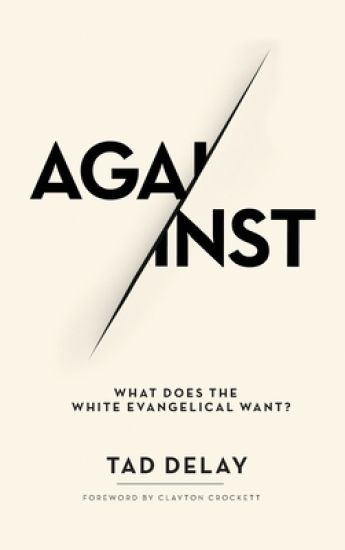
What does the white evangelical want? In our moment of crisis and rage, this question is everywhere. Scholars ask from where its desires emerged, pundits divine its political future, and the public asks how we lapsed into social chaos. For their part, white evangelicals feel misunderstood while failing to see the direction of their ambitions. We must interrogate its aims not only through its past or current trends but also through the various fantasies by which it rejects and enlivens reality. Against traces five zones of opposition: future, knowledge, sexuality, reality, and society. If climate change is the greatest threat civilization has ever faced, then a faith aiding collapse must face analysis. If it swims in assured forgiveness, it feels no shame for its sins against humanity. If it wants a king, it threatens democracy. If it veils xenophobia, it shall be ever more cruel. In a critical and accessible history of odd ideas, DeLay chronicles the past and sketches its troubling future. It might die, but what's certain is that a faith built on nostalgia and supremacy won't moderate. We live in dangerous times, so let us consider its justifications, turmoil, appetite, and catastrophe.
What are we to make of Jacques Derrida's famous claim that "every other is every other," if the other could also be an object, a stone or an elementary particle? Derrida's philosophy is relevant not just for human ethical language and animality, but to profound developments in the physical and natural sciences, as well as ecology. Derrida After the End of Writing argues for the importance of reading Derrida's later work from a new materialist perspective. In conversation with Heidegger, Lacan, and Deleuze, and critically engaging newer philosophies of speculative realism and object-oriented ontology, Crockett claims that Derrida was never a linguistic idealist. Furthermore, something changes in his later philosophy something that cannot be simply described as a "turn." In Catherine Malabou's terms, there is a shift from a motor scheme of writing to a motor scheme of plasticity. Crockett explores some of the implications of interpreting Derrida through the new materialist lens of technicity or plasticity, attending to the significance of ethics, religion, and politics in his later work. By reading Derrida from a new materialist perspective, Crockett provides fresh readings of his ideas of sovereignty, religion, responsibility, and mourning. These new readings produce fruitful engagements with the thinkers who have followed Derrida, including Malabou, Timothy Morton, John D. Caputo, and Karen Barad. Here is a new reading of Derrida that moves beyond conventional understandings of poststructuralism and deconstruction, a reading that is responsive to and critical of some of the crucial developments shaping the humanities today.
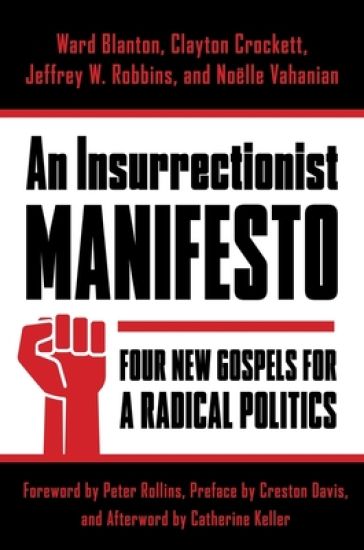
An Insurrectionist Manifesto
Ward Blanton; Clayton Crockett; Jeffrey Robbins; Noëlle Vahanian; Peter Rollins; Catherine Keller
Columbia University Press
2016
pokkari
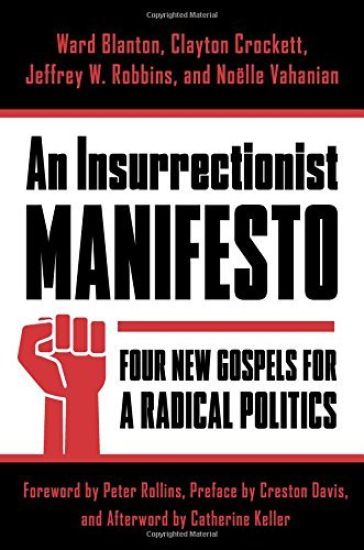
An Insurrectionist Manifesto contains four insurrectionary gospels based on Martin Heidegger's philosophical model of the fourfold: earth and sky, gods and mortals. Challenging religious dogma and dominant philosophical theories, they offer a cooperative, world-affirming political theology that promotes new life through not resurrection but insurrection. The insurrection in these gospels unfolds as a series of miraculous yet worldly practices of vital affirmation. Since these routines do not rely on fantasies of escape, they engender intimate transformations of the self along the very coordinates from which they emerge. Enacting a comparative and contagious postsecular sensibility, these gospels draw on the work of Slavoj Zizek, Giorgio Agamben, Catherine Malabou, Francois Laruelle, Peter Sloterdijk, and Gilles Deleuze yet rejuvenate scholarship in continental philosophy, critical race theory, the new materialisms, speculative realism, and nonphilosophy. They think beyond the sovereign force of the one to initiate a radical politics "after" God.
An Insurrectionist Manifesto
Ward Blanton; Clayton Crockett; Jeffrey Robbins; Noëlle Vahanian; Peter Rollins; Catherine Keller
Columbia University Press
2016
sidottu
An Insurrectionist Manifesto contains four insurrectionary gospels based on Martin Heidegger's philosophical model of the fourfold: earth and sky, gods and mortals. Challenging religious dogma and dominant philosophical theories, they offer a cooperative, world-affirming political theology that promotes new life through not resurrection but insurrection. The insurrection in these gospels unfolds as a series of miraculous yet worldly practices of vital affirmation. Since these routines do not rely on fantasies of escape, they engender intimate transformations of the self along the very coordinates from which they emerge. Enacting a comparative and contagious postsecular sensibility, these gospels draw on the work of Slavoj Zizek, Giorgio Agamben, Catherine Malabou, Francois Laruelle, Peter Sloterdijk, and Gilles Deleuze yet rejuvenate scholarship in continental philosophy, critical race theory, the new materialisms, speculative realism, and nonphilosophy. They think beyond the sovereign force of the one to initiate a radical politics "after" God.
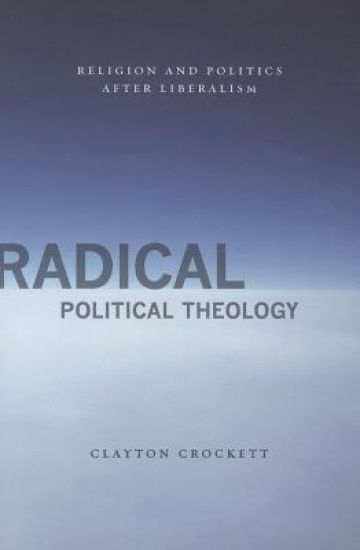
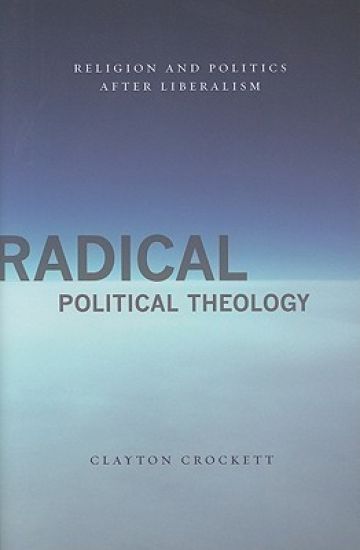
In the 1960s, the strict opposition between the religious and the secular began to break down, blurring the distinction between political philosophy and political theology. This collapse contributed to the decline of modern liberalism, which supported a neutral, value-free space for capitalism. It also deeply unsettled political, religious, and philosophical realms, forced to confront the conceptual stakes of a return to religion. Gamely intervening in a contest that defies simple resolutions, Clayton Crockett conceives of the postmodern convergence of the secular and the religious as a basis for emancipatory political thought. Engaging themes of sovereignty, democracy, potentiality, law, and event from a religious and political point of view, Crockett articulates a theological vision that responds to our contemporary world and its theo-political realities. Specifically, he claims we should think about God and the state in terms of potentiality rather than sovereign power. Deploying new concepts, such as Slavoj Zizek's idea of parallax and Catherine Malabou's notion of plasticity, his argument engages with debates over the nature and status of religion, ideology, and messianism. Tangling with the work of Derrida, Deleuze, Spinoza, Antonio Negri, Giorgio Agamben, Alain Badiou, John D. Caputo, and Catherine Keller, Crockett concludes with a reconsideration of democracy as a form of political thought and religious practice, underscoring its ties to modern liberal capitalism while also envisioning a more authentic democracy unconstrained by those ties.
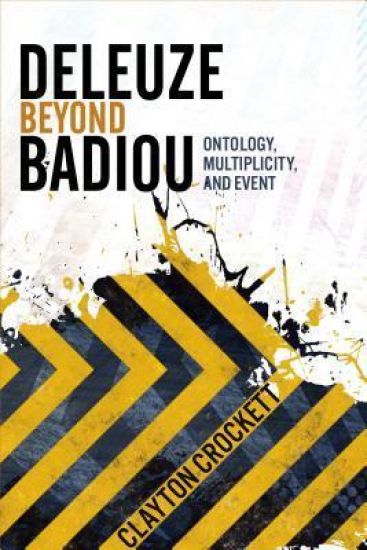
First published in 1997, Alain Badiou's Deleuze: The Clamor of Being cast Gilles Deleuze as a secret philosopher of the One. In this work, Clayton Crockett rehabilitates Deleuze's position within contemporary political and philosophical thought, advancing an original reading of the thinker's major works and a constructive conception of his philosophical ontology. Through close readings of Deleuze's Difference and Repetition, Capitalism and Schizophrenia (with Felix Guattari), and Cinema 2, Crockett argues that Deleuze is anything but the austere, quietistic, and aristocratic intellectual Badiou had portrayed. Instead, Crockett underscores Deleuze's radical aesthetics and innovative scientific, political, and mathematical forms of thought. He also refutes the notion Deleuze retreated from politics toward the end of his life. Using Badiou's critique as a foil, Crockett maintains the profound continuity of Deleuze's work and builds a general interpretation of his more obscure formulations.
In the 1960s, the strict opposition between the religious and the secular began to break down, blurring the distinction between political philosophy and political theology. This collapse contributed to the decline of modern liberalism, which supported a neutral, value-free space for capitalism. It also deeply unsettled political, religious, and philosophical realms, forced to confront the conceptual stakes of a return to religion. Gamely intervening in a contest that defies simple resolutions, Clayton Crockett conceives of the postmodern convergence of the secular and the religious as a basis for emancipatory political thought. Engaging themes of sovereignty, democracy, potentiality, law, and event from a religious and political point of view, Crockett articulates a theological vision that responds to our contemporary world and its theo-political realities. Specifically, he claims we should think about God and the state in terms of potentiality rather than sovereign power. Deploying new concepts, such as Slavoj Zizek's idea of parallax and Catherine Malabou's notion of plasticity, his argument engages with debates over the nature and status of religion, ideology, and messianism. Tangling with the work of Derrida, Deleuze, Spinoza, Antonio Negri, Giorgio Agamben, Alain Badiou, John D. Caputo, and Catherine Keller, Crockett concludes with a reconsideration of democracy as a form of political thought and religious practice, underscoring its ties to modern liberal capitalism while also envisioning a more authentic democracy unconstrained by those ties.
Plasticity at the Dusk of Writing
Catherine Malabou; Clayton Crockett
Columbia University Press
2009
sidottu
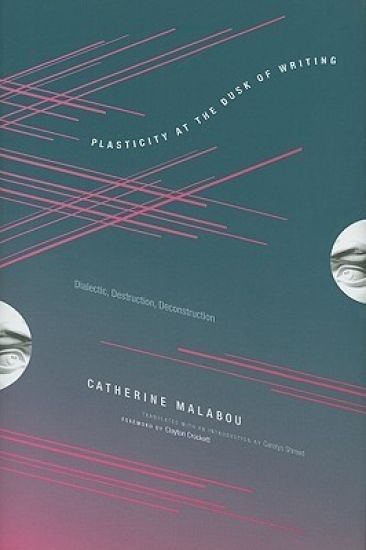
A former student and collaborator of Jacques Derrida, Catherine Malabou has generated worldwide acclaim for her progressive rethinking of postmodern, Derridean critique. Building on her notion of plasticity, a term she originally borrowed from Hegel's Phenomenology of Spirit and adapted to a reading of Hegel's own work, Malabou transforms our understanding of the political and the religious, revealing the malleable nature of these concepts and their openness to positive reinvention. In French to describe something as plastic is to recognize both its flexibility and its explosiveness-its capacity not only to receive and give form but to annihilate it as well. After defining plasticity in terms of its active embodiments, Malabou applies the notion to the work of Hegel, Heidegger, Levinas, Levi-Strauss, Freud, and Derrida, recasting their writing as a process of change (rather than mediation) between dialectic and deconstruction. Malabou contrasts plasticity against the graphic element of Derrida's work and the notion of trace in Derrida and Levinas, arguing that plasticity refers to sculptural forms that accommodate or express a trace. She then expands this analysis to the realms of politics and religion, claiming, against Derrida, that "the event" of justice and democracy is not fixed but susceptible to human action.
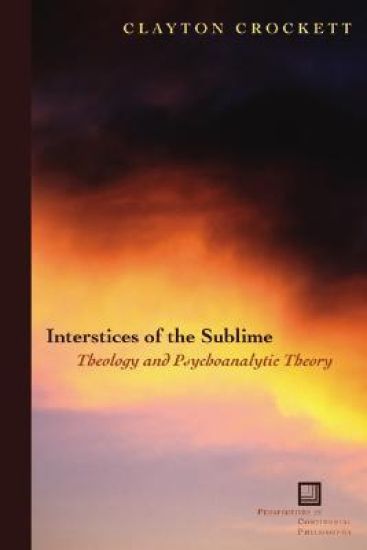
Interstices of the Sublime represents a powerful theological engagement with psychoanalytic theory in Freud, Lacan, Kristeva and Zizek, as well as major expressions of contemporary Continental philosophy, including Deleuze, Derrida, Marion, and Badiou. Through creative and constructive psycho-theological readings of topics such as sublimation, schizophrenia, God, and creation ex nihilo, this book contributes to a new form of radical theological thinking that is deeply involved in the world. Here the idea of the Kantian sublime is read into Freud and Lacan, and compared with sublimation. The sublime refers to a conflict of the Kantian faculties of reason and imagination, and involves the attempt to represent what is intrinsically unrepresentable. Sublimation, by contrast, involves the expression and partial satisfaction of primal desires in culturally acceptable terms. The sublime is negatively expressed in sublimation, because it is both the "source" of sublimation as well as that which resists being sublimated. That is, the Freudian sublime is related to the process of sublimation, but it also distorts or disrupts sublimation, and invokes what Lacan calls the Real. The effects of the sublime are not just psychoanalytic but, importantly, theological, because the sublime is the main form that "God" takes in the modern world. A radical postmodern theology attends to the workings of the sublime in our thinking and living, and provides resources to understand the complexity of reality. This book is one of the first sustained theological readings of Lacan in English.
How are we to think about religion and violence in the contemporary world, especially in the wake of the events of September 11, 2001? In this collection of essays, nearly a dozen scholars, including some of the leading voices in the field of academic religious thought, offer a theoretical and theological response to the 9/11 attacks as well as a broader and more interdisciplinary reflection on the issues surrounding religion and violence, politics and terrorism, in the world today. Drawing on Continental philosophy as a methodology, the contributors provide insights from and implications for the Western monotheistic traditions of Judaism and Christianity and their engagement with the secular world. Here, religion and secularity are understood not in opposition to one another but rather in interrelationship, religion being seen as both implicated in and providing resources for the overcoming of violence. Raising questions that are timely as well as urgent, ""Religion and Violence in a Secular World"" eschews easy solutions in an effort to foster critical and constructive attempts to understand these complex and ambivalent phenomena.
A Theology of the Sublime is the first major response to the influential and controversial Radical Orthodoxy movement. Clayton Crockett develops a constructive radical theology from the philosophy of Immanuel Kant - a philosophy attacked by Radical Orthodoxy - to show Kant's relevance to postmodern philosophy and contemporary theology.