Kirjojen hintavertailu – 12 903 735 kirjaa ja 27 kauppaa

Kirjailija

Cliff Lord

Kirjat ja teokset yhdessä paikassa: 8 kirjaa, julkaisuja vuosilta 2004–2025, suosituimpiin kuuluu Armed Forces of Aden and the Protectorate 1839-1967. Vertaile teosten hintoja ja tarkista saatavuus suomalaisista kirjakaupoista.

8 kirjaa

Kirjojen julkaisuvuodet: 2004–2025.

The Royal Corps of Signals

The Royal Corps of Signals

Cliff Lord; Graham Watson

HELION COMPANY
2025
nidottu
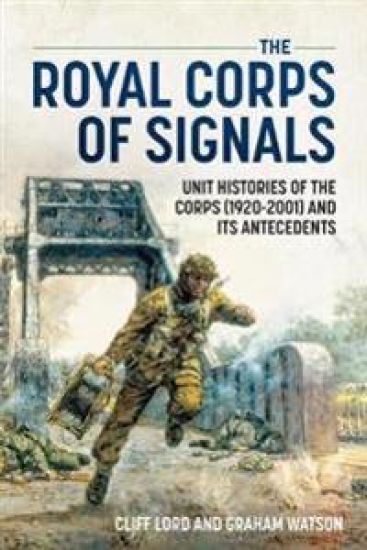
The ability to communicate is fundamental to success in both military and civilian life. Surprisingly, while most take communication for granted, few consider the immense complexity behind its achievement. This book provides a comprehensive insight into the Royal Corps of Signals, a cornerstone of the British Army's operational effectiveness since its inception in 1920. Expanding upon the original edition, this updated work traces the history of the Corps through to 2016, offering an in-depth perspective on its evolution alongside advancements in technology and military strategy. The Royal Corps of Signals has been instrumental in delivering secure, reliable, and innovative communication systems, adapting to the demands of modern warfare, peacekeeping, and humanitarian missions. Delving into unit histories rather than campaign narratives, this volume showcases the diversity and specialized roles of signal units, from the Golden Arrow Detachments of World War II to the high-tech communications supporting 21st-century expeditionary forces. It also highlights the Corps' contributions to signals intelligence, electronic warfare, and joint operations with allied forces. Richly illustrated with rare badges, photographs, and detailed unit histories from both Regular and Territorial units, this expanded edition is an invaluable resource for historians, genealogists, and military professionals. Whether exploring the Corps' roots in the Royal Engineers or its contemporary roles, the book underscores the Royal Signals' enduring motto: "Swift and Sure." This meticulously researched and extensively updated history is essential reading for anyone interested in the intricate art of military communication and its profound impact on operations and outcomes.

The Military and Police Forces of the Gulf States Volume 4
In January 1839, Captain S. B. Haines of the Indian Marine, the East India Company’s navy, occupied Aden, a magnificent natural harbour located at the junction of the Red Sea and the Indian Ocean. Britain recognised its strategic importance, and this began a period of rule which lasted until 29 of November 1967. When Britain left South Arabia in 1967 it marked the end of an era – it finalised the period of frontier-style soldiering. Over the 140 years of British control over Aden, and especially during the times this area was the British Protectorate of Aden, several local military services were established. As a consequence, all had a strong British flavour, as demonstrated by their doctrine, organisation, structure, ranks, uniforms, drill, equipment and other arrangements. Drawing upon interviews with veterans of the services involved, archival and museum research in Great Britain and the Gulf states, and support from several veteran’s associations, Military and Police Forces of the Gulf States, Volume 3, provides an organisational history of each service in pre-independence Aden, along with exclusive photographs, colour profiles and diagrams detailing the uniforms, badges, insignia and equipment of the various forces over the time period until Aden achieved independence in 1967.
The Military and Police Forces of the Gulf States Volume 3

The Military and Police Forces of the Gulf States Volume 3

Cliff Lord; David Birtles

Helion Company
2021
nidottu
The Military and Police Forces of the Gulf States, Volume 3, covers the military, police, and selected para-military services of Bahrain, Kuwait and Qatar from early 20th Century until 1980. Great Britain and these three states have had various mutual defence treaties since centuries. This resulted in establishment of very close ties between the British and the Sultan of Oman’s armed forces. Since 1920s, the British seconded and contract personnel served with the latter services through forming, leading, advising and training them.
The Armed Forces of the Gulf States

The Armed Forces of the Gulf States

Cliff Lord

Helion Company
2019
nidottu
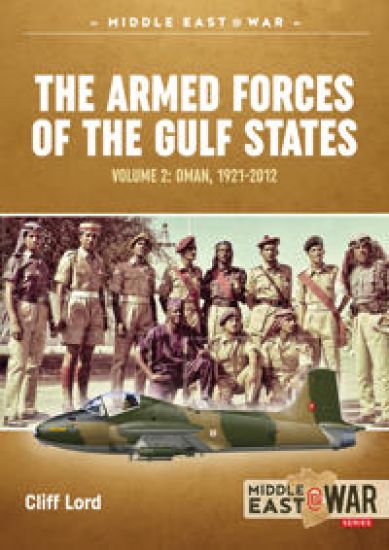
This book provides an overview of the military forces of Muscat & Oman and successor State of Oman. Britain and Oman have had various treaties over several centuries brought closer with Britain’s involvement in creating the Sultan’s Armed Forces. The book covers the Muscat Armed Forces and the Sultan’s Armed Forces of Oman, Dhofar Force, plus selected paramilitary forces and the Royal Oman Police Force. The narrative includes regimental and corps histories, and selected military operations. The book also details the contribution made by British seconded and contract personnel who have shaped these forces from the 1920s to the present, through forming, leading, advising and training them. Maps of the areas concerned are provided, along with a glossary of terms and a comprehensive time chart showing the dates of formation and disbandment of units, and if they were merged or reformed into new units. Many photographs are included showing the uniforms and a selection of badges and insignia. The work has been written by Cliff Lord and Dr Athol Yates. Cliff has had published a number of books including a history of the Armed Forces of Aden and the Protectorate, which in some respects is a lead on to this history. This book is a sister companion to The Armed Forces of the Smaller Gulf States also by Cliff Lord and Athol Yates.
The Military and Police Forces of the Gulf States Volume 1
This book provides an overview of the military forces, and their antecedents, of the Arabian Gulf States. Most were British Protected States, resulting in their armed forces being heavily influenced by the British military. The States are: Kuwait, Bahrain, Qatar, Oman and the United Arab Emirates and its constituent Emirates of (Abu Dhabi, Dubai, Ras Al Khaimah, Sharjah, Umm al Quwain, Ajman and Fujairah). Military forces include the Bahrain Levy Corps, Trucial Oman Levies, Trucial Oman Scouts, Union Defence Force, Federal Armed Force, Abu Dhabi Defence Force, Dubai Defence Force, Ras Al-Khaimah Mobile Force, Sharjah National Guard, Umm Al-Quwain National Guard and Sultan’s Armed Forces of Oman, plus selected paramilitary and police forces. This narrative includes historical information regarding the various states and enables the reader to understand easily how the various militaries have evolved. The military forces mainly evolved from Emiri (princely) and city guards into competent military organisations with some of the world most sophisticated military technology. British seconded and contract officers and men shaped these forces through establishing, leading, advising and training them. Maps of the areas concerned are provided, along with a glossary of terms and many ORBATs in diagrammatical form. Historical overviews and military history of the forces is provided along with regimental histories for Oman. Scores of photographs are included showing the uniforms and a selection of badges and insignia. The work has been written by Cliff Lord and Dr Athol Yates. Cliff has had published a number of books including a history of the Armed Forces of Aden and the Protectorate, which in some respects is a lead on to this history. Dr Athol Yates is Assistant Professor at Al Khalifa University in Abu Dhabi and specialises in military history and security. The authors have a wealth of photographs and information from interviews with veterans of many of the forces included, and help from the Trucial Oman Scouts Association, Sultan’s Armed Forces Association, and have had access to archival and museum research in Britain and the Gulf States.
The Royal Corps of Signals

The Royal Corps of Signals

Cliff Lord

Helion Company
2013
nidottu
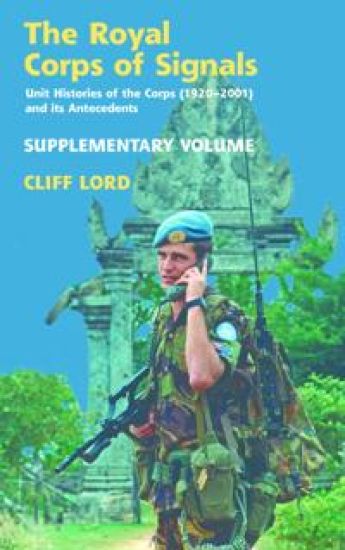
With the interest shown in The Royal Corps of Signals: Unit Histories of the Corps (1920-2001) and its Antecedents (Helion, 2003), it was decided to extend the work to include some of the principal Commonwealth Signal Corps, and to provide supplemental data regarding British Signals that has come to light since the original volume was published. The book concentrates on Commonwealth signal corps unit histories for the following countries: Australia, Canada, India, New Zealand, Nigeria, Pakistan, Rhodesia, Singapore, and South Africa. The emphasis is post Second World War so as not to rewrite the official histories already published. A brief overview is also given of each country’s Corps history, and illustrations of many of the unit’s distinctive insignia are shown. Supplementary information is included on Ceylon in the Second World War, and British Signal units that served in Northern and Southern Russia after the end of the First World War, Royal Engineer Signal Service Volunteers in 1918, and Air Formation Signals. This collection of individual signal unit histories will not only be of interest to those that served in them and their families, but will assist researchers of military history. Signals provide the nervous system of any army, and without good communications there can be no success on the battlefield. Signals not only provide tactical communications within their formation but strategic communications linking Headquarters with Headquarters around the world, and with allies. More and more technology is determining the outcome of conflict. More and more the importance of Signals is being understood. Today the close liaison between Headquarters, Intelligence and Signals is ever more obvious, while the boundaries between the Staff, Intelligence Corps and Signals is ever more blurred. The challenge of Information Technology is being accepted and integrated into the way signals do business, and in progressive Corps it is having a profound effect on the way they operate and think. They are the silent elite. About the Author Cliff Lord was a cipher operator in Britain's Royal Signals during the 1960s, serving in England and Germany and on active service in South Arabia. He is Honorary Historian for the Royal New Zealand Corps of Signals. Cliff is coauthor of numerous books and articles on military history. The books include: Swift and Sure: A History of the Royal New Zealand Corps of Signals and Army Signalling in New Zealand, New Zealand Army Distinguishing Patches 1911-1991 (2 vols), The Armed Forces of Aden 1831-1967, ANZAC Elite: The Airborne& Special Forces Insignia of Australia & New Zealand, and The Royal Corps of Signals: Unit Histories of the Corps (1920-2001) and its Antecedents. Cliff is a Team Leader at the Southern Cross Cable Network Operations Centre, Auckland, which is run by Telecom New Zealand.
Armed Forces of Aden and the Protectorate 1839-1967

Armed Forces of Aden and the Protectorate 1839-1967

David Birtles; Cliff Lord

Helion Company
2012
nidottu
In January 1839 Captain S. B. Haines of the Indian Marine, the East India Company's Navy, occupied the port of Aden. Possessing a magnificent natural harbour at the junction of the Red Sea and the Indian Ocean, Britain recognised its strategic importance and thus began a period of British control which lasted until 29th November 1967. This book presents an updated and expanded record of the mainly Arab armed forces raised in Aden and the Protectorate during the time of British control. Not only are brief historical details provided for each unit but details of insignia and uniform are included, and the book is brought to life by Jonathan Paynter’s superb colour uniform illustrations. It includes over 220 black and white photographs and 11 pages of colour photos, 5 pages of colour uniform plates as well as further information on the Armed Forces and awards. New information is to be found on the Lahej Trained Forces and Mukalla Regular Army and other forces. H. H. Sultan Ghalib II has provided access to his personal collection of photographs which provide an exceptional insight into the Eastern Aden Protectorate and former FRA/SAA Sgt. Tony Ford provided access to hundreds of colour photographs. About the Authors Cliff Lord served as a cipher Operator in 15 Signal Regiment, Aden, during 1967. After leaving the Army, he worked for the Washington Post before joining Air New Zealand Network Control. The late David Birtles joined Royal Signals after a few years in the Merchant Navy. He served in Aden in 1960 including time with the Aden Protectorate Levies.
The Royal Corps of Signals

The Royal Corps of Signals

Cliff Lord; Graham Watson

Helion Company
2004
nidottu
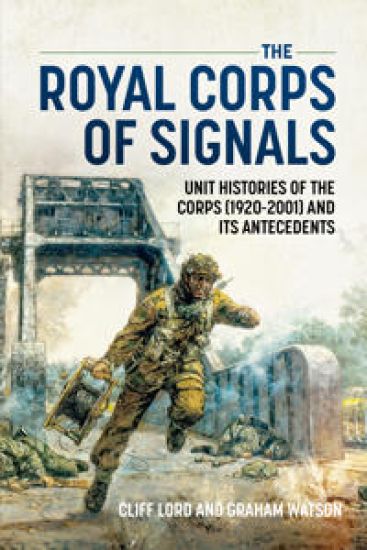
The ability to communicate is a prerequisite for success both in military and civil life. Surprisingly, everyone expects access to communications, but rarely wonders how it is achieved. The purpose of this book is to bring into focus one of the cornerstones of the success of the British Army, and to provide an insight into the complexity and diversity of the Royal Corps of Signals. This is done, not by narrative, but by delving into unit history rather than campaign history, thus offering a different perspective for the historian. Royal Signals is one of the largest Corps in the British Army, and consists of a body of very highly trained and dedicated personnel to manage, operate, and repair the advanced technology that is theirs to administer. Signals are the Invisible Elite, without them there is no victory. Before the independent Corps of Signals was formed in 1920, Royal Engineers provided communications for much of the Army. Details of their signal units are included. Reflecting the new technologies as they occur, the reader will see the new signal units being raised to facilitate the exigencies of the time. For example, during the Second World War the Golden Arrow Detachments were created as independent, mobile, high-speed transmitting and receiving stations to provide links to Britain, and thus provide High Command with the information from Commanders in the Field that was desperately needed. These units also passed intercepted enemy signals back to England for the code breakers at Bletchley Park. Other specialist Signal units were created for Air Support, Para Signals, Commandos, Interception, Fixed Communications, Peace-keeping and a multitude of other reasons. In today's changing world signals continue to get their message through - Swift and Sure. A paperback reprint of this critically-acclaimed title.