Kirjojen hintavertailu – 12 859 828 kirjaa ja 27 kauppaa

Kirjailija

Clifford Shearing

Kirjat ja teokset yhdessä paikassa: 8 kirjaa, julkaisuja vuosilta 2006–2019, suosituimpiin kuuluu Imagining Security. Vertaile teosten hintoja ja tarkista saatavuus suomalaisista kirjakaupoista.

8 kirjaa

Kirjojen julkaisuvuodet: 2006–2019.

Security Governance, Policing, and Local Capacity

Security Governance, Policing, and Local Capacity

Jan Froestad; Clifford Shearing

Routledge
2019
nidottu
The security governance of South Africa has faced immense challenges amid post-apartheid constitutional and political transformations. In many cases, policing and governmental organizations have failed to provide security and other services to the poorest inhabitants. Security Governance, Policing, and Local Capacity explores an experiment that took place in Zwelethemba—located in South Africa’s Western Cape Province—to establish legitimate and effective nonstate security governance within poor urban settlements. There has been, and continues to be, much reticence to endorsing private forms of security governance that operate outside of state institutions within local communities. Those initiatives have often led to situations where force is used illegally and punishment is dispensed arbitrarily and brutally. This book explores the extent to which this model of mobilizing local knowledge and capacity was able to effectively achieve justice, democracy, accountability, and development in this region. Whenever possible, the book includes raw data and a thorough analysis of existing information on security governance. Examining this case and its outcome, the authors provide a theoretical analysis of the model used and present a series of design principles for future applications in local security governance. The book concludes that poor communities are a significant source of untapped resources that can, under certain conditions, be mobilized to significantly enhance safety. This volume is an important examination of experimental models and a presentation of new groundbreaking theory on engaging the local community in solving security governance problems.

Security in the Anthropocene

Security in the Anthropocene

Cameron Harrington; Clifford Shearing

Transcript Verlag
2017
sidottu
The belief that »Nature« exists as a blank, stable stage upon which humans act out tragic performances of international relations is no longer tenable. In a world defined by human action, we must reorient our understanding of ourselves, of our environment, and our security. This book considers how decentred and reflexive approaches to security are required to cope with the Anthropocene – the Human Age. Drawing from various disciplines, this bold reinterpretation explores the possibilities for understanding and preparing a future that will look vastly different than the past. The book asks to dig deeper into what it means to be human and secure in an age of ecological exception." In a growing field of interdisciplinary work on the Anthropocene, ›Security in the Anthropocene‹ sets itself apart. It blends ideas from criminology, international security studies and the environmental humanities to provide unique interdisciplinary insight into the challenges of living on an increasingly turbulent earth."– Audra Mitchell, Balsillie School of International Affairs/Wilfrid Laurier University"This essential, groundbreaking book offers a new conceptual framework that recalibrates what security means in the Anthropocene. Not content on simply highlighting the state of crisis fostered by existential risks in this new era, Cameron Harrington and Clifford Shearing invite us to imagine a more positive and caring form of security."– Benoit Dupont, University of Montreal"Harrington and Shearing's fine book explores evocatively how humans might cope with a world that is fundamentally changed through a critical appraisal of how new impacts on the Earth system shift the conditions of security. This is a tour de force of how our concepts of security create the world that afflicts us. The authors argue, convincingly, that there can be no security in the Anthropocene without an expanded vision of care."– John Braithwaite, Australian National University
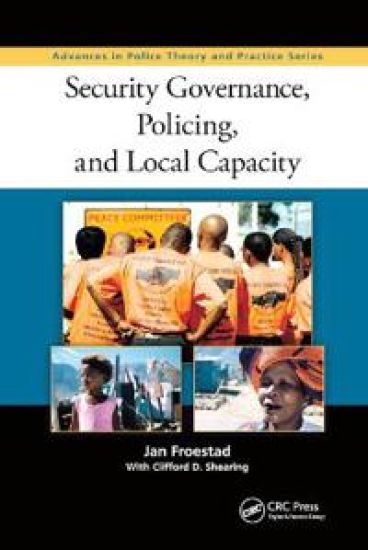
Security Governance, Policing, and Local Capacity

Security Governance, Policing, and Local Capacity

Jan Froestad; Clifford Shearing

CRC Press Inc
2012
sidottu
The security governance of South Africa has faced immense challenges amid post-apartheid constitutional and political transformations. In many cases, policing and governmental organizations have failed to provide security and other services to the poorest inhabitants. Security Governance, Policing, and Local Capacity explores an experiment that took place in Zwelethemba—located in South Africa’s Western Cape Province—to establish legitimate and effective nonstate security governance within poor urban settlements. There has been, and continues to be, much reticence to endorsing private forms of security governance that operate outside of state institutions within local communities. Those initiatives have often led to situations where force is used illegally and punishment is dispensed arbitrarily and brutally. This book explores the extent to which this model of mobilizing local knowledge and capacity was able to effectively achieve justice, democracy, accountability, and development in this region. Whenever possible, the book includes raw data and a thorough analysis of existing information on security governance. Examining this case and its outcome, the authors provide a theoretical analysis of the model used and present a series of design principles for future applications in local security governance. The book concludes that poor communities are a significant source of untapped resources that can, under certain conditions, be mobilized to significantly enhance safety. This volume is an important examination of experimental models and a presentation of new groundbreaking theory on engaging the local community in solving security governance problems.

The New Environmental Governance

The New Environmental Governance

Cameron Holley; Neil Gunningham; Clifford Shearing

Earthscan Ltd
2011
sidottu
A bold and profoundly new way of governing environmental problems is palpable around the globe and aims to overcome the limitations of the interventionist state and its market alternative to offer more effective and legitimate solutions to today's most pressing environmental problems. The 'new environmental governance' (NEG) emphasises a host of novel characteristics including participation, collaboration, deliberation, learning and adaptation and 'new' forms of accountability. While these unique features have generated significant praise from legal and governance scholars, there have been very few systematic evaluations of NEG in practice, and it is still unclear whether NEG will in fact 'work', and if so, when and how. This book offers one of the most rigorous research investigations into cutting edge trends in environmental governance to date. Focusing its inquiry around some of the most central, controversial and/or under researched characteristics of NEG, the book offers fresh insights into the conditions under which we can best achieve successful collaboration, effective learning and adaptation, meaningful participatory and deliberative governance and effective forms of accountability. The book synthesizes its findings to identify seven key pillars of 'good' NEG that are central to its success and will provide useful guidance for policymakers and scholars seeking to apply new governance to a wide range of environmental and non-environmental policy contexts. The book also advances our understanding of State governance and will be a valuable reference for scholars, researchers and students working in law and regulation studies - especially in the field of environmental law.
Lengthening the Arm of the Law

Lengthening the Arm of the Law

Julie Ayling; Peter Grabosky; Clifford Shearing

Cambridge University Press
2008
pokkari
Relentless fiscal pressures faced by the public police over the last few decades have meant that police organisations have had to find new ways to obtain and harness the resources needed to achieve their goals. Through entering into relationships of coercion, commercial exchange, and gift with a wide variety of external institutions and individuals operating in both public and private capacities, police organisations have risen to this challenge. Indeed, police organisations are increasingly operating within a business paradigm. But what are the benefits of these relationships and the nature of the risks that might accompany reliance upon them? This book examines these new modes of exchange between police and 'outsiders' and explores how far these relationships can be taken before certain fundamental values - equity in the distribution of policing, cost-effectiveness in the delivery of police services, and the legitimacy of the police institution itself - are placed in jeopardy.
Lengthening the Arm of the Law

Lengthening the Arm of the Law

Julie Ayling; Peter Grabosky; Clifford Shearing

Cambridge University Press
2008
sidottu
Relentless fiscal pressures faced by the public police over the last few decades have meant that police organisations have had to find new ways to obtain and harness the resources needed to achieve their goals. Through entering into relationships of coercion, commercial exchange, and gift with a wide variety of external institutions and individuals operating in both public and private capacities, police organisations have risen to this challenge. Indeed, police organisations are increasingly operating within a business paradigm. But what are the benefits of these relationships and the nature of the risks that might accompany reliance upon them? This book examines these new modes of exchange between police and 'outsiders' and explores how far these relationships can be taken before certain fundamental values - equity in the distribution of policing, cost-effectiveness in the delivery of police services, and the legitimacy of the police institution itself - are placed in jeopardy.
Imagining Security

Imagining Security

Jennifer Wood; Clifford Shearing

Willan Publishing
2006
sidottu
This book is concerned with the ways in which the problem of security is thought about and promoted by a range of actors and agencies in the public, private and nongovernmental sectors. The authors are concerned not simply with the influence of risk-based thinking in the area of security, but seek rather to map the mentalities and practices of security found in a variety of sectors, and to understand the ways in which thinking from these sectors influence one another. Their particular concern is to understand the drivers of innovation in the governance of security, the conditions that make innovation possible and the ways in which innovation is imagined and realised by actors from a wide range of sectors. The book has two key themes: first, governance is now no longer simply shaped by thinking within the state sphere, for thinking originating within the business and community spheres now also shapes governance, and influence one another. Secondly, these developments have implications for the future of democratic values as assumptions about the traditional role of government are increasingly challenged. The first five chapters of the book explore what has happened to the governance of security, through an analysis of the drivers, conditions and processes of innovation in the context of particular empirical developments. Particular reference is made here to 'waves of change' in security within the Ontario Provincial Police in Canada. In the final chapter the authors examine the implications of 'nodal governance' for democratic values, and then suggest normative directions for deepening democracy in these new circumstances.
Imagining Security

Imagining Security

Jennifer Wood; Clifford Shearing

Willan Publishing
2006
nidottu
This book is concerned with the ways in which the problem of security is thought about and promoted by a range of actors and agencies in the public, private and nongovernmental sectors. The authors are concerned not simply with the influence of risk-based thinking in the area of security, but seek rather to map the mentalities and practices of security found in a variety of sectors, and to understand the ways in which thinking from these sectors influence one another. Their particular concern is to understand the drivers of innovation in the governance of security, the conditions that make innovation possible and the ways in which innovation is imagined and realised by actors from a wide range of sectors. The book has two key themes: first, governance is now no longer simply shaped by thinking within the state sphere, for thinking originating within the business and community spheres now also shapes governance, and influence one another. Secondly, these developments have implications for the future of democratic values as assumptions about the traditional role of government are increasingly challenged. The first five chapters of the book explore what has happened to the governance of security, through an analysis of the drivers, conditions and processes of innovation in the context of particular empirical developments. Particular reference is made here to 'waves of change' in security within the Ontario Provincial Police in Canada. In the final chapter the authors examine the implications of 'nodal governance' for democratic values, and then suggest normative directions for deepening democracy in these new circumstances.