Kirjojen hintavertailu – 12 859 827 kirjaa ja 27 kauppaa

Kirjailija

Clive Bell

Kirjat ja teokset yhdessä paikassa: 68 kirjaa, julkaisuja vuosilta 2003–2026, suosituimpiin kuuluu Pot-Boilers. Vertaile teosten hintoja ja tarkista saatavuus suomalaisista kirjakaupoista.

68 kirjaa

Kirjojen julkaisuvuodet: 2003–2026.

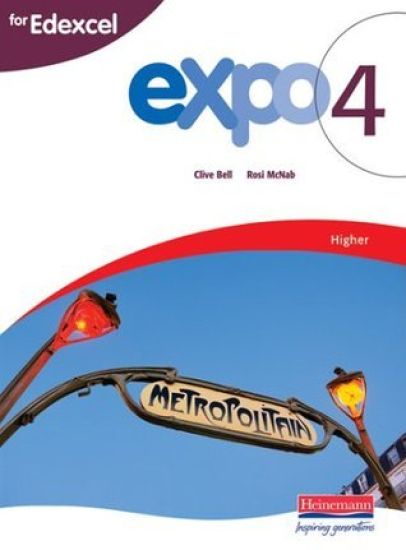
Expo 4 for Edexcel Higher Student Book

Expo 4 for Edexcel Higher Student Book

Clive Bell; Rosi McNab

pearson education limited
2006
nidottu
Developed to follow on from the increasingly popular Expo for Key Stage 3, this motivating course offers seamless progression from Year 9 for optimal results at GCSE. This book is fully differentiated for higher level. Exam practice activities in the Student Book containing practice and revision exercises will prepare students completely for the GCSE. Please note this text book is for exams up to 2010.
Expo 4 AQA Higher Student Book

Expo 4 AQA Higher Student Book

Clive Bell; Rosi McNab

pearson education limited
2006
nidottu
Developed to follow on from the increasingly popular Expo for Key Stage 3, this motivating course offers seamless progression from Year 9 for optimal results at GCSE. This book is fully differentiated for higher level. Exam practice activities in the Student Book containing practice and revision exercises will prepare students completely for the GCSE. Please note this text book is for exams up to 2010.
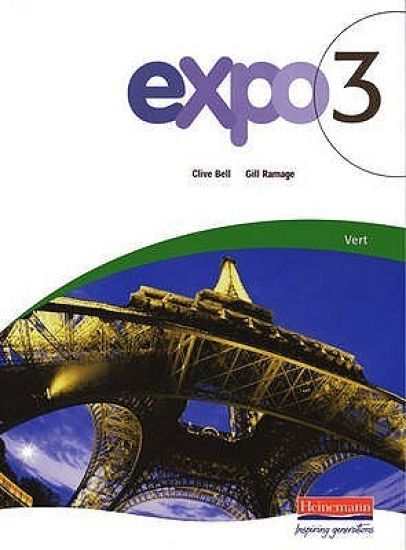
Expo 3 Vert Pupil Book

Expo 3 Vert Pupil Book

Clive Bell; Gill Ramage

pearson education limited
2005
nidottu
This book offers a lively, communicative approach to modern languages, underpinned by a clear grammatical foundation, for pupils with a lower ability. It should develop pupils' use and understanding of French by providing staightforward explanations of the way that the language works, and providing a stimulating introduction to the culture of France and French-speaking countries around the world. A strong emphasis is placed on teaching pupils correct pronunciation from the start. Explanations of how to pronounce French sounds and models of French pronunciation are accompanied by regular practice activities throughout the book that can be completed as homework and cover work. Short two-page units show pupils exactly what is required of them, and mini-tests are included half-way through each module so that pupils can check their own progress. There is also plenty of scope for individual work in the "A toi" and "Grammaire" sections, with numerous reading and writing activities.
Expo 3 Rouge Pupil Book

Expo 3 Rouge Pupil Book

Clive Bell; Gill Ramage

pearson education limited
2005
nidottu
The books develop pupils’ use and understanding of French by providing straightforward explanations of the way the language works, alongside motivating, stepped activities. Clear grammatical objectives are made explicit to the pupils at the beginning of each unit. The books provide a stimulating introduction to the French language and the culture of France and other French-speaking countries across the world. Great emphasis is placed on teaching pupils correct pronunciation from the start. Explanations of how to pronounce French sounds and models of French pronunciation are accompanied by regular practice activities throughout the book. Exactly the right level for higher ability pupils in the third year they study French Integrated grammar explanations and practice Regular pronunciation tips and practice activities A wealth of activities for individual work at home or in class Easy-to-use vocabulary lists to help pupils memorise vocabulary as they go along Introduction to the culture of France and other French-speaking countries
Development Policy as Public Finance

Development Policy as Public Finance

Clive Bell

Oxford University Press
2003
nidottu
This book is written out of a conviction that development economics needs to draw more heavily and systematically on recent advances in knowledge made in public economics, especially where the formulation and analysis of development policy are concerned. The central questions - how to raise and spend revenues well, in the sense of promoting development - are surely normative; but whether something is done 'well' must also be judged in relation to what is actually feasible. With unrestricted lump-sum transfers ruled out in practice, the design of policy is inherently concerned with considerations of the second-best. This awkward fact besets the analysis of interventions in all areas of economic activity, from international trade to small-scale finance. Debates over whether and how to promote particular sectors or activities at the expense of others, when viewed from this perspective, draw attention away from the humdrum, but decidedly more important goal of raising revenue efficiently and with due regard for equity. This stricture applies to international trade, industry, and agriculture, as well as to the familiar choice among different forms of taxes, seigniorage, and debt. At the same time, all proposals to spend public funds, introduce or change regulations, and reform policy should be subjected to a rigorous and uniform system of appraisal, especially when there is a substantial premium on public funds. The methods of social cost-benefit analysis, based on shadow prices, provide just the apparatus that is needed for this purpose. This apparatus and its many applications are developed at length, in the hope of promoting its use as a matter of course. Development Policy as Public Finance will be of interest to graduate students, academics, and advanced undergraduates in economics, development studies, and political science; government agencies and NGOs.

Development Policy as Public Finance

Development Policy as Public Finance

Clive Bell

Oxford University Press
2003
sidottu
This work is written out of a conviction that development economics needs to draw more heavily and systematically on recent advances in knowledge made in public economics - especially where the formulation and analysis of development policy are concerned. The central questions - how to raise and spend revenues well, in the sense of promoting development - are surely normative; but whether something is done "well" must also be judged in relation to what is actually feasible. With unrestricted lump-sum transfers ruled out in practice, the design of policy is inherently concerned with considerations of the second-best. This awkward fact besets the analysis of interventions in all areas of economic activity, from international trade to small-scale finance. Debates over whether and how to promote particular sectors or activities at the expense of others, when viewed from this perspective, draw attention away from the humdrum, but decidedly more important goal of raising revenue efficiently and with due regard for equity.