Kirjojen hintavertailu – 12 859 827 kirjaa ja 27 kauppaa

Kirjailija

Confucius

Kirjat ja teokset yhdessä paikassa: 145 kirjaa, julkaisuja vuosilta 1979–2027, suosituimpiin kuuluu Confucian Analects. Vertaile teosten hintoja ja tarkista saatavuus suomalaisista kirjakaupoista.

Nimi esiintyy myös muodoissa: * Confucius

145 kirjaa

Kirjojen julkaisuvuodet: 1979–2027.

The Analects

The Analects

Confucius

The Chinese University Press
2000
nidottu
One of the undisputed giants in the history of human thought, and the founder of one of the world's longest-lasting cultural traditions, Confucius (known as Kong Fuzi in his native China) is arguably the most enduring of all the world's great thinkers. The Analects, the slender volume thought to have been compiled by his followers, has the strongest claim to represent Confucius' actual words. Sometimes pithy, sometimes conversational, occasionally enigmatic, often profoundly searching, the book contains memorable sayings about the moral health of the individual, the family and the body politic, and continues to be a source of inexhaustible wisdom after more than two and a half millennia.
The Analects of Confucius

The Analects of Confucius

Confucius

WW Norton Co
1998
nidottu
In this terse, brilliant translation, Simon Leys restores the human dimension to Confucius. He emerges a full-blooded character with a passion for politics and a devotion to the ideals of a civilization he saw in decline. Leys's notes draw Confucius into conversation with the great thinkers of the Western tradition. In all, this volume provides new readers the perfect introduction to a classic work.
The Analects of Confucius (Lun Yu)

The Analects of Confucius (Lun Yu)

Confucius

Oxford University Press Inc
1997
nidottu
In the long river of human history, if one person can represent the civilization of a whole nation, it is perhaps Master Kong, better known as Confucius in the West. If there is one single book that can be upheld as the common code of a whole people, it is perhaps Lun Yu, or The Analects. Surely few individuals in history have shaped their country's civilization more profoundly than Master Kong. The great Han historiographer, Si-ma Qian, writing 2,100 years ago said, "He may be called the wisest indeed!" And, as recently as 1988, at a final session of the first international conference of Nobel prize-winners in Paris, the seventy-five participants, fifty-two of whom were scientists, concluded: "If mankind is to survive, it must go back twenty- five centuries in time to tap the wisdom of Confucius". This is a man whose influence in world history is truly incomparable. His sayings (and those of his disciples) form the basis of a distinct social, ethical, and intellectual system. They have retained their freshness and vigour for two and a half millennia, and are still admired in today's China. Compiled by pupils of Confucius's disciples half a century after the Master's death, The Analects of Confucius laid the foundation of his philosophy of humanity--a philosophy aimed at "cultivating the individual's moral conduct, achieving family harmony, bringing good order to the state and peace to the empire". Containing 501 very succinct chapters (the longest do not exceed fifteen lines and the shortest are less than one) and organized into twenty books, the collection comprises mostly dialogues between the Master and his disciples and contemporaries. The ethical tenets Confucius put forth not only became the norm of conduct for the officialdom and intelligentsia, but also had a profound impact on the behaviour of the common people. The great sage's unique integration of humanity and righteousness (love and reason) struck a powerful chord in all who attempted to understand his moral philosophy. As the translator Chichung Huang contends, "What ethical principle laid down by man could be more sensible that none which blends the best our heart can offer with the best our mind can offer as the guiding light for our conduct throughout our lives?". Ever timely, Confucius's teachings on humanity (family harmony in particular) and righteousness may well serve as a ready-made cure for today's ills in an era which human beings are blinded by force and lust, not unlike Confucius's own day. Far more literal than any English version still in circulation, this brilliant new rendition of The Analects helps the reader not only to acquire and accurate and lucid understanding of the original text, but also to appreciate the imagery, imagery, parallelism, and concision of its classical style. The translator Chichung Huang, a Chinese scholar born in a family of Confucian teachers and schooled in one of the last village Confucian schools in South China, brings to this treasure of world literature a sure voice that captures the power and subtleties of the original. Vivid, simple, and eminently readable, this illuminating work makes the golden teachings of the sage of the East readily available to anyone in search of them.

The Analects of Confucius (Lun Yu)

The Analects of Confucius (Lun Yu)

Confucius

Oxford University Press Inc
1997
sidottu
In the long river of human history, if one person can represent the civilization of a whole nation, it is perhaps Master Kong, better known as Confucius in the West. If there is one single book that can be upheld as the common code of a whole people, it is perhaps Lun Yu, or The Analects. Surely, few individuals in history have shaped their country's civilization more profoundly than Master Kong. The great Han historiographer, Si-ma Qian, writing 2,100 years ago said, "He may be called the wisest indeed!" And, as recently as 1988, at a final session of the first international conference of Nobel prize-winners in Paris, the seventy-five participants, fifty-two of whom where scientists, concluded: "If mankind is to survive, it must go back twenty- five centuries in time to tap the wisdom of Confucius." This a man whose influence in world history is truly incomparable. His sayings (and those of his disciples) form the basis of a distinct social, ethical, and intellectual system. They have retained their freshness and vigor for two and a half millennia, and are still admired in today's China. Compiled by pupils of Confucius's disciples half a century after the Master's death, The Analects of Confucius laid the foundation of his philosophy of humanity--a philosophy aimed at "cultivating the individual's moral conduct, achieving family harmony, bringing good order to the state and peace to the empire. Containing 501 very succinct chapters (the longest do not exceed fifteen lines and the shortest are less than one) and organized into twenty books, the collection comprises mostly dialogues between the Master and his disciples and contemporaries. The ethical tenets Confucius put forth not only became the norm of conduct for the officialdom and intelligentsia, but also profoundly impacted the behavior of the common people. The great sage's unique integration of humanity and righteousness (love and reason) struck a powerful chord in all who attempted to understand his moral philosophy. As translator Chichung Huang contends, "What ethical principle laid down by man could be more sensible that none which blends the best our heart can offer with the best our mind can offer as the guiding light for our conduct throughout our lives?" Ever timely, Confucius's teachings on humanity (family harmony in particular) and righteousness may well serve as a ready-made cure for today's ills in an era which human beings are blinded by force and lust, not unlike Confucius's own day. Far more literal than any English version still in circulation, this brilliant new rendition of The Analects helps the reader not only to acquire and accurate and lucid understanding of the original text, but also to appreciate the imagery, imagery, parallelism, and concision of its classical style. The translator Chichung Huang, a Chinese scholar born in a family of Confucian teachers and schooled in one of the last village Confucian schools in South China, brings to this treasure of world literature a sure voice that captures the power and subtleties of the original. Vivid, simple, and eminently readable, this illuminating work makes the golden teachings of the sage of the East readily available to anyone in search of them.
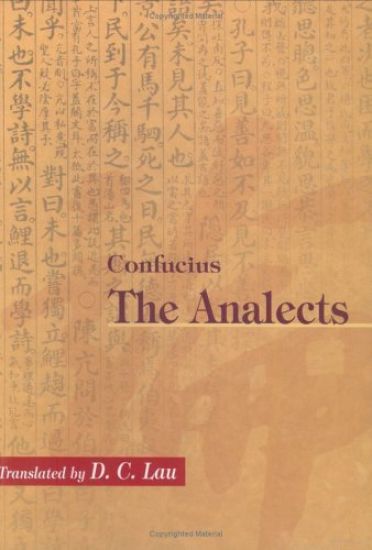
The Analects

The Analects

Confucius

Penguin Classics
1979
pokkari

Halvin toimitettuna 16,20 €

'The Master said, "If a man sets his heart on benevolence, he will be free from evil"'The Analects are a collection of Confucius's sayings brought together by his pupils shortly after his death in 497 BC. Together they express a philosophy, or a moral code, by which Confucius believed everyone should live. Upholding the ideals of wisdom, self-knowledge, courage and love of one's fellow man, he argued that the pursuit of virtue should be every individual's supreme goal. And, while following the Way, or the truth, might not result in immediate or material gain, Confucius showed that it could nevertheless bring its own powerful and lasting spiritual rewards. Translated with an Introduction and Notes by D. C. Lau