Kirjojen hintavertailu – 12 903 725 kirjaa ja 27 kauppaa

Kirjailija

Constantin Iordachi

Kirjat ja teokset yhdessä paikassa: 6 kirjaa, julkaisuja vuosilta 2014–2026, suosituimpiin kuuluu Radicalization and Fascism in the Ustasa. Vertaile teosten hintoja ja tarkista saatavuus suomalaisista kirjakaupoista.

6 kirjaa

Kirjojen julkaisuvuodet: 2014–2026.

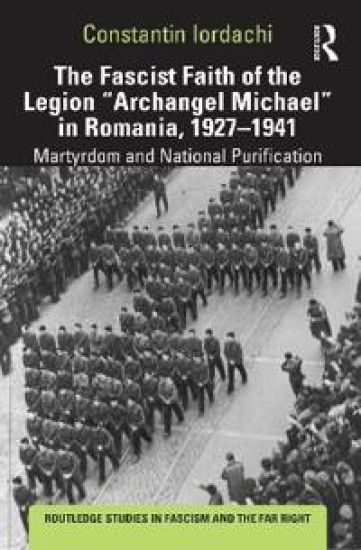
The Fascist Faith of the Legion "Archangel Michael" in Romania, 1927–1941
The Fascist Faith of the Legion "Archangel Michael" in Romania, 1927–1941 engages critically with recent works on fascism, totalitarianism, and religion, and advances an original theoretical and methodological approach to fascism as a political faith. On this basis, the book constructs an innovative comparative research framework for reconceptualizing the history of the Legion "Archangel Michael" in Romania, 1927–1941. It contends that the Legion put forward a palingenetic political faith of a theological type, called Legionarism. To provide a comprehensive analysis of the origins, main features, mechanisms of institutionalization, and demise of this self-proclaimed salvific political faith, the book documents the palingenetic foundations of the Legionary faith, the syncretism between fascist and Christian rites and rituals, and the intricate relationship between the Legion and the Orthodox Church and its dogma. The book documents three main sacrificial strategies employed by the Legion to "re-evangelize" the people in the new faith: (1) the appropriation of the cult of the fallen soldiers; (2) terrorist missions meant to create fascist heroes through violent sacrifice; and (3) sanctification through heroic fight for Christianity in the Spanish Civil War, in an attempt to link Legionarism with the transnational crusade against "Judeo-Bolshevism." As well as providing a detailed historical and interpretive account of the Legion, the book makes a significant contribution to debates about defining fascism and its relation to religion. It also provides novel comparative perspectives for studying other attempts at constructing fascist faiths in interwar Europe, most notably in Fascist Italy and Nazi Germany but also in Central and Eastern Europe. This book will be of interest to students and scholars of fascism, Romanian studies, politics and religion, political theory, totalitarianism, youth radicalization, violence, and the emergence of terrorism.

The Fascist Faith of the Legion "Archangel Michael" in Romania, 1927–1941
The Fascist Faith of the Legion "Archangel Michael" in Romania, 1927–1941 engages critically with recent works on fascism, totalitarianism, and religion, and advances an original theoretical and methodological approach to fascism as a political faith. On this basis, the book constructs an innovative comparative research framework for reconceptualizing the history of the Legion "Archangel Michael" in Romania, 1927–1941. It contends that the Legion put forward a palingenetic political faith of a theological type, called Legionarism. To provide a comprehensive analysis of the origins, main features, mechanisms of institutionalization, and demise of this self-proclaimed salvific political faith, the book documents the palingenetic foundations of the Legionary faith, the syncretism between fascist and Christian rites and rituals, and the intricate relationship between the Legion and the Orthodox Church and its dogma. The book documents three main sacrificial strategies employed by the Legion to "re-evangelize" the people in the new faith: (1) the appropriation of the cult of the fallen soldiers; (2) terrorist missions meant to create fascist heroes through violent sacrifice; and (3) sanctification through heroic fight for Christianity in the Spanish Civil War, in an attempt to link Legionarism with the transnational crusade against "Judeo-Bolshevism." As well as providing a detailed historical and interpretive account of the Legion, the book makes a significant contribution to debates about defining fascism and its relation to religion. It also provides novel comparative perspectives for studying other attempts at constructing fascist faiths in interwar Europe, most notably in Fascist Italy and Nazi Germany but also in Central and Eastern Europe. This book will be of interest to students and scholars of fascism, Romanian studies, politics and religion, political theory, totalitarianism, youth radicalization, violence, and the emergence of terrorism.
Liberalism, Constitutional Nationalism, and Minorities
Winner of the 2019 CEU Award for Outstanding Research This book documents the making of Romanian citizenship from 1750 to 1918 as a series of acts of national self-determination by the Romanians, as well as the emancipation of subordinated gender, social, and ethno-religious groups. It focuses on the progression of a sum of transnational “questions” that were at the heart of North-Atlantic, European, and local politics during the long nineteenth century, concerning the status of peasants, women, Greeks, Jews, Roma, Armenians, Muslims, and Dobrudjans. The analysis emphasizes the fusion between nationalism and liberalism, and the emancipatory impact national-liberalism had on the transition from the Old Regime to the modern order of the nation-state. While emphasizing liberalism's many achievements, the study critically scrutinizes the liberal doctrine of legal-political “capacity” and the dark side of nationalism, marked by tendencies toward exclusion. It highlights the challenges nascent liberal democracies face in the process of consolidation and the enduring appeal of illiberalism in periods of upheaval, represented mainly by nativism. The book's innovative interdisciplinary approach to citizenship in the Ottoman and post-Ottoman Balkans and the richness of the sources employed, appeal to a diverse readership.
The Comparative History of Fascism in Eastern Europe

The Comparative History of Fascism in Eastern Europe

Constantin Iordachi

Bloomsbury Academic
2019
sidottu
The Comparative History of Fascism in Eastern Europe provides a comprehensive outline of the history of fascism in the region. It includes a general introduction to comparative fascist studies, with a focus on the general features of, and historiographical debates on, fascism in Eastern Europe. It then charts the history, organisation and leadership of the fascist movements and regimes in that region through an extensive set of encyclopedia entries and a rich and previously unpublished collection of primary source material, in English translation, that cover the significant individuals, parties, groups and concepts. Illustrated throughout, this is an essential volume for anyone wanting to know more about the history of fascism in 20th-century Europe.
The Bio-Politics of the Danube Delta

The Bio-Politics of the Danube Delta

Constantin Iordachi; Kristof Van Assche

Lexington Books
2014
sidottu
The Danube Delta is one of the largest and most valuable wetlands in Europe. Throughout history it has been a contested area and subject to conflicting claims and policies from the Ottoman Empire, Russia, Romania, the Soviet Union, and Ukraine. In this volume Constantin Iordachi and Kirstof Van Assche take an interdisciplinary look at the history, policy, and culture of the development and politics of the Danube Delta.