Kirjojen hintavertailu – 12 859 824 kirjaa ja 27 kauppaa

Kirjailija

Cor Claeys

Kirjat ja teokset yhdessä paikassa: 6 kirjaa, julkaisuja vuosilta 2009–2019, suosituimpiin kuuluu Metal Impurities in Silicon- and Germanium-Based Technologies. Vertaile teosten hintoja ja tarkista saatavuus suomalaisista kirjakaupoista.

6 kirjaa

Kirjojen julkaisuvuodet: 2009–2019.

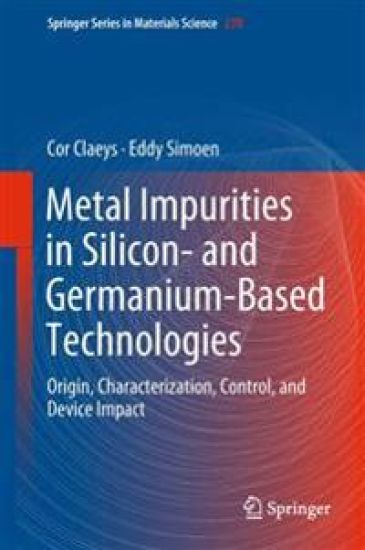
Metal Impurities in Silicon- and Germanium-Based Technologies

Metal Impurities in Silicon- and Germanium-Based Technologies

Cor Claeys; Eddy Simoen

Springer Nature Switzerland AG
2019
nidottu
This book provides a unique review of various aspects of metallic contamination in Si and Ge-based semiconductors. It discusses all of the important metals including their origin during crystal and/or device manufacturing, their fundamental properties, their characterization techniques and their impact on electrical devices’ performance. Several control and possible gettering approaches are addressed. The book offers a valuable reference guide for all researchers and engineers studying advanced and state-of-the-art micro- and nano-electronic semiconductor devices and circuits. Adopting an interdisciplinary approach, it combines perspectives from e.g. material science, defect engineering, device processing, defect and device characterization, and device physics and engineering.
Metal Impurities in Silicon- and Germanium-Based Technologies

Metal Impurities in Silicon- and Germanium-Based Technologies

Cor Claeys; Eddy Simoen

Springer International Publishing AG
2018
sidottu
This book provides a unique review of various aspects of metallic contamination in Si and Ge-based semiconductors. It discusses all of the important metals including their origin during crystal and/or device manufacturing, their fundamental properties, their characterization techniques and their impact on electrical devices’ performance. Several control and possible gettering approaches are addressed. The book offers a valuable reference guide for all researchers and engineers studying advanced and state-of-the-art micro- and nano-electronic semiconductor devices and circuits. Adopting an interdisciplinary approach, it combines perspectives from e.g. material science, defect engineering, device processing, defect and device characterization, and device physics and engineering.
Extended Defects in Germanium

Extended Defects in Germanium

Cor Claeys; Eddy Simoen

Springer-Verlag Berlin and Heidelberg GmbH Co. K
2010
nidottu
The aim is to give an overview of the physics of extended defects in Germanium, i.e. dislocations (line defects), grain boundaries, stacking faults, twins and {311} defects (two-dimensional defects) and precipitates, bubbles, etc. The first part covers fundamentals, describing the crystallographic structure and other physical and electrical properties, mainly of dislocations. Since dislocations are essential for the plastic deformation of Germanium, methods for analysis and imaging of dislocations and to evaluate their structure are described. Attention is given to the electrical and optical properties, which are important for devices made in dislocated Ge. The second part treats the creation of extended defects during wafer and device processing. Issues are addressed such as defect formation during ion implantation, necessary to create junctions, which are an essential part in every device type. Extended defects are also created during the deposition of thin or thick epitaxial layers on other substrates, which are important for optoelectronic and photovoltaic applications. In brief, the book is intended to provide a fundamental understanding of the extended-defect formation during Ge materials and device processing, providing ways to distinguish harmful from less detrimental defects and should point out ways for defect engineering and control.
Extended Defects in Germanium

Extended Defects in Germanium

Cor Claeys; Eddy Simoen

Springer-Verlag Berlin and Heidelberg GmbH Co. K
2009
sidottu
The aim is to give an overview of the physics of extended defects in Germanium, i.e. dislocations (line defects), grain boundaries, stacking faults, twins and {311} defects (two-dimensional defects) and precipitates, bubbles, etc. The first part covers fundamentals, describing the crystallographic structure and other physical and electrical properties, mainly of dislocations. Since dislocations are essential for the plastic deformation of Germanium, methods for analysis and imaging of dislocations and to evaluate their structure are described. Attention is given to the electrical and optical properties, which are important for devices made in dislocated Ge. The second part treats the creation of extended defects during wafer and device processing. Issues are addressed such as defect formation during ion implantation, necessary to create junctions, which are an essential part in every device type. Extended defects are also created during the deposition of thin or thick epitaxial layers on other substrates, which are important for optoelectronic and photovoltaic applications. In brief, the book is intended to provide a fundamental understanding of the extended-defect formation during Ge materials and device processing, providing ways to distinguish harmful from less detrimental defects and should point out ways for defect engineering and control.