Kirjojen hintavertailu – 12 859 828 kirjaa ja 27 kauppaa

Kirjailija

Cornelius Castoriadis

Kirjat ja teokset yhdessä paikassa: 17 kirjaa, julkaisuja vuosilta 1990–2024, suosituimpiin kuuluu Fenster zum Chaos. Vertaile teosten hintoja ja tarkista saatavuus suomalaisista kirjakaupoista.

17 kirjaa

Kirjojen julkaisuvuodet: 1990–2024.

The Greek Imaginary

The Greek Imaginary

Cornelius Castoriadis

EDINBURGH UNIVERSITY PRESS
2024
nidottu
This book collects 12 previously untranslated lectures by Castoriadis from 1982 to 1983. Castoriadis focuses on the interconnection between philosophy and democracy and the way both emerge within a self-critical imaginary already in development in the work of early Greek poets and Presocratic philosophers. Displaying both mastery of the relevant scholarship and original interpretation, he reveals the birth of a society thatwould place its highest value in calling itself and its institutions into question. He argues that this spirit would developdirectly into the twin signatures of the Greek world, namely radical philosophy, on the one hand, and radical democratic practices, on the other. Like no previous interpreter, Castoriadis allows us to feel the existential need, already present in the earliest Greek thinkers, to question the significance of human existence and to share in shaping its meaning. The Greeks not only did this, he argues, they also began the equally important work of establishing the institutions to support such a project.
The Greek Imaginary

The Greek Imaginary

Cornelius Castoriadis

EDINBURGH UNIVERSITY PRESS
2023
sidottu
Offers in English for the first time philosopher Cornelius Castoriadis's earliest surviving lectures on the ancient Greeks Includes renowned scholar Pierre Vidal-Naquet's essay, 'Castoriadis and Ancient Greece'" (1999), which provides an introduction and memorial to Castoriadis's research Includes Castoriadis's previously untranslated, substantive essay, "'Political Thought'" (1979), which presages many of the key themes in the seminars Includes Castoriadis's thematic reports on his teaching in the 1980-1984 seminars Includes an "Editors' Introduction" plus extensive editorial commentary on the seminars and an Analytic Table of Contents provided by the academic editor of the French edition of the volume (from 2004) Includes a "Foreword" by the translator, which highlights key terms in the seminars This book collects 12 previously untranslated lectures by Castoriadis from 1982 to 1983. Castoriadis focuses on the interconnection between philosophy and democracy and the way both emerge within a self-critical imaginary already in development in the work of early Greek poets and Presocratic philosophers. Displaying both mastery of the relevant scholarship and original interpretation, he reveals the birth of a society that?would place its highest value in?calling itself and its institutions into question.? He argues that this spirit would?develop?directly?into?the twin signatures of the Greek world, namely?radical philosophy, on the one hand, and?radical democratic practices, on the other. ? Like no previous interpreter, Castoriadis allows us to feel the existential need, already present in the earliest Greek thinkers, to question the significance of human existence and to share in shaping its meaning. The Greeks not only did this, he argues, they also began the equally important work of?establishing the institutions to support such a project. "

Democracy and Relativism

Democracy and Relativism

Cornelius Castoriadis

Rowman Littlefield International
2019
sidottu
In this vibrant debate with intellectuals influenced by Marcel Mauss, including Alain Caillé and Chantal Mouffe, the incisive Greek-French activist and philosopher Cornelius Castoriadis addresses the challenge of critical thinking in an international context. The first half explores the tradition of radical self-critique and the prospect of affirming its value in a non-ethnocentric way. While defending ancient Greek contributions to the Western tradition of radical self-critique — including the practice of “relativizing” one's own culture, of engaging in philosophical interrogation, and of establishing democratic institutions — Castoriadis is challenged to explore the trans-contextual features of any self-critical, or “autonomous,” social institution. In the second half Castoriadis offers a penetrating critique of representative democracy, and the discussion makes important strides toward a new conception of direct democracy, of political education, and of the institutional prerequisites for the continuation of radical self-critique in politics and philosophy.
Democracy and Relativism

Democracy and Relativism

Cornelius Castoriadis

Rowman Littlefield International
2019
nidottu
In this vibrant debate with intellectuals influenced by Marcel Mauss, including Alain Caillé and Chantal Mouffe, the incisive Greek-French activist and philosopher Cornelius Castoriadis addresses the challenge of critical thinking in an international context. The first half explores the tradition of radical self-critique and the prospect of affirming its value in a non-ethnocentric way. While defending ancient Greek contributions to the Western tradition of radical self-critique — including the practice of “relativizing” one's own culture, of engaging in philosophical interrogation, and of establishing democratic institutions — Castoriadis is challenged to explore the trans-contextual features of any self-critical, or “autonomous,” social institution. In the second half Castoriadis offers a penetrating critique of representative democracy, and the discussion makes important strides toward a new conception of direct democracy, of political education, and of the institutional prerequisites for the continuation of radical self-critique in politics and philosophy.
A Socialisme ou Barbarie Anthology

A Socialisme ou Barbarie Anthology

Cornelius Castoriadis; Jean-Francois Lyotard; Claude Lefort

Eris
2019
nidottu
Socialisme ou Barbarie (1948–67) was a revolutionary group whose members included such major figures such as Cornelius Castoriadis, Claude Lefort and Jean-François Lyotard. Its journal of the same name helped inspire France’s May ’68 student-worker rebellion and influenced generations of radicals worldwide. This Anthology, for the first time in print in the English language, restores the collective nature of the group’s adventure, where manual and intellectual workers creatively, and not without profound disagreements, reflected and acted together in anticipation of a non-hierarchical, self-governing society. The group radically reoriented critical revolutionary theory by affirming how social change emerges through ordinary people’s everyday lives and struggles. In a world divided into two competing bureaucratic-capitalist camps, the autonomous grassroots response to rationalized forms of outside control (State-corporation-trade union-political party) would be workers’ management—a conclusion stunningly confirmed, against traditional Left expectations, by the workers’ revolts of 1953 and 1956 in the East, and by increasingly widespread challenges to established organizational forms in the 1960s in the West. These texts not only examine the overall crisis of systems of domination, but explore their creative contestation in the workplace, in changing relations between the sexes and between generations, and in movements for national liberation (China, Algeria), to bring out “the positive content of socialism” while remaining clear-eyed about how bureaucratization may be reintroduced into emancipatory struggles.
Postscript on Insignificance

Postscript on Insignificance

Cornelius Castoriadis

Continuum Publishing Corporation
2011
nidottu
This title is a collection of interviews in which Cornelius Castoriadis discusses his key works and ideas. Cornelius Castoriadis (1922-1997) was a philosopher, social critic, political activist, practicing psychoanalyst and professional economist. His work is widely recognized as one of the most singular and important contributions to twentieth-century thought. In this collection of interviews, Castoriadis discusses some of his most important ideas with leading figures in the disciplines that play such a crucial part in his philosophical work: poetry, psychoanalysis, biology and mathematics. Available in English for the first time, these interviews provide a concise and accessible introduction to his work as a whole, allowing him to draw on the astounding breadth of his knowledge (ranging from philosophy and mathematics to political theory and psychoanalysis). They also render Castoriadis' cutting, polemical and entertaining style while displaying the originality and clarity of his primary concepts. Intellectually provoking, this timely collection shows how Castoriadis' polemics are sharp and riveting, his conceptual manoeuvres rigorous and original, and his passion inspiring. This is an excellent introduction to one of Europe's most important intellectuals.
Postscript on Insignificance

Postscript on Insignificance

Cornelius Castoriadis

Continuum Publishing Corporation
2011
sidottu
This is a collection of interviews in which Cornelius Castoriadis discusses his key works and ideas. Cornelius Castoriadis (1922-1997) was a philosopher, social critic, political activist, practicisn psychoanalyst and professional economist. His work is widely recognized as one of the most singular and important contributions to twentieth-century thought. In this collection of interviews, Castoriadis discusses some of his most important ideas with leading figures in the disciplines that play such a crucial part in his philosophical work: poetry, psychoanalysis, biology and mathematics. Available in English for the first time, these interviews provide a concise and accessible introduction to his work as a whole, allowing him to draw on the astounding breadth of his knowledge (ranging from philosophy and mathematics to political theory and psychoanalysis). They also render Castoriadis' cutting, polemical and entertaining style while displaying the originality and clarity of his primary concepts. Intellectually provoking, this timely collection shows how Castoriadis' polemics are sharp and riveting, his conceptual manoeuvres rigorous and original, and his passion inspiring. This is an excellent introduction to one of Europe's most important intellectuals.
A Society Adrift

A Society Adrift

Cornelius Castoriadis; Myrto Gondicas; Pascal Vernay

Fordham University Press
2010
pokkari
This posthumous collection of interviews and occasional papers given by Castoriadis between 1974 and 1997 is a lively, direct introduction to the thinking of a writer who never abandoned his radically critical stance. It provides a clear, handy résumé of his political ideas, in advance of their times and profoundly relevant to today's world. For this political thinker and longtime militant (co-founder with Claude Lefort of the revolutionary group "Socialisme ou Barbarie"), economist, psychoanalyst, and philosopher, two endless interrogations—how to understand the world and life in society—were intertwined with his own life and combats. An important chapter discusses the history of "Socialisme ou Barbarie" (1949—1967); in it, Castoriadis presents the views he defended, in that group, on a number of subjects: a critique of Marxism and of the Soviet Union, the bureaucratization of society and of the workers' movement, and the primacy of individual and collective autonomy. Another chapter presents the concept, central to his thinking, of "imaginary significations" as what make a society "cohere." Castoriadis constantly returns to the question of democracy as the never-finished, deliberate creation by the people of societal institutions, analyzing its past and its future in the Western world. He scathingly criticizes "representative" democracy and develops a conception of direct democracy extending to all spheres of social life. He wonders about the chances of achieving freedom and autonomy—those requisites of true democracy—in a world of endless, meaningless accumulation of material goods, where the mechanisms for governing society have disintegrated, the relationship with nature is reduced to one of destructive domination, and, above all, the population has withdrawn from the public sphere: a world dominated by hobbies and lobbies—"a society adrift."
A Society Adrift

A Society Adrift

Cornelius Castoriadis; Myrto Gondicas; Pascal Vernay

Fordham University Press
2010
sidottu
This posthumous collection of interviews and occasional papers given by Castoriadis between 1974 and 1997 is a lively, direct introduction to the thinking of a writer who never abandoned his radically critical stance. It provides a clear, handy résumé of his political ideas, in advance of their times and profoundly relevant to today's world. For this political thinker and longtime militant (co-founder with Claude Lefort of the revolutionary group "Socialisme ou Barbarie"), economist, psychoanalyst, and philosopher, two endless interrogations—how to understand the world and life in society—were intertwined with his own life and combats. An important chapter discusses the history of "Socialisme ou Barbarie" (1949—1967); in it, Castoriadis presents the views he defended, in that group, on a number of subjects: a critique of Marxism and of the Soviet Union, the bureaucratization of society and of the workers' movement, and the primacy of individual and collective autonomy. Another chapter presents the concept, central to his thinking, of "imaginary significations" as what make a society "cohere." Castoriadis constantly returns to the question of democracy as the never-finished, deliberate creation by the people of societal institutions, analyzing its past and its future in the Western world. He scathingly criticizes "representative" democracy and develops a conception of direct democracy extending to all spheres of social life. He wonders about the chances of achieving freedom and autonomy—those requisites of true democracy—in a world of endless, meaningless accumulation of material goods, where the mechanisms for governing society have disintegrated, the relationship with nature is reduced to one of destructive domination, and, above all, the population has withdrawn from the public sphere: a world dominated by hobbies and lobbies—"a society adrift."
Figures of the Thinkable

Figures of the Thinkable

Cornelius Castoriadis

Stanford University Press
2007
pokkari
In this posthumous collection of writings, Cornelius Castoriadis (1922-1997) pursues his incisive analysis of modern society, the philosophical basis of our ability to change it, and the points of intersection between his many approaches to this theme. His main philosophical postulate, that the human subject and society are not predetermined, asserts the primacy of creation and the possibility of creative, autonomous activity in every domain. This argument is combined with penetrating political and social criticism, opening numerous avenues of critical thought and action. The book's wide-ranging topics include the core worldview of ancient Athens, where the idea of self-creation and self-limitation made democracy possible; the wealth of poetic resources; a deconstruction of the so-called rationality of capitalism and of the current conception of democracy, along with a discussion of what a radical, revolutionary project means today; the role of what he calls the radical imagination in the creation of both societal institutions and history; the roots of hate; a psychoanalytic view of human development torn between heteronomy and autonomy; the role of education in forming autonomous individuals; and notions of chaos, space, and number.
Figures of the Thinkable

Figures of the Thinkable

Cornelius Castoriadis

Stanford University Press
2007
sidottu
In this posthumous collection of writings, Cornelius Castoriadis (1922-1997) pursues his incisive analysis of modern society, the philosophical basis of our ability to change it, and the points of intersection between his many approaches to this theme. His main philosophical postulate, that the human subject and society are not predetermined, asserts the primacy of creation and the possibility of creative, autonomous activity in every domain. This argument is combined with penetrating political and social criticism, opening numerous avenues of critical thought and action. The book's wide-ranging topics include the core worldview of ancient Athens, where the idea of self-creation and self-limitation made democracy possible; the wealth of poetic resources; a deconstruction of the so-called rationality of capitalism and of the current conception of democracy, along with a discussion of what a radical, revolutionary project means today; the role of what he calls the radical imagination in the creation of both societal institutions and history; the roots of hate; a psychoanalytic view of human development torn between heteronomy and autonomy; the role of education in forming autonomous individuals; and notions of chaos, space, and number.
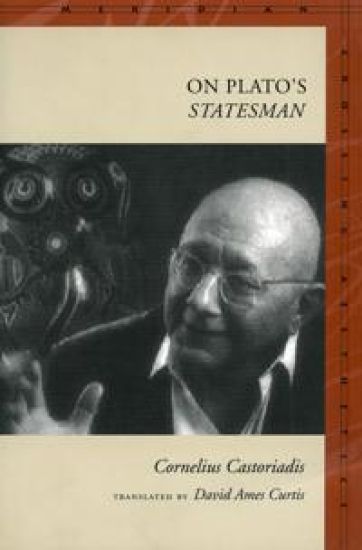
On Plato's "Statesman"

On Plato's "Statesman"

Cornelius Castoriadis

Stanford University Press
2002
sidottu
This posthumous book represents the first publication of one of the seminars of Cornelius Castoriadis, a renowned and influential figure in twentieth-century thought. A close reading of Plato's Statesman, it is an exemplary instance of Castoriadis's pragmatic, pertinent, and discriminating approach to thinking and reading a great work: "I mean really reading it, by respecting it without respecting it, by going into the recesses and details without having decided in advance that everything it contains is coherent, homogeneous, makes sense, and is true." Castoriadis brings out what he calls The Statesman's "quirky structure," with its three digressions, its eight incidental points, and its two definitions, neither of which is deemed good. He does not hesitate to differ with the text, to show that what is, in appearance, secondary is really essential, and that the denunciation of the Sophists accommodates itself quite well to the use of sophistical procedures. Castoriadis shows how The Statesman takes us into the heart of what is distinctive in the late Plato: blending, acceptance of the mixed, of the intermediate. These transcriptions of Cornelius's afford the reader an opportunity to discover his trenchant, convincing, energetic, provocative, and often droll voice. Here is a hitherto unknown Castoriadis, who reflects as he speaks, collects himself, corrects himself, and doesn't hesitate to revisit key points. In short, this is Castoriadis's thinking in action.
The Imaginary Institution of Society

The Imaginary Institution of Society

Cornelius Castoriadis

Polity Press
1997
nidottu

Halvin toimitettuna 37,20 €

This is one of the most original and important works of contemporary European thought. First published in France in 1975, it is the major theoretical work of one of the foremost thinkers in Europe. Castoriadis offers a brilliant and far-reaching analysis of the unique character of the social-historical world and its relations to the individual, to language and to nature. He argues that the most traditional conceptions of society and history overlook the essential feature of the social-historical world, namely that this world is not articulated once and for all but is in each case the creation of the society concerned. In emphasizing the element of creativity, Castoriadis opens the way for rethinking political theory and practice in terms of the autonomous and explicit self-institution of society. Castoriadis' wide-ranging discussion deals with many issues which are currently topical in the English-speaking world: the critique of Marxism; the creative and imaginary character of language; the relations between action and social institutions; the nature of the unconscious and the reappraisal of psychoanalysis; and the role of symbolism on both the individual and the social levels. This book will be of great interest to anyone concerned with social and political theory and contemporary European thought.