Kirjailija
Costas Lapavitsas
Kirjat ja teokset yhdessä paikassa: 17 kirjaa, julkaisuja vuosilta 2003–2026, suosituimpiin kuuluu Profiting Without Producing. Vertaile teosten hintoja ja tarkista saatavuus suomalaisista kirjakaupoista.
17 kirjaa
Kirjojen julkaisuvuodet: 2003–2026.
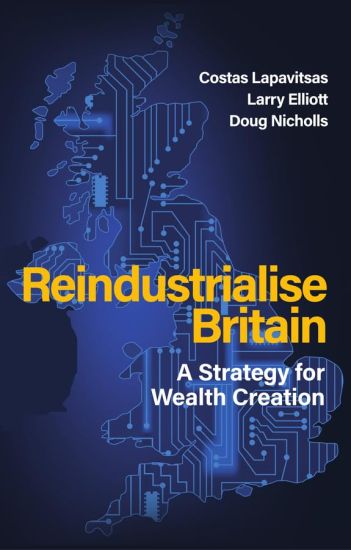
Britain is broken: its economy hollowed out, unbalanced, and unable to provide good livelihoods for millions. We import too much, make too little, and keep wages low. Neoliberalism has failed to deliver the prosperity it promised; deregulation and privatisation have eroded our productive base and fractured communities. This book puts forward a concrete, costed programme for real economic renewal: rebuilding the foundations of industry, expanding manufacturing, and lifting productivity through skilled work, investment, and domestic capability. This reindustrialisation strategy is a practical route to generating real wealth rather than recycling financial gains. To deliver it requires sovereignty to plan and invest, and democratic power to mobilise workers, skills, and institutions at the required scale. Strong rights at work, reskilling, and secure employment anchor the programme, supporting living standards, advancing Net Zero, and reducing the reliance on imported labour. This bold intervention is a blueprint for a programme that can take the whole country forward in a united, inclusive endeavour. Anyone who wishes to be part of the democratic movement that will be needed to make this happen should read this book.
The State of Capitalism
Costas Lapavitsas; The EReNSEP Writing Collective
Verso Books
2023
nidottu
Halvin toimitettuna 27,60 €
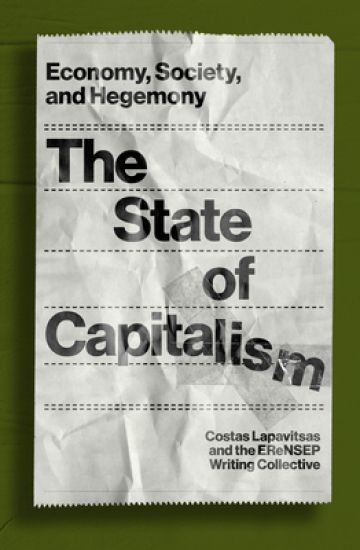
The health emergency that broke out in 2020 is a landmark event in the development of capitalism, confirming the underlying change signalled by the Great Crisis of 2007-9. The Pandemic Crisis has catapulted the state to the centre of economic activity. However, a historic impasse is steadily becoming apparent at the core of the world economy Productive accumulation is flaccid, as both profitability and labour productivity are weak. Financialisation has entered a new phase, as "shadow banking" grew relative to other banks but is entirely dependent on the state. The power of the state derives from command over fiat money and can certainly deliver enormous boosts to aggregate demand, but that is not enough to tackle the weakness of the productive sector. The rise in inflation for the first time in forty years indicates the impasse. There is a transparent need for intervention on the supply side, directly challenging capitalist property rights. There is no evidence, however, that the ruling blocs in core countries would engage in such policies. The Pandemic Crisis also brought to the fore fresh divisions of core and periphery across the world economy. Imperialism has assumed new forms, spurred by globally active financial capital and internationalised productive capital. A renewed contest for hegemony has emerged as US power declined. The economic challenge of China will unfold steadily in the years ahead, intensifying political tensions and military rivalries. This book is the work of a research collective comprising authors from several parts of the world. It analyses these vital issues from the perspective of Marxist political economy and puts forth alternative anticapitalist proposals.
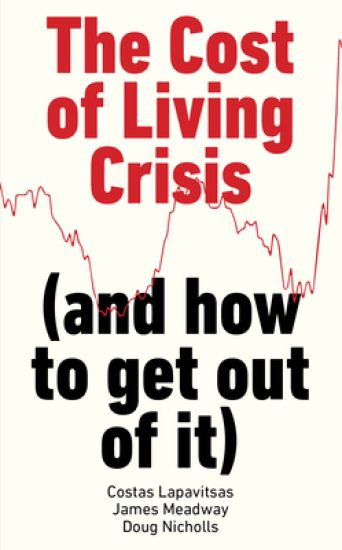
We are living through a cost of living crisis, with interest rate hikes and the prices of everyday consumables and energy bills sky-rocketing. Why is this happening? Sometimes we are told that wages are too high, or that the government has "printed" too much money or that events far away, such as the war in Ukraine, are solely to blame. The plain argument that high prices go together with high profits, falling wages, and weak production is often distorted and hidden by mainstream commentary in the media and elsewhere. This plain-speaking pamphlet tells it straight: the big businesses dominating production and distribution make huge profits out of high inflation, while working people lose out. It sets out factual evidence to illustrate that the source of record profits is the fall in real wages as inflation rises. A large part of the income of working people is being transferred directly into the profits of big business. The pamphlet shows that the deeper roots of the "cost of living crisis" lie in the very low investment and poor productivity growth for many years. The basic steps to resolving the crisis are simple: prices, especially of essentials, must be brought down, and wages, salaries, benefits, and pensions must be increased.
The Ottoman Empire went through rapid economic and social development in the late nineteenth and early twentieth centuries, as it approached its end. Profound changes took place in its European territories, particularly and prominently in Macedonia. In the decades before the First World War, industrial capitalism began to emerge in Ottoman Macedonia and its impact was felt across society. The port city of Salonica was at the epicentre of this transformation, led by its Jewish community. But the most remarkable site of development was found deep in provincial Macedonia, where industrial capitalism sprang from domestic sources in spite of unfavourable conditions. Ottoman Greek traders and industrialists from the region of Mount Vermion helped shape the economic trajectory of ‘Turkey in Europe’, and competed successfully against Jewish capitalists from Salonica. The story of Ottoman Macedonian capitalism was nearly forgotten in the century that followed the demise of the Empire. This book pieces it together by unearthing Ottoman archival materials combined with Greek sources and field research. It offers a fresh perspective on late Ottoman economic history and will be an invaluable resource for scholars of Ottoman, Greek and Turkish history. Published in Association with the British Institute at Ankara
Capitalism in the Ottoman Balkans
Costas Lapavitsas; Pinar Cakiroglu
I.B. Tauris
2019
sidottu
Halvin toimitettuna 217,90 €
The Ottoman Empire went through rapid economic and social development in the late nineteenth and early twentieth centuries, as it approached its end. Profound changes took place in its European territories, particularly and prominently in Macedonia. In the decades before the First World War, industrial capitalism began to emerge in Ottoman Macedonia and its impact was felt across society. The port city of Salonica was at the epicentre of this transformation, led by its Jewish community. But the most remarkable site of development was found deep in provincial Macedonia, where industrial capitalism sprang from domestic sources in spite of unfavourable conditions. Ottoman Greek traders and industrialists from the region of Mount Vermion helped shape the economic trajectory of ‘Turkey in Europe’, and competed successfully against Jewish capitalists from Salonica. The story of Ottoman Macedonian capitalism was nearly forgotten in the century that followed the demise of the Empire. This book pieces it together by unearthing Ottoman archival materials combined with Greek sources and field research. It offers a fresh perspective on late Ottoman economic history and will be an invaluable resource for scholars of Ottoman, Greek and Turkish history. Published in Association with the British Institute at Ankara
Many on the Left see the European Union as a fundamentally benign project with the potential to underpin ever greater cooperation and progress. If it has drifted rightward, the answer is to fight for reform from within. In this iconoclastic polemic, economist Costas Lapavitsas demolishes this view. He contends that the EU’s response to the Eurozone crisis represents the ultimate transformation of the union into a neoliberal citadel that institutionally embeds austerity, privatization, and wage cuts. Concurrently, the rise of German hegemony has divided the EU into an unstable core and dependent peripheries. These related developments make the EU impervious to meaningful reform. The solution is therefore a direct challenge to the EU project that stresses popular and national sovereignty as preconditions for true internationalist socialism. Lapavitsas’s powerful manifesto for a left opposition to the EU upends the wishful thinking that often characterizes the debate and will be a challenging read for all on the Left interested in the future of Europe.
This essential volume collects the papers of Costas Lapavistas, one of the first political economists to notice the ascendancy of money and finance as dominant features of contemporary capitalism. These ground breaking papers range far and wide, covering markets and money, finance and the enterprise, power and money, the financialisation of capitalism, finance and profit, and even the subject of money as art.
The collected papers of Costas Lapavitsas are a pathway to Marxist monetary theory, a field that continues to attract strong interest. The papers range far and wide, including markets and money, finance and the enterprise, power and money, the financialisation of capitalism, finance and profit, even money as art. Despite its breadth, the collection remains highly coherent. Money and finance are pre-eminent, even dominant, features of contemporary capitalism. Lapavitsas has been one of the first political economists to notice their ascendancy and to devote his research to it. He offers a resolutely Marxist perspective on contemporary capitalism while remaining conversant with the history of political economy, sensitive to mainstream economic theory, and fully aware of the empirical reality of financialisation.
Against the Troika
Heiner Flassbeck; Costas Lapavitsas; Oskar Lafontaine; Alberto Garzón Espinosa
Verso Books
2015
nidottu
On the 25th January 2015 the Greek people voted in an election of historic importance-not just for Greece but potentially all of Europe. The radical party Syriza was elected and austerity and the neoliberal agenda is being challenged. Suddenly it seems as if there is an alternative. But what? The Eurozone is in a deep and prolonged crisis. It is now clear that monetary union is a historic failure, beyond repair-and certainly not in the interests of Europe's working people. Building on the economic analysis of two of Europe's leading thinkers, Heiner Flassbeck and Costas Lapavitsas (a candidate standing for election on Syriza's list), Against the Troika is the first book to propose a strategic left-wing plan for how peripheral countries could exit the euro. With a change in government in Greece, and looming political transformations in countries such as Spain, this major intervention lays out a radical, anti-capitalist programme at a critical juncture for Europe. The final three chapters offer a detailed postmortem of the Greek catastrophe, explain what can be learned from it-and provide a possible alternative. Against the Troika is a practical blueprint for real change in a continent wracked by crisis and austerity.
Where does the power of money come from? Why is trust so important in financial operations? How does the swapping of gifts differ from the exchange of commodities? Where does self-interest stop and communal solidarity start in capitalist economies? These issues and many more are discussed in a rigorous, yet readable, manner in Social Foundations of Markets, Money and Credit. It is shown in particular that capitalist economies are permeated with non-economic characteristics. This carefully argued book will prove interesting and valuable to students and researchers not only in economics, but also in sociology and anthropology. Well-informed critics of capitalism will also find it a useful read.
How Finance Exploits Us All
Financialization is one of the most innovative concepts to emerge in the field of political economy in the last three decades, although there is no agreement on what exactly it is. Profiting Without Producing defines financialization in terms of the fundamental conduct of non-financial enterprises, banks and households. Its most prominent feature is the rise of financial profit, in part extracted directly from households through financial expropriation. Financialized capitalism is prone to crises, none greater than the gigantic turmoil that began in 2007. Using abundant empirical data, the book establishes the causes of the crisis and discusses the options broadly available for controlling finance.
The on-going economic crisis commenced in the sphere of finance, spread into production lines and quickly became a global recession. In Financialisation in Crisis, several well-known political economists draw on the insights of Marxist and other heterodox economics to argue that the turmoil of 2007-2009 represents a crisis of financialised capitalism, and is thus systemic and unusual. The book puts the crisis in its appropriate context, drawing on Marxist and other unorthodox economics to cast light on the broader implications of financialisation for society.
First, there was the credit crunch, and governments around the world stepped in to bail out the banks. The sequel to that debacle is the sovereign debt crisis, which has hit the eurozone hard. The hour has come to pay the piper, and ordinary citizens across Europe are growing to realize that socialism for the wealthy means punching a few new holes in their already-tightened belts. Building on his work as a leading member of the renowned Research on Money and Finance group, Costas Lapavitsas argues that European austerity is counterproductive. Cutbacks in public spending will mean a longer, deeper recession, worsen the burden of debt, further imperil banks, and may soon spell the end of monetary union itself. Crisis in the Eurozone charts a cautious path between political economy and radical economics to envisage a restructuring reliant on the forces of organized labour and civil society. The clear-headed rationalism at the heart of this book conveys a controversial message, unwelcome in many quarters but soon to be echoed across the continent: impoverished states have to quit the euro and cut their losses or worse hardship will ensue.
Where does the power of money come from? Why is trust so important in financial operations? How does the swapping of gifts differ from the exchange of commodities? Where does self-interest stop and communal solidarity start in capitalist economies? These issues and many more are discussed in a rigorous, yet readable, manner in Social Foundations of Markets, Money and Credit. It is shown in particular that capitalist economies are permeated with non-economic characteristics. This carefully argued book will prove interesting and valuable to students and researchers not only in economics, but also in sociology and anthropology. Well-informed critics of capitalism will also find it a useful read.