

Kirjailija
Cranford Pratt
Kirjat ja teokset yhdessä paikassa: 6 kirjaa, julkaisuja vuosilta 1988–2023, suosituimpiin kuuluu A New Deal In Central Africa. Vertaile teosten hintoja ja tarkista saatavuus suomalaisista kirjakaupoista.
6 kirjaa
Kirjojen julkaisuvuodet: 1988–2023.
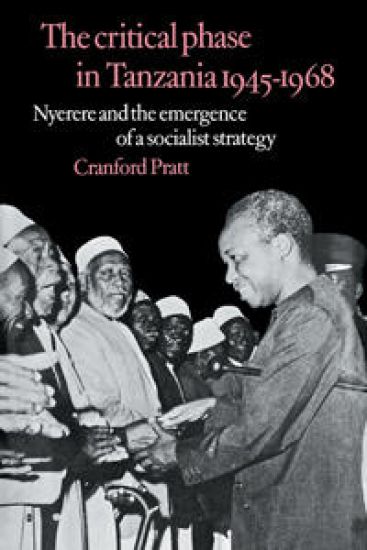
'How can a country which is poor, with few socialists and without either a strong proletariat or a radicalised peasantry be led to a socialist transformation of its values and institutions?' In January 1967 Julius Nyerere, President of Tanzania, made this the central preoccupation of his government and of his party, the Tanganyika African National Union. The emergence of that socialist commitment provides the central focus for this study of political leadership in Tanzania. Many independent countries are in the 'critical phase' in which the aspirations of their peoples race ahead of their productive capabilities. This study of the forces and considerations that led to the emergence of a democratic and socialist strategy of development in Tanzania is therefore of wide relevance elsewhere in Africa and the developing world.
Canadian International Development Assistance Policies
Cranford Pratt
McGill-Queen's University Press
1995
nidottu
Topics covered include Canadian food aid and the varied factors that have determined its use, the complex relationship between CIDA and Canadian non-governmental organizations, and CIDA assistance to the major multilateral institutions. There is also detailed discussion of CIDA's choice of recipient countries; its use of aid for trade promotion, human rights and development assistance; issues relating to the administration of the aid program; its recent support for the International Monetary Fund and World Bank leverage on the economic policies of the recipient countries; and two case studies, one of public policy dialogue on aid policies in Central America and the second of Canadian aid for development in Asia. In the final chapters the work of CIDA is assessed from a comparative international perspective and the editor, Cranford Pratt, reviews the main determinants of Canadian aid policy and explains why there has been such a significant erosion in CIDA's declared objective of helping the world's poor. This timely and important book contains contributions by Tim Brodhead, Marcia Burdette, Mark Charlton, Tim Draimin, David Gillies, Terence Keenleyside, David Morrison, Katharine Pearson, Cranford Pratt, David Protheroe, Phillip Rawkins, Martin Rudner, and Jean Philippe Therien.
During the 1970s the picture looked very different. The countries involved in the Organization for Economic Co-operation and Development gave the impression that they felt it their duty to help the Third World. Since the beginning of the 1980s, however, this attitude has disappeared from the foreign policy agenda of one developed country after another. It seems that only when a state's self-interest is at risk does a concern for humanistic values emerge. Canada, Denmark, the Netherlands, Norway, and Sweden -- the key middle powers -- have long been regarded as significantly more responsive to the needs of the Third World than most of the other rich industrialized nations. Middle Power Internationalism helps to identify the scope and limitations of the foreign policies of these middle power countries with respect to what Cranford Pratt terms "humane internationalism." Asbjrn Lvbraek describes the major effort in the 1970s to mobilize middle power support for the New International Economic Order. Bernard Wood considers the prospects for effective co-operation between the middle powers of the North and the South. And Raphael Kaplinsky studies the likely impact of new technologies and new methods of production on the economies, and consequently on the North-South policies, of the industrial middle powers. Cranford Pratt concludes with a reflective essay in which he discusses the constraints upon middle power internationalism and the future of middle power diplomacy.
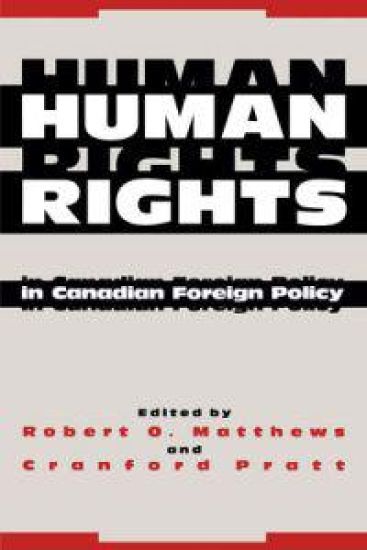
Human Rights in Canadian Foreign Policy
Robert O. Matthews; Cranford Pratt
McGill-Queen's University Press
1988
nidottu
The pattern revealed is one of deliberate ambiguity. On some issues and in some forums, Canada has acted vigorously to promote human rights internationally, as in the United Nations Human Rights Commission, the United Nations Committee on Human Rights, and the Conference on Security and Cooperation in Europe. Canada has been much less forceful about human rights in dealings with the International Labour Organization and has almost completely ignored this issue as it relates to international financial institutions. Canada has been outspoken about the violation of rights in countries ruled by communist regimes, while hesitation and ambiguity are a feature of Canadian policies toward South Africa and Central America, as well as in lending policies to international financial institutions, Canadian development assistance, and Canadian arms sales. Each of these areas is examined in Human Rights in Canadian Foreign Policy. Canada is most vigorous on issues of human rights when the rights in question are civil and political rather than economic and social, and when the offending regime is under Soviet rather than American influence. The contributors include: Frances Arbour, Victoria Berry, John W. Foster, Rhoda E. Howard, Kalmen Kaplansky, T. A. Keenleyside, Allen McChesney, Ronald Manzer, Robert O. Matthews, Stefania Szlek Miller, Cathal J. Nolan, Kim Richard Nossal, Cranford Pratt, Renate Pratt, Ernie Regehr, and H. Gordon Skilling.