Kirjojen hintavertailu – 12 876 017 kirjaa ja 26 kauppaa

Kirjailija

Cristina Stoica

Kirjat ja teokset yhdessä paikassa: 3 kirjaa, julkaisuja vuosilta 2009–2013, suosituimpiin kuuluu Zonotopes. Vertaile teosten hintoja ja tarkista saatavuus suomalaisista kirjakaupoista.

3 kirjaa

Kirjojen julkaisuvuodet: 2009–2013.

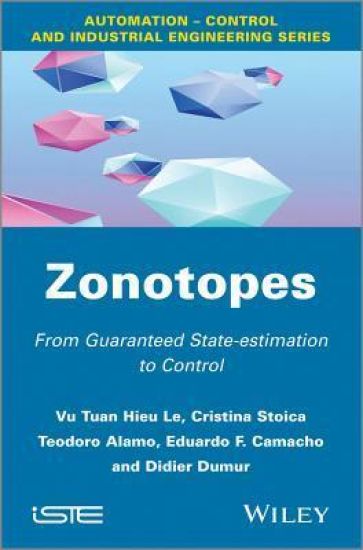
Zonotopes

Zonotopes

Vu Tuan Hieu Le; Cristina Stoica; Teodoro Alamo; Eduardo F. Camacho; Didier Dumur

ISTE Ltd and John Wiley Sons Inc
2013
sidottu
This title focuses on two significant problems in the field of automatic control, in particular state estimation and robust Model Predictive Control under input and state constraints, bounded disturbances and measurement noises. The authors build upon previous results concerning zonotopic set-membership state estimation and output feedback tube-based Model Predictive Control. Various existing zonotopic set-membership estimation methods are investigated and their advantages and drawbacks are discussed, making this book suitable both for researchers working in automatic control and industrial partners interested in applying the proposed techniques to real systems. The authors proceed to focus on a new method based on the minimization of the P-radius of a zonotope, in order to obtain a good trade-off between the complexity and the accuracy of the estimation. They propose a P-radius based set-membership estimation method to compute a zonotope containing the real states of a system, which are consistent with the disturbances and measurement noise. The problem of output feedback control using a zonotopic set-membership estimation is also explored. Among the approaches from existing literature on the subject, the implementation of robust predictive techniques based on tubes of trajectories is developed. Contents 1. Uncertainty Representation Based on Set Theory. 2. Several Approaches on Zonotopic Guaranteed Set-Membership Estimation. 3. Zonotopic Guaranteed State Estimation Based on P-Radius Minimization. 4. Tube Model Predictive Control Based on Zonotopic Set-Membership Estimation. About the Authors Vu Tuan Hieu Le is a Research Engineer at the IRSEEM/ESIGELEC Technopôle du Madrillet, Saint Etienne du Rouvray, France. Cristina Stoica is Assistant Professor in the Automatic Control Department at SUPELEC Systems Sciences (E3S), France. Teodoro Alamo is Professor in the Department of Systems Engineering and Automatic Control at the University of Seville, Spain. Eduardo F. Camacho is Professor in the Department of Systems Engineering and Automatic Control at the University of Seville, Spain. Didier Dumur is Professor in the Automatic Control Department, SUPELEC Systems Sciences (E3S), France.
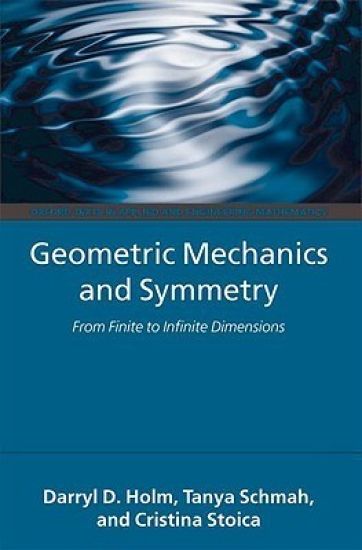
Geometric Mechanics and Symmetry

Geometric Mechanics and Symmetry

Darryl D. Holm; Tanya Schmah; Cristina Stoica

Oxford University Press
2009
nidottu
Classical mechanics, one of the oldest branches of science, has undergone a long evolution, developing hand in hand with many areas of mathematics, including calculus, differential geometry, and the theory of Lie groups and Lie algebras. The modern formulations of Lagrangian and Hamiltonian mechanics, in the coordinate-free language of differential geometry, are elegant and general. They provide a unifying framework for many seemingly disparate physical systems, such as n–particle systems, rigid bodies, fluids and other continua, and electromagnetic and quantum systems. Geometric Mechanics and Symmetry is a friendly and fast-paced introduction to the geometric approach to classical mechanics, suitable for a one- or two- semester course for beginning graduate students or advanced undergraduates. It fills a gap between traditional classical mechanics texts and advanced modern mathematical treatments of the subject. After a summary of the necessary elements of calculus on smooth manifolds and basic Lie group theory, the main body of the text considers how symmetry reduction of Hamilton's principle allows one to derive and analyze the Euler-Poincaré equations for dynamics on Lie groups. Additional topics deal with rigid and pseudo-rigid bodies, the heavy top, shallow water waves, geophysical fluid dynamics and computational anatomy. The text ends with a discussion of the semidirect-product Euler-Poincaré reduction theorem for ideal fluid dynamics. A variety of examples and figures illustrate the material, while the many exercises, both solved and unsolved, make the book a valuable class text.
Geometric Mechanics and Symmetry

Geometric Mechanics and Symmetry

Darryl D. Holm; Tanya Schmah; Cristina Stoica

Oxford University Press
2009
sidottu
Classical mechanics, one of the oldest branches of science, has undergone a long evolution, developing hand in hand with many areas of mathematics, including calculus, differential geometry, and the theory of Lie groups and Lie algebras. The modern formulations of Lagrangian and Hamiltonian mechanics, in the coordinate-free language of differential geometry, are elegant and general. They provide a unifying framework for many seemingly disparate physical systems, such as n–particle systems, rigid bodies, fluids and other continua, and electromagnetic and quantum systems. Geometric Mechanics and Symmetry is a friendly and fast-paced introduction to the geometric approach to classical mechanics, suitable for a one- or two- semester course for beginning graduate students or advanced undergraduates. It fills a gap between traditional classical mechanics texts and advanced modern mathematical treatments of the subject. After a summary of the necessary elements of calculus on smooth manifolds and basic Lie group theory, the main body of the text considers how symmetry reduction of Hamilton's principle allows one to derive and analyze the Euler-Poincaré equations for dynamics on Lie groups. Additional topics deal with rigid and pseudo-rigid bodies, the heavy top, shallow water waves, geophysical fluid dynamics and computational anatomy. The text ends with a discussion of the semidirect-product Euler-Poincaré reduction theorem for ideal fluid dynamics. A variety of examples and figures illustrate the material, while the many exercises, both solved and unsolved, make the book a valuable class text.