
Kirjojen hintavertailu – 12 903 725 kirjaa ja 27 kauppaa

Kirjailija

Csilla Bertha

Kirjat ja teokset yhdessä paikassa: 2 kirjaa, julkaisuja vuosilta 1991–1992, suosituimpiin kuuluu The Celebration of the Fantastic. Vertaile teosten hintoja ja tarkista saatavuus suomalaisista kirjakaupoista.

2 kirjaa

Kirjojen julkaisuvuodet: 1991–1992.

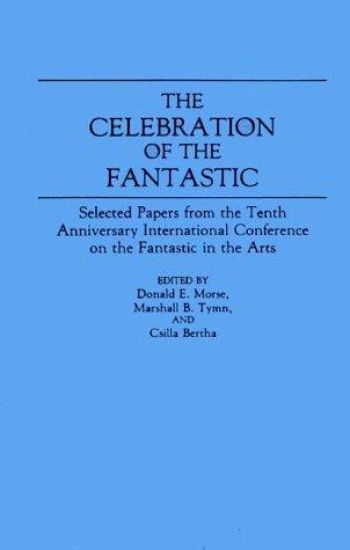
The Celebration of the Fantastic

The Celebration of the Fantastic

Csilla Bertha; Donald Morse; Marshall B. Tymn

Praeger Publishers Inc
1992
sidottu
The Celebration of the Fantastic reaffirms the wide range and validity of the subject, treatment, and approach that the fantastic demands. Twenty-five essays, selected from among the more than 230 presented at the Tenth Anniversary Conference of the IAFA, consider writers as diverse as Stephen King, Doris Lessing, Rudyard Kipling, Loren Eiseley, Mary Stewart, Bernard Malamud, Orson Scott Card, Toni Morrison, Henry James, and Ray Bradbury as well as television personalities, film directors, and German and Hungarian visual artists. Also included are essays on science fiction writers Robert Silverberg, Joe Haldeman, and Greg Bear. Some of the more provocative work is on Feminist Fantasy and Open Structure, The Greatest Fantasy on Earth: The Superweapon in Fiction and Fact, Virtual Space and Its Boundaries in Science Fiction Film and Television, The Fantastic in German Democratic Republic Literature, Csontvary: The Painter of the Sun's Path, and The Shaman in Modern Fantasy. The essays illustrate the essential theme of the fantastic: the testing of the limits of civilization and the questioning of commonly accepted values and ideas as writers and artists explore the hidden and the repressed.
More Real Than Reality

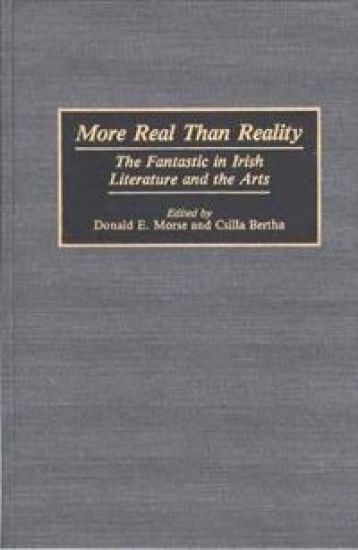
More Real Than Reality

Csilla Bertha; Donald Morse

Praeger Publishers Inc
1991
sidottu
For many readers, the Irish and the fantastic are synonymous. From the ancient texts and medieval illuminated manuscripts to 20th century poetry, painting, drama, stories, and novels, Irish writers and artists have found the fantastic not only congenial but necessary to their art. In his introduction to this collection of fifteen essays that focus on the fantastic in Irish literature and the arts, Donald E. Morse contends that the use of the fantastic mode has allowed Irish writers and artists to express ideas, emotions, and insights not available through the direct imitation of everyday reality. Morse argues that for the Irish, the road to insight was often through the territory of the marvelous and the fantastic rather than through literalism, rationalism, or logic. In seeking to arrive at a definition of what constitutes the fantastic, Morse looks at work by Sean O'Casey and Seamus Heaney and finds that the fantastic occurs during encounters with what is considered to be the impossible, a concept contingent upon personal beliefs. To demonstrate how the fantastic may yield new insights into human beings, their behavior, feelings, and thoughts, as well as lead to innovations in art, Morse scrutinizes Circe from James Joyce's Ulysses, probably the most famous use of the fantastic in all modern Irish literature. The works of Yeats, Field, Shelly, Synge, Beckett, Swift, Coleridge, and others are examined in incisive chapters written from the point of view of the fantastic. The four-part study begins with a section on Ancient Knowledge and the Fantastic in which four chapters discuss Yeats's plays; The Figure of the Mermaid in Irish Legend and Poetry; Ghosts in Irish Drama; and The Only Jealousy of Emer. In a section devoted to Irish theatre, music, and painting, the paintings of Jack B. Yeats are examined for fantastic content and Peter Egri finds parallels between the work of John Field and Chopin, Shelly, and Turner. The plays of Synge, O'Casey, Beckett, and Thomas Murphy are the subject of Part III. The final section considers The Occult, Fantasy, and Phantasmagoria in Swift, Dunsany, Joyce, and Yeats. The coeditors' afterword, Looking Backward, Looking Ahead, concludes the volume which also contains a select bibliography on the fantastic. Generalists in literature or the arts, students and scholars of Irish Studies and the fantastic in the arts, as well as those enamored of things Irish will find this collection resonant with rich insights into the genre.