Kirjojen hintavertailu – 12 903 725 kirjaa ja 27 kauppaa

Kirjailija

Cybelle Fox

Kirjat ja teokset yhdessä paikassa: 4 kirjaa, julkaisuja vuosilta 2005–2027, suosituimpiin kuuluu Unauthorized Welfare. Vertaile teosten hintoja ja tarkista saatavuus suomalaisista kirjakaupoista.

4 kirjaa

Kirjojen julkaisuvuodet: 2005–2027.

Unauthorized Welfare

Unauthorized Welfare

Cybelle Fox

PRINCETON UNIVERSITY PRESS
2027
pokkari
The evolution of federal welfare policies between the 1930s and the 1970s, and the roots of today’s anti-immigrant politics Between 1935 and 1972, US federal welfare policy did not distinguish between citizens and noncitizens. Noncitizens, including unauthorized immigrants, were eligible for Social Security and unemployment insurance as well as other mean-tested programs. But that changed in the 1970s, when the federal government first barred unauthorized immigrants from virtually all federal welfare programs and loosened confidentiality provisions that prohibited health and welfare officials from sharing information with immigration authorities. In Unauthorized Welfare, Cybelle Fox examines the emergence of federal immigrant status restrictions in American social welfare policy and describes its wide-ranging effects. She shows that, contrary to previous accounts, the roots of today’s anti-immigrant politics are found not in the 1990s, when California’s Proposition 187 banned undocumented immigrants from almost all nonemergency services, but in the 1970s with the new federal constraints. Fox explores the consequences of this restrictive turn in federal welfare policy for undocumented immigrants, their US-citizen family members, and anyone suspected of being in the country without authorization—especially Mexicans and Mexican Americans. She also considers the effects on state and local communities, which were no longer reimbursed for the costs of care they provided to unauthorized immigrants. Over time, federal restrictions increased intergovernmental tensions, contributed to popular nativism, and helped propel the passage of anti-immigrant state and federal initiatives two decades later. With Unauthorized Welfare, Fox sheds new light on the origins of anti-immigrant policies and politics.

Unauthorized Welfare

Unauthorized Welfare

Cybelle Fox

PRINCETON UNIVERSITY PRESS
2027
sidottu
The evolution of federal welfare policies between the 1930s and the 1970s, and the roots of today’s anti-immigrant politics Between 1935 and 1972, US federal welfare policy did not distinguish between citizens and noncitizens. Noncitizens, including unauthorized immigrants, were eligible for Social Security and unemployment insurance as well as other mean-tested programs. But that changed in the 1970s, when the federal government first barred unauthorized immigrants from virtually all federal welfare programs and loosened confidentiality provisions that prohibited health and welfare officials from sharing information with immigration authorities. In Unauthorized Welfare, Cybelle Fox examines the emergence of federal immigrant status restrictions in American social welfare policy and describes its wide-ranging effects. She shows that, contrary to previous accounts, the roots of today’s anti-immigrant politics are found not in the 1990s, when California’s Proposition 187 banned undocumented immigrants from almost all nonemergency services, but in the 1970s with the new federal constraints. Fox explores the consequences of this restrictive turn in federal welfare policy for undocumented immigrants, their US-citizen family members, and anyone suspected of being in the country without authorization—especially Mexicans and Mexican Americans. She also considers the effects on state and local communities, which were no longer reimbursed for the costs of care they provided to unauthorized immigrants. Over time, federal restrictions increased intergovernmental tensions, contributed to popular nativism, and helped propel the passage of anti-immigrant state and federal initiatives two decades later. With Unauthorized Welfare, Fox sheds new light on the origins of anti-immigrant policies and politics.
Three Worlds of Relief

Three Worlds of Relief

Cybelle Fox

Princeton University Press
2012
pokkari
Three Worlds of Relief examines the role of race and immigration in the development of the American social welfare system by comparing how blacks, Mexicans, and European immigrants were treated by welfare policies during the Progressive Era and the New Deal. Taking readers from the turn of the twentieth century to the dark days of the Depression, Cybelle Fox finds that, despite rampant nativism, European immigrants received generous access to social welfare programs. The communities in which they lived invested heavily in relief. Social workers protected them from snooping immigration agents, and ensured that noncitizenship and illegal status did not prevent them from receiving the assistance they needed. But that same helping hand was not extended to Mexicans and blacks. Fox reveals, for example, how blacks were relegated to racist and degrading public assistance programs, while Mexicans who asked for assistance were deported with the help of the very social workers they turned to for aid. Drawing on a wealth of archival evidence, Fox paints a riveting portrait of how race, labor, and politics combined to create three starkly different worlds of relief. She debunks the myth that white America's immigrant ancestors pulled themselves up by their bootstraps, unlike immigrants and minorities today. Three Worlds of Relief challenges us to reconsider not only the historical record but also the implications of our past on contemporary debates about race, immigration, and the American welfare state.
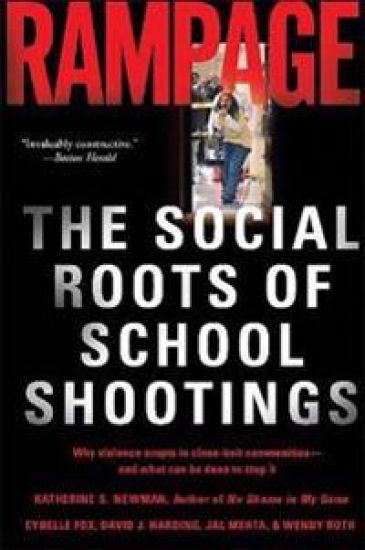
Rampage

Rampage

Cybelle Fox; David Harding; Jal Mehta; Katherine Newman; Wendy Roth

Basic Books
2005
pokkari
The first study to examine violence in small towns and suburbs uses interviews with more than two hundred people to challenge the "loner theory" and illuminate the role of parents, communities, and schools in missing the warning signs.