Kirjojen hintavertailu – 12 903 725 kirjaa ja 27 kauppaa

Kirjailija

Cynthia Rosenzweig

Kirjat ja teokset yhdessä paikassa: 4 kirjaa, julkaisuja vuosilta 2008–2022, suosituimpiin kuuluu Climate Change Risks and Food Security in Bangladesh. Vertaile teosten hintoja ja tarkista saatavuus suomalaisista kirjakaupoista.

4 kirjaa

Kirjojen julkaisuvuodet: 2008–2022.

Climate Change Risks and Food Security in Bangladesh

Climate Change Risks and Food Security in Bangladesh

Winston Yu; Mozaharul Alam; Ahmadul Hassan; Abu Saleh Khan; Alex Ruane; Cynthia Rosenzweig; David Major; James Thurlow

Routledge
2016
nidottu
Managing climate variability and change remains a key development and food security issue in Bangladesh. Despite significant investments, floods, droughts, and cyclones during the last two decades continue to cause extensive economic damage and impair livelihoods. Climate change will pose additional risks to ongoing efforts to reduce poverty. This book examines the implications of climate change on food security in Bangladesh and identifies adaptation measures in the agriculture sector using a comprehensive integrated framework. First, the most recent science available is used to characterize current climate and hydrology and its potential changes. Second, country-specific survey and biophysical data is used to derive more realistic and accurate agricultural impact functions and simulations. A range of climate risks (i.e. warmer temperatures, higher carbon dioxide concentrations, changing characteristics of floods, droughts and potential sea level rise) is considered to gain a more complete picture of potential agriculture impacts. Third, while estimating changes in production is important, economic responses may to some degree buffer against the physical losses predicted, and an assessment is made of these. Food security is dependent not only on production, but also future food requirements, income levels and commodity prices. Finally, adaptation possibilities are identified for the sector. This book is the first to combine these multiple disciplines and analytical procedures to comprehensively address these impacts. The framework will serve as a useful guide to design policy intervention strategies and investments in adaptation measures.
Climate Change Risks and Food Security in Bangladesh

Climate Change Risks and Food Security in Bangladesh

Winston Yu; Mozaharul Alam; Ahmadul Hassan; Abu Saleh Khan; Alex Ruane; Cynthia Rosenzweig; David Major; James Thurlow

Earthscan Ltd
2010
sidottu
Managing climate variability and change remains a key development and food security issue in Bangladesh. Despite significant investments, floods, droughts, and cyclones during the last two decades continue to cause extensive economic damage and impair livelihoods. Climate change will pose additional risks to ongoing efforts to reduce poverty. This book examines the implications of climate change on food security in Bangladesh and identifies adaptation measures in the agriculture sector using a comprehensive integrated framework. First, the most recent science available is used to characterize current climate and hydrology and its potential changes. Second, country-specific survey and biophysical data is used to derive more realistic and accurate agricultural impact functions and simulations. A range of climate risks (i.e. warmer temperatures, higher carbon dioxide concentrations, changing characteristics of floods, droughts and potential sea level rise) is considered to gain a more complete picture of potential agriculture impacts. Third, while estimating changes in production is important, economic responses may to some degree buffer against the physical losses predicted, and an assessment is made of these. Food security is dependent not only on production, but also future food requirements, income levels and commodity prices. Finally, adaptation possibilities are identified for the sector. This book is the first to combine these multiple disciplines and analytical procedures to comprehensively address these impacts. The framework will serve as a useful guide to design policy intervention strategies and investments in adaptation measures.
Climate Change and U.S. Cities

Climate Change and U.S. Cities

William D Solecki; Cynthia Rosenzweig

Island Press
2022
pokkari
Approximately 80% of the U. S. population now lives in urban metropolitan areas, and this number is expected to grow significantly in the coming years. At the same time, the built infrastructure sustaining these populations has become increasingly vulnerable to climate change. Stresses to existing systems, such as buildings, energy, transportation, water, and sanitation are growing. If the status quo continues, these systems will be unable to support a high quality of life for urban residents over the next decades, a vulnerability exacerbated by climate change impacts. Understanding this dilemma and identifying a path forward is particularly important as cities are becoming leading agents of climate action. Prepared as a follow-up to the Fourth National Climate Assessment (NCA), Climate Change and U. S. Cities documents the current understanding of existing and future climate risk for U. S. cities, urban systems, and the residents that depend on them. Beginning with an examination of the existing science since 2012, chapters develop connections between existing and emerging climate risk, adaptation planning, and the role of networks and organizations in facilitating climate action in cities. From studies revealing disaster vulnerability among low-income populations to the development of key indicators for tracking climate change, this is an essential, foundational analysis. Importantly, the assessment puts a critical emphasis on the cross-cutting factors of economics, equity, and governance. Urban stakeholders and decision makers will come away with a full picture of existing climate risks and a set of conclusions and recommendations for action. Many cities in the United States still have not yet planned for climate change and the costs of inaction are great. With bold analysis, Climate Change and U. S. Cities reveals the need for action and the tools that cities must harness to effect decisive, meaningful change.
Climate Variability and the Global Harvest

Climate Variability and the Global Harvest

Cynthia Rosenzweig; Daniel Hillel

Oxford University Press Inc
2008
sidottu
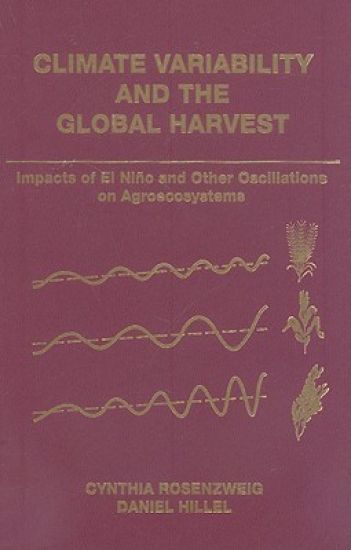
The Earth's climate is constantly changing. Some of the changes are progressive, while others fluctuate at various time scales. The El Niño-la Niña cycle is one such fluctuation that recurs every few years and has far-reaching impacts. It generally appears at least once per decade, but this may vary with our changing climate. The exact frequency, sequence, duration and intensity of El Niño's manifestations, as well as its effects and geographic distributions, are highly variable. The El Niño-la Niña cycle is particularly challenging to study due to its many interlinked phenomena that occur in various locations around the globe. These worldwide teleconnections are precisely what makes studying El Niño-la Niña so important. Cynthia Rosenzweig and Daniel Hillel describe the current efforts to develop and apply a global-to-regional approach to climate-risk management. They explain how atmospheric and social scientists are cooperating with agricultural practitioners in various regions around the world to determine how farmers may benefit most from new climate predictions. Specifically, the emerging ability to predict the El Niño-Southern Oscillation (ENSO) cycle offers the potential to transform agricultural planning worldwide. Biophysical scientists are only now beginning to recognize the large-scale, globally distributed impacts of ENSO on the probabilities of seasonal precipitation and temperature regimes. Meanwhile, social scientists have been researching how to disseminate forecasts more effectively within rural communities. Consequently, as the quality of climatic predictions have improved, the dissemination and presentation of forecasts have become more effective as well. This book explores the growing understanding of the interconnectedness of climate predictions and productive agriculture for sustainable development, as well as methods and models used to study this relationship.