Kirjojen hintavertailu – 12 903 725 kirjaa ja 27 kauppaa

Kirjailija

Damien Cahill

Kirjat ja teokset yhdessä paikassa: 8 kirjaa, julkaisuja vuosilta 2012–2024, suosituimpiin kuuluu The End of Laissez-Faire?. Vertaile teosten hintoja ja tarkista saatavuus suomalaisista kirjakaupoista.

8 kirjaa

Kirjojen julkaisuvuodet: 2012–2024.

The Economy in Society

The Economy in Society

Damien Cahill

Routledge
2024
nidottu
The notion that when governments regulate the economy they are ‘intervening’ or ‘interfering’ in an otherwise natural, self-regulating sphere is ubiquitous in mainstream economic commentary. Such a notion has its roots in orthodox neoclassical economics which has historically assumed that the economy and society are separate and antithetical spheres of human conduct. This is demonstrably not the case and the economy is fundamentally socially embedded. This book introduces a range of heterodox traditions of economic thought – Keynesian, Institutional, Marxist and Feminist – which offer alternative understanding of the economy. It explores the insights gleaned from these traditions including the social relations of production at the heart of capitalist economies; the essential role of institutions such as states and firms; the role of social expectations and norms in structuring economic behaviour; the way that gender shapes the distribution of economic resources; processes of commodification; and the way in which ‘social structures of accumulation’ provide stability and order to capitalist economies over time. Offering a critical perspective, the book also explores the contradictions and within and between each of these traditions. Written in an accessible form, this text provides readers with the tools with which to view markets as underpinned by a range of social institutions – including state regulations, class and gender relations as well as social norms – and thus to counter the mystifications of orthodox economics with a more realistic appreciation of how economies are actually constituted in practice.

The Economy in Society

The Economy in Society

Damien Cahill

Routledge
2024
sidottu
The notion that when governments regulate the economy they are ‘intervening’ or ‘interfering’ in an otherwise natural, self-regulating sphere is ubiquitous in mainstream economic commentary. Such a notion has its roots in orthodox neoclassical economics which has historically assumed that the economy and society are separate and antithetical spheres of human conduct. This is demonstrably not the case and the economy is fundamentally socially embedded. This book introduces a range of heterodox traditions of economic thought – Keynesian, Institutional, Marxist and Feminist – which offer alternative understanding of the economy. It explores the insights gleaned from these traditions including the social relations of production at the heart of capitalist economies; the essential role of institutions such as states and firms; the role of social expectations and norms in structuring economic behaviour; the way that gender shapes the distribution of economic resources; processes of commodification; and the way in which ‘social structures of accumulation’ provide stability and order to capitalist economies over time. Offering a critical perspective, the book also explores the contradictions and within and between each of these traditions. Written in an accessible form, this text provides readers with the tools with which to view markets as underpinned by a range of social institutions – including state regulations, class and gender relations as well as social norms – and thus to counter the mystifications of orthodox economics with a more realistic appreciation of how economies are actually constituted in practice.
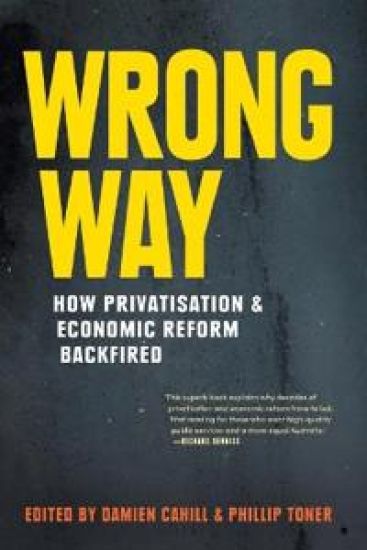
Wrong Way: How Privatisation and Economic Reform Backfired

Wrong Way: How Privatisation and Economic Reform Backfired

Damien Cahill; Phillip Toner

La Trobe University Press
2018
pokkari
Since the 1980s, waves of neoliberal 'economic reform' have transformed Australia. Privatisation, deregulation, marketisation and the contracting out of government services- for three decades now, there has been widespread agreement among policymakers on the desirability of these strategies. But the benefits of economic reform are increasingly being questioned. Alongside growing voter disenchantment, new voices of dissent argue that instead of efficiency and improved services, economic reform has led to unaccountable oligopolies, increased prices, reduced productivity and degradation of the public good. In Wrong Way, Australia's leading economists and public intellectuals do a cost-benefit analysis of economic reform across key areas. Have these reforms been worthwhile for the Australian community and its economy? Have they given us a better society, as promised?'Has privatisation led to more productivity-enhancing competition? Has deregulation increased economic welfare in energy, finance, health, education and labour markets? Does the lived experience of Australians measure up to the promise of economic reform? The authors answer these questions with conclusions that are both compelling and disturbing.'--Emeritus professor Roy Green, University of Technology SydneyDamien Cahill & Phillip Toner on Economic ReformElizabeth Hill & Matt Wade on Early Childhood Education And CareStephen Duckett on Private Health InsurancePhillip Toner on Vocational Education And TrainingJane Andrew & Max Baker on PrisonsBob Davidson on Aged CarePaul Davies on Public Sector EngineeringSue Olney & Wilma Gallet on Employment ServicesJohn Quiggin on ElectricityJim Stanford on Labour MarketsEvan Jones on BankingPeter Phibbs & Nicole Gurran on HousingLee Ridge on The NBNBen Spies-Butcher & Gareth Bryant on UniversitiesMichael Beggs on Monetary Policy And UnemploymentJohn Quiggin on ProductivityPeter Brain on Orthodox Economic ModelsPatricia Ranald on Free TradeDavid Richardson on Foreign InvestmentFrank Stilwell on Inequality
Neoliberalism

Neoliberalism

Damien Cahill; Martijn Konings

Polity Press
2017
nidottu
For over three decades neoliberalism has been the dominant economic ideology. While it may have emerged relatively unscathed from the global financial crisis of 2007-8, neoliberalism is now - more than ever - under scrutiny from critics who argue that it has failed to live up to its promises, creating instead an increasingly unequal and insecure world. This book offers a nuanced and probing analysis of the meaning and practical application of neoliberalism today, separating myth from reality. Drawing on examples such as the growth of finance, the role of corporate power and the rise of workfare, the book advances a balanced but distinctive perspective on neoliberalism as involving the interaction of ideas, material economic change and political transformations. It interrogates claims about the impending death of neoliberalism and considers the sources of its resilience in the current climate of political disenchantment and economic austerity. Clearly and accessibly written, this book will be a valuable resource for students and scholars across the social sciences.
Neoliberalism

Neoliberalism

Damien Cahill; Martijn Konings

Polity Press
2017
sidottu
For over three decades neoliberalism has been the dominant economic ideology. While it may have emerged relatively unscathed from the global financial crisis of 2007-8, neoliberalism is now - more than ever - under scrutiny from critics who argue that it has failed to live up to its promises, creating instead an increasingly unequal and insecure world. This book offers a nuanced and probing analysis of the meaning and practical application of neoliberalism today, separating myth from reality. Drawing on examples such as the growth of finance, the role of corporate power and the rise of workfare, the book advances a balanced but distinctive perspective on neoliberalism as involving the interaction of ideas, material economic change and political transformations. It interrogates claims about the impending death of neoliberalism and considers the sources of its resilience in the current climate of political disenchantment and economic austerity. Clearly and accessibly written, this book will be a valuable resource for students and scholars across the social sciences.
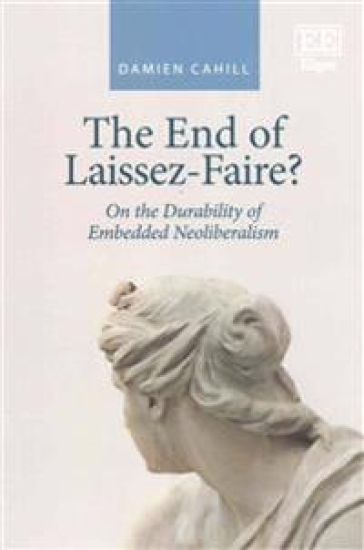
The End of Laissez-Faire?

The End of Laissez-Faire?

Damien Cahill

Edward Elgar Publishing Ltd
2015
nidottu
When the global financial crisis hit in 2007, many commentators thought it heralded the end of neoliberalism. Several years later, neoliberalism continues to dominate policy making. This book sets out why such commentators got it so wrong, and why neoliberalism remains so durable in the face of crisis. This book is the first comprehensive critique of the dominant 'ideas-centered' approach to understanding neoliberalism. It offers an alternative view of neoliberalism as a policy regime that is embedded in institutions, class relations and ideological norms. Damien Cahill argues that the socially embedded nature of neoliberalism explains why policy makers continue to use neoliberal policies as forms of crisis response, even though the crisis itself resulted from several decades of neoliberal restructuring. It takes aim at dominant interpretations of neoliberalism, arguing that it is wrongly viewed as reflecting neoliberal free market ideals, or as resulting from the influence of fundamentalist neoliberal intellectuals. The book concludes with a prognosis of the future prospects for neoliberalism. The End of Laissez-Faire? is a compelling and insightful analysis of neoliberalism, which will appeal to scholars and students of public policy, political science, sociology, political economy, anthropology, human geography, industrial relations and economics-related studies.
The End of Laissez-Faire?

The End of Laissez-Faire?

Damien Cahill

Edward Elgar Publishing Ltd
2014
sidottu
When the global financial crisis hit in 2007, many commentators thought it heralded the end of neoliberalism. Several years later, neoliberalism continues to dominate policy making. This book sets out why such commentators got it so wrong, and why neoliberalism remains so durable in the face of crisis. This book is the first comprehensive critique of the dominant 'ideas-centered' approach to understanding neoliberalism. It offers an alternative view of neoliberalism as a policy regime that is embedded in institutions, class relations and ideological norms. Damien Cahill argues that the socially embedded nature of neoliberalism explains why policy makers continue to use neoliberal policies as forms of crisis response, even though the crisis itself resulted from several decades of neoliberal restructuring. It takes aim at dominant interpretations of neoliberalism, arguing that it is wrongly viewed as reflecting neoliberal free market ideals, or as resulting from the influence of fundamentalist neoliberal intellectuals. The book concludes with a prognosis of the future prospects for neoliberalism. The End of Laissez-Faire? is a compelling and insightful analysis of neoliberalism, which will appeal to scholars and students of public policy, political science, sociology, political economy, anthropology, human geography, industrial relations and economics-related studies.
Market Society

Market Society

Benjamin Spies-Butcher; Joy Paton; Damien Cahill

Cambridge University Press
2012
pokkari
Market Society: History, Theory, Practice explores the social basis of economic life, from the emergence of market society in feudal England to the complex and interwoven markets of modern capitalist society. This lively and accessible book draws upon a variety of theories to examine the social structures at the heart of capitalist economies. It considers how capitalism is constituted, the institutions that regulate economic processes in market society and the experience of living in contemporary market societies. Market Society: History, Theory, Practice provides students of both political economy and economic sociology with a more nuanced understanding of how markets and people interact and how this relationship has influenced the nature and structure of modern economies.