Kirjojen hintavertailu – 12 876 352 kirjaa ja 26 kauppaa

Kirjailija

Dan Sperber

Kirjat ja teokset yhdessä paikassa: 8 kirjaa, julkaisuja vuosilta 1995–2019, suosituimpiin kuuluu Förnuft och fördom : varför vi tänker som vi gör. Vertaile teosten hintoja ja tarkista saatavuus suomalaisista kirjakaupoista.

8 kirjaa

Kirjojen julkaisuvuodet: 1995–2019.

Förnuft och fördom : varför vi tänker som vi gör

Förnuft och fördom : varför vi tänker som vi gör

Dan Sperber; Hugo Mercier

Fri Tanke Förlag
2019
sidottu
Förnuftet sägs vara en unik egenskap för oss människor, grunden för vår kunskap och visdom. Men om förnuftet är så viktigt, varför har det inte utvecklats hos andra djur? Om förnuftet är att lita på, varför har det gett upphov till så mycket nonsens? Förnuft och fördom skrotar idén om det ensamma geniet. Hugo Mercier och Dan Sperber argumenterar för att förnuftet är en kollektiv färdighet som utvecklats för att övertyga andra, bedöma olika argument och motivera våra handlingar. Författarna förklarar de svagheter och styrkor som länge har förvirrat filosofer och psykologer varför förnuftet är partiskt till fördel för sådant som vi redan tror på, varför det bidrar till förskräckliga idéer men ändå är oumbärligt för att sprida bra idéer. Med ett förord av Åsa Wikforss, professor i teoretisk filosofi. Hugo Mercier är kognitionsforskare och psykolog med fokus på förnuftets funktion hos människan. Han har skrivit för edge.org, Psychology Today, samt hållit en TED-föreläsning. Dan Sperber är kognitionsforskare som bland annat arbetat med kognitiv antropologi och lingvistik. Han är ordförande för den tvärvetenskapliga forskningsinstitutionen International Cognition and Culture Institute.
The Enigma of Reason

The Enigma of Reason

Hugo Mercier; Dan Sperber

HARVARD UNIVERSITY PRESS
2019
nidottu
"Brilliant... Timely and necessary." --Financial Times "Especially timely as we struggle to make sense of how it is that individuals and communities persist in holding beliefs that have been thoroughly discredited." --Darren Frey, Science If reason is what makes us human, why do we behave so irrationally? And if it is so useful, why didn't it evolve in other animals? This groundbreaking account of the evolution of reason by two renowned cognitive scientists seeks to solve this double enigma. Reason, they argue, helps us justify our beliefs, convince others, and evaluate arguments. It makes it easier to cooperate and communicate and to live together in groups. Provocative, entertaining, and undeniably relevant, The Enigma of Reason will make many reasonable people rethink their beliefs. "Reasonable-seeming people are often totally irrational. Rarely has this insight seemed more relevant... Still, an essential puzzle remains: How did we come to be this way?... Cognitive scientists Hugo Mercier and Dan Sperber argue that] reason developed not to enable us to solve abstract, logical problems... but] to resolve the problems posed by living in collaborative groups." --Elizabeth Kolbert, New Yorker "Turns reason's weaknesses into strengths, arguing that its supposed flaws are actually design features that work remarkably well." --Financial Times "The best thing I have read about human reasoning. It is extremely well written, interesting, and very enjoyable to read."--Gilbert Harman, Princeton University
Enigma of Reason

Enigma of Reason

Dan Sperber; Hugo Mercier

Penguin
2018
pokkari

Halvin toimitettuna 17,00 €

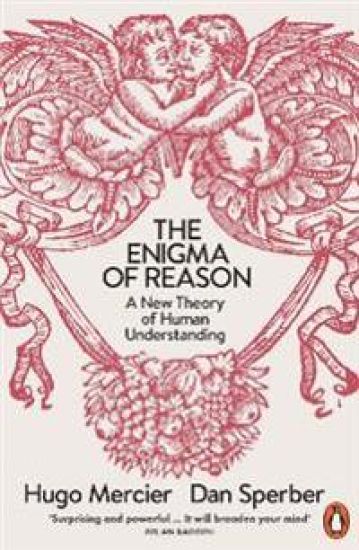
Reason, we are told, is what makes us human, the source of our knowledge and wisdom. If reason is so useful, why didn't it also evolve in other animals? If reason is that reliable, why do we produce so much thoroughly reasoned nonsense? In their ground-breaking account of the evolution and workings of reason, Hugo Mercier and Dan Sperber set out to solve this double enigma. Reason, they argue with a compelling mix of real-life and experimental evidence, is not geared to solitary use, to arriving at better beliefs and decisions on our own. What reason does, rather, is help us justify our beliefs and actions to others, convince them through argumentation, and evaluate the justifications and arguments that others address to us. In other words, reason has evolved to help humans better exploit their uniquely rich social environment. This illuminating interpretation of reason makes sense of strengths and weaknesses that have long puzzled philosophers and psychologists - why reason is biased in favour of what we already believe, why it may lead to terrible ideas and yet is indispensable to spreading good ones. Ambitious, provocative, and entertaining, The Enigma of Reason will spark debate among psychologists and philosophers, and make many reasonable people rethink their own thinking.
The Enigma of Reason

The Enigma of Reason

Hugo Mercier; Dan Sperber

HARVARD UNIVERSITY PRESS
2017
sidottu
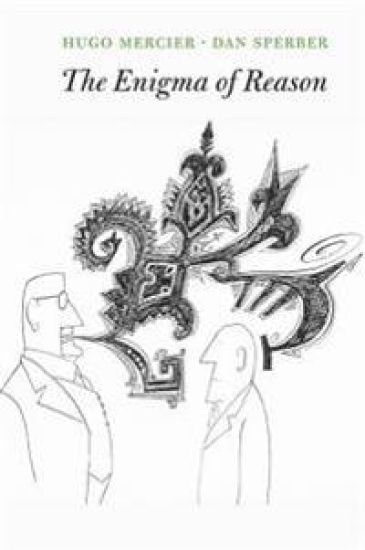
Reason, we are told, is what makes us human, the source of our knowledge and wisdom. If reason is so useful, why didn't it also evolve in other animals? If reason is that reliable, why do we produce so much thoroughly reasoned nonsense? In their groundbreaking account of the evolution and workings of reason, Hugo Mercier and Dan Sperber set out to solve this double enigma. Reason, they argue with a compelling mix of real-life and experimental evidence, is not geared to solitary use, to arriving at better beliefs and decisions on our own. What reason does, rather, is help us justify our beliefs and actions to others, convince them through argumentation, and evaluate the justifications and arguments that others address to us. In other words, reason helps humans better exploit their uniquely rich social environment. This interactionist interpretation explains why reason may have evolved and how it fits with other cognitive mechanisms. It makes sense of strengths and weaknesses that have long puzzled philosophers and psychologists--why reason is biased in favor of what we already believe, why it may lead to terrible ideas and yet is indispensable to spreading good ones. Ambitious, provocative, and entertaining, The Enigma of Reason will spark debate among psychologists and philosophers, and make many reasonable people rethink their own thinking.
Meaning and Relevance

Meaning and Relevance

Deirdre Wilson; Dan Sperber

Cambridge University Press
2012
sidottu
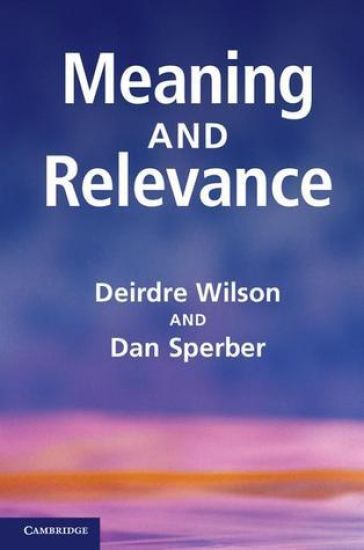
When people speak, their words never fully encode what they mean, and the context is always compatible with a variety of interpretations. How can comprehension ever be achieved? Wilson and Sperber argue that comprehension is a process of inference guided by precise expectations of relevance. What are the relations between the linguistically encoded meanings studied in semantics and the thoughts that humans are capable of entertaining and conveying? How should we analyse literal meaning, approximations, metaphors and ironies? Is the ability to understand speakers' meanings rooted in a more general human ability to understand other minds? How do these abilities interact in evolution and in cognitive development? Meaning and Relevance sets out to answer these and other questions, enriching and updating relevance theory and exploring its implications for linguistics, philosophy, cognitive science and literary studies.
Explaining Culture

Explaining Culture

Dan Sperber

JOHN WILEY AND SONS LTD
1996
nidottu
Ideas, Dan Sperber argues, may be contagious. They may invade whole populations. In the process, the people, their environment, and the ideas themselves are being transformed. To explain culture is to describe the causes and the effects of this contagion of ideas. This book will be read by all those with an interest in the impact of the cognitive revolution on our understanding of culture.
Relevance

Relevance

Dan Sperber; Deirdre Wilson

JOHN WILEY AND SONS LTD
1995
nidottu

Halvin toimitettuna 47,50 €

Relevance, first published in 1986, was named as one of the most important and influential books of the decade in the Times Higher Educational Supplement. This revised edition includes a new Preface outlining developments in Relevance Theory since 1986, discussing the more serious criticisms of the theory, and envisaging possible revisions or extensions. The book sets out to lay the foundation for a unified theory of cognitive science. The authors argue than human cognition has a goal: we pay attention only to information which seems to us relevant. To communicate is to claim someone's attention, and hence to imply that the information communicated is relevant. Thus, a single property - relevance is seen as the key to human communication and cognition. A second important feature of the book is its approach to the study of reasoning. It elucidates the role of background or contextual information in spontaneous inference, and shows that non-demonstrative inference processes can be fruitfully analysed as a form of suitably constrained guesswork. It directly challenges recent claims that human central thought processes are likely to remain a mystery for some time to come. Thirdly, the authors offer new insight into language and literature, radically revising current view on the nature and goals of verbal comprehension, and in particular on metaphor, irony, style, speech acts, presupposition and implicature.