Kirjojen hintavertailu – 12 903 737 kirjaa ja 27 kauppaa

Kirjailija

Daniel A. Smith

Kirjat ja teokset yhdessä paikassa: 4 kirjaa, julkaisuja vuosilta 1998–2012, suosituimpiin kuuluu Storykeeper. Vertaile teosten hintoja ja tarkista saatavuus suomalaisista kirjakaupoista.

Nimi esiintyy myös muodoissa: Daniel a Smith

4 kirjaa

Kirjojen julkaisuvuodet: 1998–2012.

Storykeeper

Storykeeper

Daniel a Smith

Createspace Independent Publishing Platform
2012
pokkari
NYC Big Book Award (Distinguished Favorite 2023)Book Excellence Awards (Historical Fiction Winner 2022)Maincrest Media Book Award (Mainstream Winner 2021)Shelf Unbound Best Indie Book Award (Top 100 Notable 2016)Historical Novel Society (Editor's Choice 2015)Best Indie Book Award (Literary/Mainstream Winner 2013) "A stunning novel and a joy to read" Helen Hollick, Managing Editor - Historical Novel Society (Editor's Choice)"Smith writes fluidly, and the society he depicts is intriguingly complex." - Kirkus Reviews"Steeped in immediacy and vivid detail." D. Donovan, Senior Reviewer - Midwest Book Review The first recorded Europeans to cross the Mississippi River reached the western shore on June 18, 1541. Hernando De Soto and his army of three hundred and fifty conquistadors spent the next year and a half conquering the nations in the fertile flood plains of eastern Arkansas. Three surviving sixteenth-century journals written during the expedition detailed a complex array of twelve different nations. Each had separate beliefs, languages, and interconnected villages with capital towns comparable in size to European cities of the time. Through these densely populated sites, the Spanish carried a host of deadly old-world diseases, a powerful new religion, and war. No other Europeans ventured into this land until French explorers arrived one hundred and thirty years later. They found nothing of the people or the towns that the Spanish had so vividly described. For those lost nations, the only hope that their stories, their last remaining essence will ever be heard again lies with one unlikely Storykeeper. Editorial Reviews of Storykeeper"'A man without a story is one without a past, ' Smith writes, 'and a man without a past is one without wisdom.' By the time readers have wandered freely through the strange realm of the Storykeeper, they may well find those words more prophetic, and more powerful." - Kirkus Reviews "Storykeeper is a complex read . . . With both perspective and time in flux, readers are carried along on a historical and cultural journey that, while compelling, requires attention to detail: not for those seeking light entertainment, it's a saga that demands - and deserves - careful reading and contemplation." D. Donovan, Senior Reviewer - Midwest Book Review" I was not only entertained by this book, but educated about a period of history of which I knew nothing. I loved the chapter structure which has a rhythm of its own, all wrapped in an attractive and appropriate cover. I have no hesitation in recommending this book no matter where your historical interest may lie. I give it 5 stars " Helen Hollick, Managing Editor - Historical Novel Society (Editor's Choice) "Smith has created a wealth of history and culture that will make you weep. Creating words and phrases with a poetic sense, building a feel for Native American culture that feels so genuine and, yet, is eminently readable." Kathy Davie - Books, Movies, Reviews "I love this story, and I applaud Daniel A. Smith on his diligent research. Smith writes some strong characters in this gripping story. Every human emotion is engaged, and at times I felt like I was right there with Manaha and the tribes who fought against DeSoto. Superbly done. I'm sure I will be reading this book again." SK - The Jelly Bomb Review "The book's images, enhanced by objective historical writing are portals into the distant past, sometimes humorous, often heartbreaking, but always illuminating." Fred Petrucelli - Log Cabin
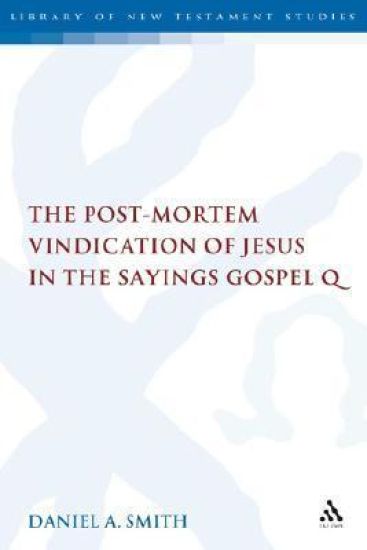
The Post-Mortem Vindication of Jesus in the Sayings Gospel Q
13:34-35, the Jerusalem Logion, aligns the rejection of the speaker by Jerusalem both with the abandonment of Jerusalem's house and with the future invisibility and return of the speaker: you will not see me until you say, Blessed is the Coming One in the name of the Lord' (13:35b). The coincidence of not seeing language with a reference to a future coming is reminiscent of the connection, in Jewish literature especially, between the assumption and eschatological function. The book proposes that this reference to Jesus' assumption is a clue to how Q conceives of the post-mortem vindication of Jesus, since numerous Q sayings presuppose a knowledge of Jesus' death. In support of this, the book argues that in Hellenistic Jewish writings assumption was not always considered to be an escape from death (as in the biblical instances of Enoch and Elijah), but could happen at or after death, as was more clearly the case in Greek thought. Such a strategy of vindication is necessary for Q because it evidences a belief in Jesus' ongoing existence and future return as the Son of Man, and because resurrection though a feature of Q's eschatology is not individually applied to Jesus. A similar view is presupposed by the pre-Markan empty tomb tradition, which describes the disappearance of Jesus' body but narrates neither the resurrection itself nor an appearance of the risen Jesus. The book also draws out implications of the thesis for the place of the Sayings Gospel Q within the early Christian movements, particularly vis-vis the vindication of Jesus.
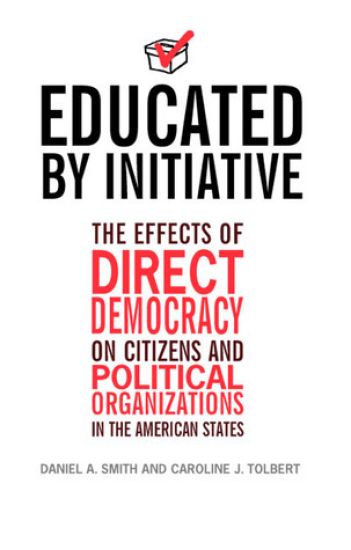
Educated by Initiative

Educated by Initiative

Daniel A. Smith; Caroline Tolbert

The University of Michigan Press
2004
nidottu
"This body of research not only passes academic muster but is the best guidepost in existence for activists who are trying to use the ballot initiative process for larger policy and political objectives."--Kristina Wilfore, Executive Director, Ballot Initiative Strategy Center and FoundationEducated by Initiative moves beyond previous evaluations of public policy to emphasize the educational importance of the initiative process itself. Since a majority of ballots ultimately fail or get overturned by the courts, Smith and Tolbert suggest that the educational consequences of initiative voting may be more important than the outcomes of the ballots themselves. The result is a fascinating and thoroughly-researched book about how direct democracy teaches citizens about politics, voting, civic engagement and the influence of special interests and political parties. Designed to be accessible to anyone interested in the future of American democracy, the book includes boxes (titled "What Matters") that succinctly summarize the authors' data into easily readable analyses. Daniel A. Smith is Associate Professor of Political Science at the University of Florida. Caroline J. Tolbert is Associate Professor of Political Science at Kent State University.
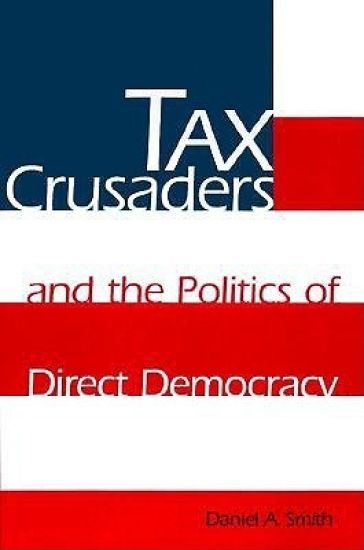
Tax Crusaders and the Politics of Direct Democracy
Daniel A. Smith exposes the truth about the American tax revolt. Contrary to conventional wisdom, recent ballot initiatives to limit state taxes have not been the result of a groundswell of public outrage; rather, they have been carefully orchestrated from the top down by professional tax crusaders: political entrepreneurs with their own mission. These faux populist initiatives--in contrast to genuine grassroots movements--involve minimal citizen participation. Instead, the tax crusaders hire public relations firms and use special interest groups to do the legwork and influence public opinion. Although they successfully tap into the pervasive anti-tax public mood by using populist rhetoric, these organizations serve corporate interests rather than groups of concerned neighbors. The author shows that direct democracy can, ironically, lead to diminished public involvement in government. Smith looks at the key players, following the trail of money and power in three important initiatives: Proposition 13 in California (1978), Proposition 2 1/2 in Massachusetts (1980), and Amendment 1 in Colorado (1992). He provides a thorough history of tax limitation movements in America, showing how direct democracy can be manipulated to subvert the democratic process and frustrate the public good.