Kirjojen hintavertailu – 12 903 725 kirjaa ja 27 kauppaa

Kirjailija

Daniel Ashlock

Kirjat ja teokset yhdessä paikassa: 11 kirjaa, julkaisuja vuosilta 2005–2024, suosituimpiin kuuluu Exploring Representation in Evolutionary Level Design. Vertaile teosten hintoja ja tarkista saatavuus suomalaisista kirjakaupoista.

11 kirjaa

Kirjojen julkaisuvuodet: 2005–2024.

AI Versus Epidemics

AI Versus Epidemics

James Hughes; Sheridan Houghten; Michael Dubé; Daniel Ashlock; Joseph Alexander Brown; Wendy Ashlock; Matthew Stoodley

Springer International Publishing AG
2024
sidottu
This book presents algorithms and tools that are designed to model and extract information from personal contact networks, which represent which individuals in a population are physically in contact with one another. The authors developed these tools based on research they conducted during the COVID-19 pandemic, with the goal of improving responses to epidemics in the future. The book provides methods for modelling the transmission of infection across a population. The authors explain how an epidemic model can be used to strategically distribute vaccines and minimize the spread of a virus. The book shows how evolutionary computation, graph compression, and network induction can be utilized to manage issues that arise from an epidemic.
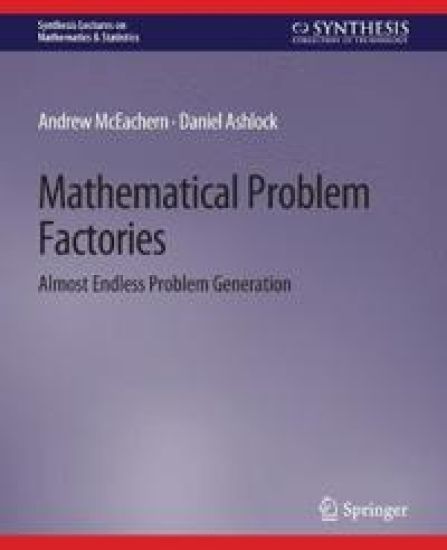
Mathematical Problem Factories

Mathematical Problem Factories

Andrew McEachern; Daniel Ashlock

Springer International Publishing AG
2021
nidottu
A problem factory consists of a traditional mathematical analysis of a type of problem that describes many, ideally all, ways that the problems of that type can be cast in a fashion that allows teachers or parents to generate problems for enrichment exercises, tests, and classwork. Some problem factories are easier than others for a teacher or parent to apply, so we also include banks of example problems for users. This text goes through the definition of a problem factory in detail and works through many examples of problem factories. It gives banks of questions generated using each of the examples of problem factories, both the easy ones and the hard ones. This text looks at sequence extension problems (what number comes next?), basic analytic geometry, problems on whole numbers, diagrammatic representations of systems of equations, domino tiling puzzles, and puzzles based on combinatorial graphs. The final chapter previews other possible problem factories.
An Introduction to Proofs with Set Theory

An Introduction to Proofs with Set Theory

Daniel Ashlock; Colin Lee

Springer International Publishing AG
2020
nidottu
This text is intended as an introduction to mathematical proofs for students. It is distilled from the lecture notes for a course focused on set theory subject matter as a means of teaching proofs. Chapter 1 contains an introduction and provides a brief summary of some background material students may be unfamiliar with. Chapters 2 and 3 introduce the basics of logic for students not yet familiar with these topics. Included is material on Boolean logic, propositions and predicates, logical operations, truth tables, tautologies and contradictions, rules of inference and logical arguments. Chapter 4 introduces mathematical proofs, including proof conventions, direct proofs, proof-by-contradiction, and proof-by-contraposition. Chapter 5 introduces the basics of naive set theory, including Venn diagrams and operations on sets. Chapter 6 introduces mathematical induction and recurrence relations. Chapter 7 introduces set-theoretic functions and covers injective, surjective, and bijective functions, as well as permutations. Chapter 8 covers the fundamental properties of the integers including primes, unique factorization, and Euclid's algorithm. Chapter 9 is an introduction to combinatorics; topics included are combinatorial proofs, binomial and multinomial coefficients, the Inclusion-Exclusion principle, and counting the number of surjective functions between finite sets. Chapter 10 introduces relations and covers equivalence relations and partial orders. Chapter 11 covers number bases, number systems, and operations. Chapter 12 covers cardinality, including basic results on countable and uncountable infinities, and introduces cardinal numbers. Chapter 13 expands on partial orders and introduces ordinal numbers. Chapter 14 examines the paradoxes of naive set theory and introduces and discusses axiomatic set theory. This chapter also includes Cantor's Paradox, Russel's Paradox, a discussion of axiomatic theories, an exposition on Zermelo-Fraenkel Set Theory with the Axiom of Choice, and a brief explanation of Gödel's Incompleteness Theorems.
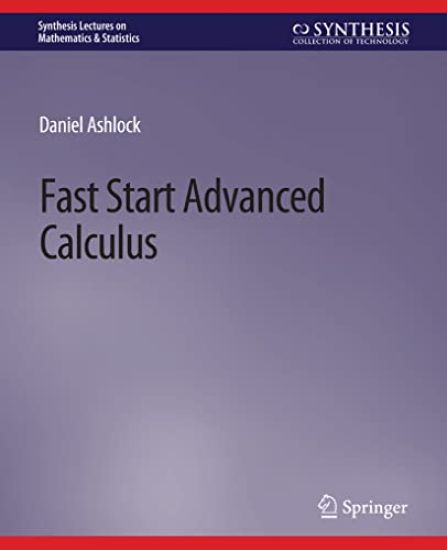
Fast Start Advanced Calculus

Fast Start Advanced Calculus

Daniel Ashlock

Springer International Publishing AG
2019
nidottu
This book continues the material in two early Fast Start calculus volumes to include multivariate calculus, sequences and series, and a variety of additional applications. These include partial derivatives and the optimization techniques that arise from them, including Lagrange multipliers. Volumes of rotation, arc length, and surface area are included in the additional applications of integration. Using multiple integrals, including computing volume and center of mass, is covered. The book concludes with an initial treatment of sequences, series, power series, and Taylor's series, including techniques of function approximation.
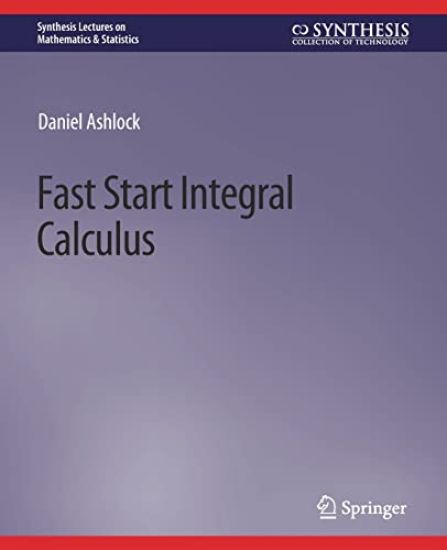
Fast Start Integral Calculus

Fast Start Integral Calculus

Daniel Ashlock

Springer International Publishing AG
2019
nidottu
This book introduces integrals, the fundamental theorem of calculus, initial value problems, and Riemann sums. It introduces properties of polynomials, including roots and multiplicity, and uses them as a framework for introducing additional calculus concepts including Newton's method, L'Hôpital's Rule, and Rolle's theorem. Both the differential and integral calculus of parametric, polar, and vector functions are introduced. The book concludes with a survey of methods of integration, including u-substitution, integration by parts, special trigonometric integrals, trigonometric substitution, and partial fractions.
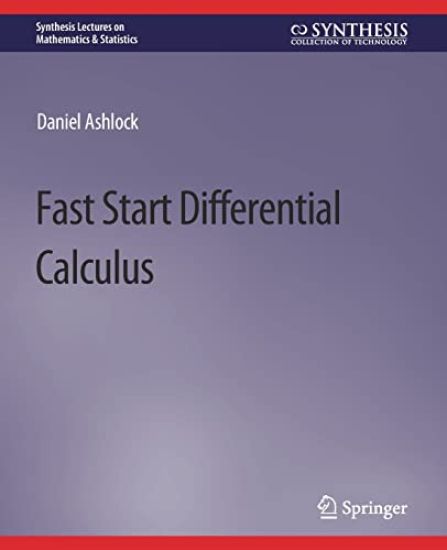
Fast Start Differential Calculus

Fast Start Differential Calculus

Daniel Ashlock

Springer International Publishing AG
2019
nidottu
This book reviews the algebraic prerequisites of calculus, including solving equations, lines, quadratics, functions, logarithms, and trig functions. It introduces the derivative using the limit-based definition and covers the standard function library and the product, quotient, and chain rules. It explores the applications of the derivative to curve sketching and optimization and concludes with the formal definition of the limit, the squeeze theorem, and the mean value theorem.
Fast Start Calculus for Integrated Physics 4th Edition

Fast Start Calculus for Integrated Physics 4th Edition

Daniel Ashlock

Independently Published
2019
nidottu
This text introduces single variable calculus and selected topics in multivariate calculus from an applied perspective. The topics are drawn from the syllabus of an integrated mathematics and physics course taught at the University of Guelph. The topics and exercises are the result of five years of testing and evaluation.
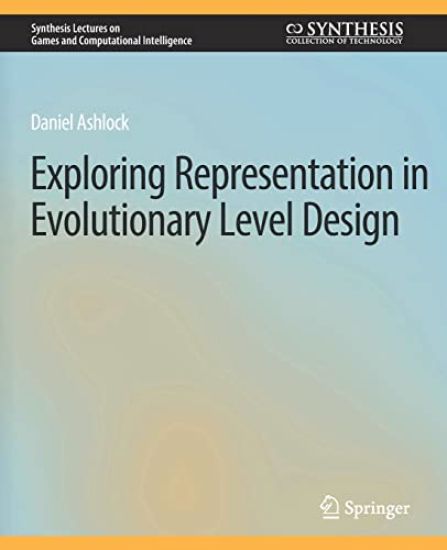
Exploring Representation in Evolutionary Level Design

Exploring Representation in Evolutionary Level Design

Daniel Ashlock

Springer International Publishing AG
2018
nidottu
Automatic content generation is the production of content for games, web pages, or other purposes by procedural means. Search-based automatic content generation employs search-based algorithms to accomplish automatic content generation. This book presents a number of different techniques for search-based automatic content generation where the search algorithm is an evolutionary algorithm. The chapters treat puzzle design, the creation of small maps or mazes, the use of L-systems and a generalization of L-system to create terrain maps, the use of cellular automata to create maps, and, finally, the decomposition of the design problem for large, complex maps culminating in the creation of a map for a fantasy game module with designersupplied content and tactical features. The evolutionary algorithms used for the different types of content are generic and similar, with the exception of the novel sparse initialization technique are presented in Chapter 2. The points where the content generation systems vary are in the design of their fitness functions and in the way the space of objects being searched is represented. A large variety of different fitness functions are designed and explained, and similarly radically different representations are applied to the design of digital objects all of which are, essentially, maps for use in games.
On the Design of Game-Playing Agents

On the Design of Game-Playing Agents

Eun-Youn Kim; Daniel Ashlock

Springer International Publishing AG
2017
nidottu
Evolving agents to play games is a promising technology. It can provide entertaining opponents for games like Chess or Checkers, matched to a human opponent as an alternative to the perfect and unbeatable opponents embodied by current artifical intelligences. Evolved agents also permit us to explore the strategy space of mathematical games like Prisoner's Dilemma and Rock-Paper-Scissors. This book summarizes, explores, and extends recent work showing that there are many unsuspected factors that must be controlled in order to create a plausible or useful set of agents for modeling cooperation and conflict, deal making, or other social behaviors. The book also provides a proposal for an agent training protocol that is intended as a step toward being able to train humaniform agents—in other words, agents that plausibly model human behavior.
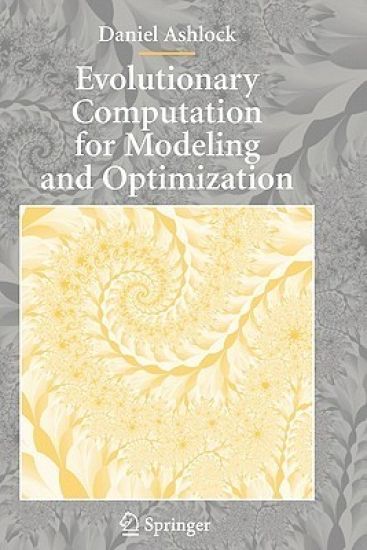
Evolutionary Computation for Modeling and Optimization

Evolutionary Computation for Modeling and Optimization

Daniel Ashlock

Springer-Verlag New York Inc.
2010
nidottu
Evolutionary Computation for Optimization and Modeling is an introduction to evolutionary computation, a field which includes genetic algorithms, evolutionary programming, evolution strategies, and genetic programming. The text is a survey of some application of evolutionary algorithms. It introduces mutation, crossover, design issues of selection and replacement methods, the issue of populations size, and the question of design of the fitness function. It also includes a methodological material on efficient implementation. Some of the other topics in this book include the design of simple evolutionary algorithms, applications to several types of optimization, evolutionary robotics, simple evolutionary neural computation, and several types of automatic programming including genetic programming. The book gives applications to biology and bioinformatics and introduces a number of tools that can be used in biological modeling, including evolutionary game theory. Advanced techniques such as cellular encoding, grammar based encoding, and graph based evolutionary algorithms are also covered. This book presents a large number of homework problems, projects, and experiments, with a goal of illustrating single aspects of evolutionary computation and comparing different methods. Its readership is intended for an undergraduate or first-year graduate course in evolutionary computation for computer science, engineering, or other computational science students. Engineering, computer science, and applied math students will find this book a useful guide to using evolutionary algorithms as a problem solving tool.
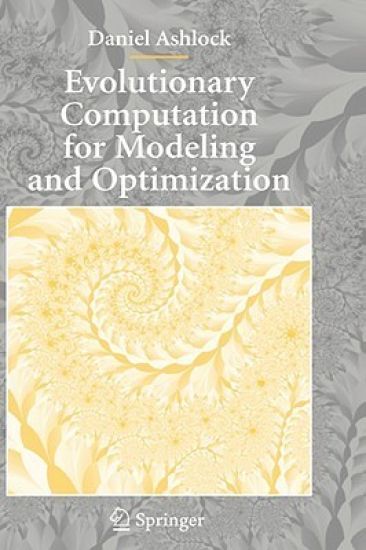
Evolutionary Computation for Modeling and Optimization

Evolutionary Computation for Modeling and Optimization

Daniel Ashlock

Springer-Verlag New York Inc.
2005
sidottu
Evolutionary Computation for Optimization and Modeling is an introduction to evolutionary computation, a field which includes genetic algorithms, evolutionary programming, evolution strategies, and genetic programming. The text is a survey of some application of evolutionary algorithms. It introduces mutation, crossover, design issues of selection and replacement methods, the issue of populations size, and the question of design of the fitness function. It also includes a methodological material on efficient implementation. Some of the other topics in this book include the design of simple evolutionary algorithms, applications to several types of optimization, evolutionary robotics, simple evolutionary neural computation, and several types of automatic programming including genetic programming. The book gives applications to biology and bioinformatics and introduces a number of tools that can be used in biological modeling, including evolutionary game theory. Advanced techniques such as cellular encoding, grammar based encoding, and graph based evolutionary algorithms are also covered. This book presents a large number of homework problems, projects, and experiments, with a goal of illustrating single aspects of evolutionary computation and comparing different methods. Its readership is intended for an undergraduate or first-year graduate course in evolutionary computation for computer science, engineering, or other computational science students. Engineering, computer science, and applied math students will find this book a useful guide to using evolutionary algorithms as a problem solving tool.