

Kirjailija
Daniel Berthold
Kirjat ja teokset yhdessä paikassa: 4 kirjaa, julkaisuja vuosilta 2011–2020, suosituimpiin kuuluu Sterben Und Gelassenheit: Von Der Kunst, Den Tod Ins Leben Zu Lassen. Vertaile teosten hintoja ja tarkista saatavuus suomalaisista kirjakaupoista.
4 kirjaa
Kirjojen julkaisuvuodet: 2011–2020.

Sterben Und Gelassenheit: Von Der Kunst, Den Tod Ins Leben Zu Lassen
Verena Begemann; Daniel Berthold; Manfred Hillmann
Vandenhoeck Ruprecht
2015
nidottu
Wenn wir schon nicht gelassen leben, wie sollten wir dann gelassen sterben konnen? Sind die eigene Endlichkeit und Gelassenheit uberhaupt zusammenzudenken? Eindrucksvoll und unmissverstandlich empfiehlt uns der Tod, sich besser fruher als spater damit auseinanderzusetzen. Drei Experten aus dem Hospiz- und Palliativbereich inspirieren dazu, sich auf die Gelassenheit einzulassen. Sie wagen das Experiment, sich dem letzten aller Abschiede vorausschauend zu nahern. In behutsamer Ehrlichkeit geben sie Angsten, Abschieden und Trauer, Hoffnungen und Lebensfreude den notigen Raum. Das Autorenteam schopft aus dem Wissen grosser Vorbilder: Religionen und Weisheitstraditionen, Literatur und Philosophie, Psychologie und Therapie. Es schopft aber auch aus Einsichten in Einzelschicksale: Wenn Menschen vor der Herausforderung stehen, Halt im Haltlosen zu finden. Der Band ist mit farbigen Bildern der Kunstlerin Karin Lenser illustriert. Das E-Book enthalt Audio-Dateien mit den von den Autoren selbst gesprochenen Kapiteln 2, 7 und 15. Zum Abpielen der Audio-Dateien wird der aktuelle Adobe Flash Player sowie der Adobe Reader ab Version 9 benotigt. Die aktuellen Versionen konnen Sie hier herunterladen:
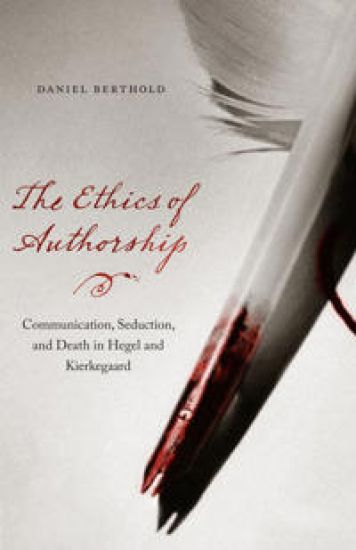
This is a book about the ethics of authorship. Most directly, it explores different conceptualizations of the responsibilities of the author to the reader. But it also engages the question of what styles of authorship allow these responsibilities to be met. Style itself is an ethical issue, since the relation between the writing subject and the reader--and the dynamics of authority and influence, of gift giving and friendship in this relation--have as much to do with how one writes as what one says. The two writers who serve as the main subjects for this work, the German idealist philosopher G. W. F. Hegel and the Danish Christian existentialist Søren Kierkegaard, invite us to confront particularly challenging questions about the ethics of authorship. Each in his own way explores styles of authorship that employ a variety of strategies of seduction in order to entice the reader into his narratives, strategies that at least on the surface appear to be fundamentally manipulative and unethical. Further, both seek to enact their own deaths as authors, effectively disappearing as reliable guides for the reader. That might also seem to be ethically irresponsible, an abandonment of the reader, who has been seduced only to be deserted. This is the first work to undertake a sustained questioning of Kierkegaard's central distinction between his own "indirect" style of communication and the (purportedly) "direct" style of Hegel's philosophy. Hegel was in fact a much more subtle practitioner of style than Kierkegaard represents him as being, indeed, a practitioner whose style is in the service of an ambitious reconceptualization of the ethics of authorship. As for Kierkegaard, his own indirect style raises a whole series of ethical questions about how the reader is imagined in relation to the author. There is finally an either/or between Hegel and Kierkegaard, just not the one Kierkegaard proposes as between an author devoid of ethics and one who makes possible a true ethics of authorship. Rather, the either/or is between two competing practices of authorship, one daunting with the cadences of a highly technical style, the other delightful for its elegance and playfulness--but both powerful experiments in the ethics of style.
This is a book about the ethics of authorship. Most directly, it explores different conceptualizations of the responsibilities of the author to the reader. But it also engages the question of what styles of authorship allow these responsibilities to be met. Style itself is an ethical issue, since the relation between the writing subject and the reader--and the dynamics of authority and influence, of gift giving and friendship in this relation--have as much to do with how one writes as what one says. The two writers who serve as the main subjects for this work, the German idealist philosopher G. W. F. Hegel and the Danish Christian existentialist Søren Kierkegaard, invite us to confront particularly challenging questions about the ethics of authorship. Each in his own way explores styles of authorship that employ a variety of strategies of seduction in order to entice the reader into his narratives, strategies that at least on the surface appear to be fundamentally manipulative and unethical. Further, both seek to enact their own deaths as authors, effectively disappearing as reliable guides for the reader. That might also seem to be ethically irresponsible, an abandonment of the reader, who has been seduced only to be deserted. This is the first work to undertake a sustained questioning of Kierkegaard's central distinction between his own "indirect" style of communication and the (purportedly) "direct" style of Hegel's philosophy. Hegel was in fact a much more subtle practitioner of style than Kierkegaard represents him as being, indeed, a practitioner whose style is in the service of an ambitious reconceptualization of the ethics of authorship. As for Kierkegaard, his own indirect style raises a whole series of ethical questions about how the reader is imagined in relation to the author. There is finally an either/or between Hegel and Kierkegaard, just not the one Kierkegaard proposes as between an author devoid of ethics and one who makes possible a true ethics of authorship. Rather, the either/or is between two competing practices of authorship, one daunting with the cadences of a highly technical style, the other delightful for its elegance and playfulness--but both powerful experiments in the ethics of style.