Kirjojen hintavertailu – 12 859 819 kirjaa ja 27 kauppaa

Kirjailija

Daniel Blank

Kirjat ja teokset yhdessä paikassa: 5 kirjaa, julkaisuja vuosilta 2014–2023, suosituimpiin kuuluu A Political History of the Editions of Marx and Engels’s “German ideology Manuscripts”. Vertaile teosten hintoja ja tarkista saatavuus suomalaisista kirjakaupoista.

5 kirjaa

Kirjojen julkaisuvuodet: 2014–2023.

Shakespeare and University Drama in Early Modern England
Dramatic performances at the universities in early modern England have usually been regarded as insular events, completely removed from the plays of the London stage. Shakespeare and University Drama in Early Modern England challenges that long-held notion, illuminating how an apparently secluded theatrical culture became a major source of inspiration for Shakespeare and his contemporaries. While many university plays featured classical themes, others reflected upon the academic environments in which they were produced, allowing a window into the universities themselves. This window proved especially fruitful for Shakespeare, who, as this book reveals, had a sustained fascination with the universities and their inhabitants. Daniel Blank provides groundbreaking new readings of plays from throughout Shakespeare's career, illustrating how depictions of academic culture in Love's Labour's Lost, Hamlet, and Macbeth were shaped by university plays. Shakespeare was not unique, however. This book also discusses the impact of university drama on professional plays by Christopher Marlowe, Robert Greene, and Ben Jonson, all of whom in various ways facilitated the connection between the university stage and the London commercial stage. Yet this connection, perhaps counterintuitively, is most significant in the works of a playwright who had no formal attachment to Oxford or Cambridge. Shakespeare, this study shows, was at the center of a rich exchange between two seemingly disparate theatrical worlds.
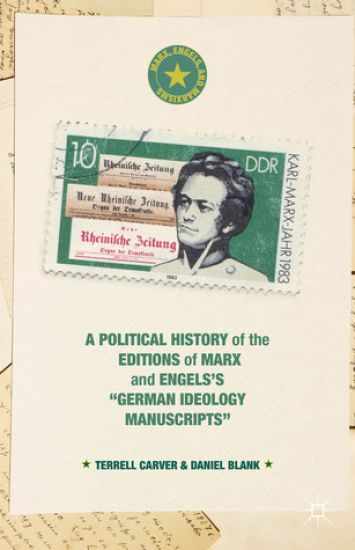
A Political History of the Editions of Marx and Engels’s “German ideology Manuscripts”
Since the 1920s, scholars have promoted a set of manuscripts, long abandoned by Marx and Engels, to canonical status in book form as The German Ideology, and in particular its 'first chapter,' known as 'I. Feuerbach.' Part one of this revolutionary study relates in detail the political history through which these manuscripts were editorially fabricated into editions and translations, so that they could represent an important exposition of Marx's 'theory of history.' Part two presents a wholly-original view of the so-called 'Feuerbach' manuscripts in a page-by-page English-language rendition of these discontinuous fragments. By including the hitherto devalued corrections that each author made in draft, the new text invites the reader into a unique laboratory for their collaborative work. An 'Analytical Introduction' shows how Marx's and Engels's thinking developed in duologue as they altered individual words and phrases on these 'left-over' polemical pages.
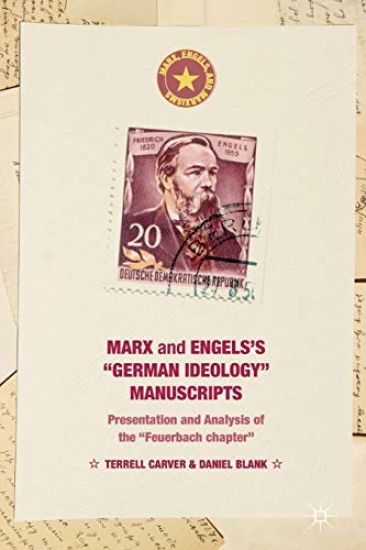
Marx and Engels's "German ideology" Manuscripts

Marx and Engels's "German ideology" Manuscripts

Terrell Carver; Daniel Blank

Palgrave Macmillan
2014
nidottu
Since the 1920s, scholars have promoted a set of manuscripts, long abandoned by Marx and Engels, to canonical status in book form as The German Ideology, and in particular its 'first chapter,' known as 'I. Feuerbach.' Part one of this revolutionary study relates in detail the political history through which these manuscripts were editorially fabricated into editions and translations, so that they could represent an important exposition of Marx's 'theory of history.' Part two presents a wholly-original view of the so-called 'Feuerbach' manuscripts in a page-by-page English-language rendition of these discontinuous fragments. By including the hitherto devalued corrections that each author made in draft, the new text invites the reader into a unique laboratory for their collaborative work. An 'Analytical Introduction' shows how Marx's and Engels's thinking developed in duologue as they altered individual words and phrases on these 'left-over' polemical pages.
Marx and Engels's "German ideology" Manuscripts

Marx and Engels's "German ideology" Manuscripts

Terrell Carver; Daniel Blank

Palgrave Macmillan
2014
sidottu
Since the 1920s, scholars have promoted a set of manuscripts, long abandoned by Marx and Engels, to canonical status in book form as The German Ideology, and in particular its 'first chapter,' known as 'I. Feuerbach.' Part one of this revolutionary study relates in detail the political history through which these manuscripts were editorially fabricated into editions and translations, so that they could represent an important exposition of Marx's 'theory of history.' Part two presents a wholly-original view of the so-called 'Feuerbach' manuscripts in a page-by-page English-language rendition of these discontinuous fragments. By including the hitherto devalued corrections that each author made in draft, the new text invites the reader into a unique laboratory for their collaborative work. An 'Analytical Introduction' shows how Marx's and Engels's thinking developed in duologue as they altered individual words and phrases on these 'left-over' polemical pages.