Kirjojen hintavertailu – 12 903 725 kirjaa ja 27 kauppaa

Kirjailija

Daniel Gerhard

Kirjat ja teokset yhdessä paikassa: 3 kirjaa, julkaisuja vuosilta 2011–2021, suosituimpiin kuuluu Dose-Response Analysis Using R. Vertaile teosten hintoja ja tarkista saatavuus suomalaisista kirjakaupoista.

3 kirjaa

Kirjojen julkaisuvuodet: 2011–2021.

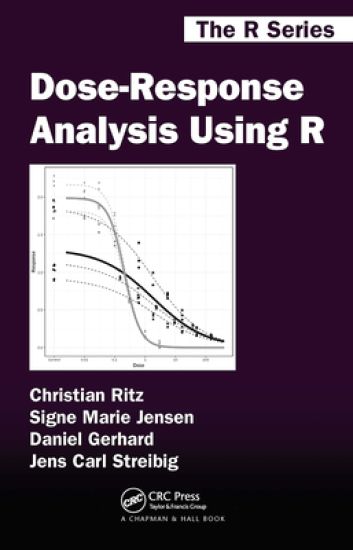
Dose-Response Analysis Using R

Dose-Response Analysis Using R

Christian Ritz; Signe Marie Jensen; Daniel Gerhard; Jens Carl Streibig

Taylor Francis Ltd
2021
nidottu
Nowadays the term dose-response is used in many different contexts and many different scientific disciplines including agriculture, biochemistry, chemistry, environmental sciences, genetics, pharmacology, plant sciences, toxicology, and zoology. In the 1940 and 1950s, dose-response analysis was intimately linked to evaluation of toxicity in terms of binary responses, such as immobility and mortality, with a limited number of doses of a toxic compound being compared to a control group (dose 0). Later, dose-response analysis has been extended to other types of data and to more complex experimental designs. Moreover, estimation of model parameters has undergone a dramatic change, from struggling with cumbersome manual operations and transformations with pen and paper to rapid calculations on any laptop. Advances in statistical software have fueled this development. Key Features: Provides a practical and comprehensive overview of dose-response analysis. Includes numerous real data examples to illustrate the methodology. R code is integrated into the text to give guidance on applying the methods. Written with minimal mathematics to be suitable for practitioners. Includes code and datasets on the book’s GitHub: https://github.com/DoseResponse. This book focuses on estimation and interpretation of entirely parametric nonlinear dose-response models using the powerful statistical environment R. Specifically, this book introduces dose-response analysis of continuous, binomial, count, multinomial, and event-time dose-response data. The statistical models used are partly special cases, partly extensions of nonlinear regression models, generalized linear and nonlinear regression models, and nonlinear mixed-effects models (for hierarchical dose-response data). Both simple and complex dose-response experiments will be analyzed.
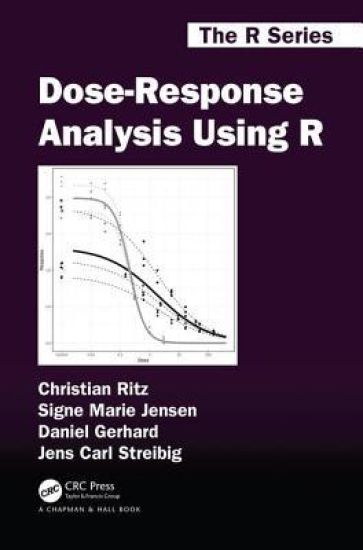
Dose-Response Analysis Using R

Dose-Response Analysis Using R

Christian Ritz; Signe Marie Jensen; Daniel Gerhard; Jens Carl Streibig

CRC Press
2019
sidottu
Nowadays the term dose-response is used in many different contexts and many different scientific disciplines including agriculture, biochemistry, chemistry, environmental sciences, genetics, pharmacology, plant sciences, toxicology, and zoology. In the 1940 and 1950s, dose-response analysis was intimately linked to evaluation of toxicity in terms of binary responses, such as immobility and mortality, with a limited number of doses of a toxic compound being compared to a control group (dose 0). Later, dose-response analysis has been extended to other types of data and to more complex experimental designs. Moreover, estimation of model parameters has undergone a dramatic change, from struggling with cumbersome manual operations and transformations with pen and paper to rapid calculations on any laptop. Advances in statistical software have fueled this development. Key Features: Provides a practical and comprehensive overview of dose-response analysis. Includes numerous real data examples to illustrate the methodology. R code is integrated into the text to give guidance on applying the methods. Written with minimal mathematics to be suitable for practitioners. Includes code and datasets on the book’s GitHub: https://github.com/DoseResponse. This book focuses on estimation and interpretation of entirely parametric nonlinear dose-response models using the powerful statistical environment R. Specifically, this book introduces dose-response analysis of continuous, binomial, count, multinomial, and event-time dose-response data. The statistical models used are partly special cases, partly extensions of nonlinear regression models, generalized linear and nonlinear regression models, and nonlinear mixed-effects models (for hierarchical dose-response data). Both simple and complex dose-response experiments will be analyzed.