

Kirjailija
Daniel Innerarity
Kirjat ja teokset yhdessä paikassa: 19 kirjaa, julkaisuja vuosilta 2010–2026, suosituimpiin kuuluu Futuro de la Democracia, El. Vertaile teosten hintoja ja tarkista saatavuus suomalaisista kirjakaupoista.
19 kirjaa
Kirjojen julkaisuvuodet: 2010–2026.

Do our political systems and democracies really reflect the complex reality of the 21st century? Or does politics seem to be legislating about yesterday’s world? In his latest book, Daniel Innerarity warns of the gap between the political concepts that serve as our guide and our overly complex reality that has long ceased to respond to them. Arguing that this theoretical deficit leads to a political practice that simplifies and impoverishes our democracies, nourishing the demagogues and sustaining reassuring old narratives, Innerarity proposes a modern update of key political concepts, from power and sovereignty to territory and representation. The theory of democracy originates from a time of relative social and political simplicity. There was less pluralism, less interdependence, political entities were autarkic, and the technological tools they had to handle had nothing to do with the sophistication of our artificial intelligence, our financial system, or the technological advances in medicine. And yet, Innerarity argues, there is no need to despair. If democracy has made the transition from the polis to the nation-state, from direct democracy to representative democracy, there is no reason to suppose that it cannot face new challenges, as long as it is provided with an adequate political architecture. Drawing on a broad range of sources, including classical and contemporary theorists, A Theory of Complex Democracy presents a new theory of democracy and government for the 21st century, a theory that starts from the premise that the most promising rejuvenation of our democracies is to make them more complex.

Do our political systems and democracies really reflect the complex reality of the 21st century? Or does politics seem to be legislating about yesterday’s world? In his latest book, Daniel Innerarity warns of the gap between the political concepts that serve as our guide and our overly complex reality that has long ceased to respond to them. Arguing that this theoretical deficit leads to a political practice that simplifies and impoverishes our democracies, nourishing the demagogues and sustaining reassuring old narratives, Innerarity proposes a modern update of key political concepts, from power and sovereignty to territory and representation. The theory of democracy originates from a time of relative social and political simplicity. There was less pluralism, less interdependence, political entities were autarkic, and the technological tools they had to handle had nothing to do with the sophistication of our artificial intelligence, our financial system, or the technological advances in medicine. And yet, Innerarity argues, there is no need to despair. If democracy has made the transition from the polis to the nation-state, from direct democracy to representative democracy, there is no reason to suppose that it cannot face new challenges, as long as it is provided with an adequate political architecture. Drawing on a broad range of sources, including classical and contemporary theorists, A Theory of Complex Democracy presents a new theory of democracy and government for the 21st century, a theory that starts from the premise that the most promising rejuvenation of our democracies is to make them more complex.

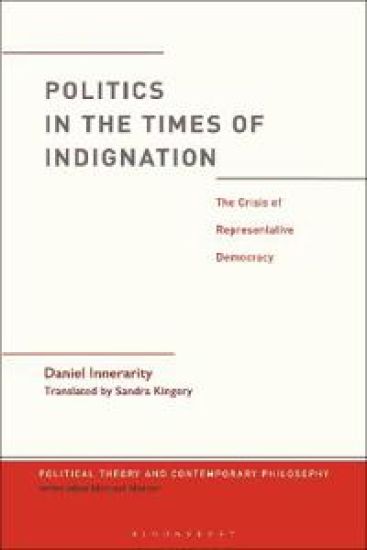
Politics in the Times of Indignation provides a critical look at Western liberal democracies in crisis, to provide us with the theoretical tools to make sense of the political disorientation of our times. Indispensable for understanding the present state of democratic societies, this book is a lens through which we can study numerous contemporary developments. He examines the popular indignation that has accompanied the crisis of governmental legitimacy, which is aggravated by the economic crisis in various countries and demonstrated by groups such as the Occupy Wall Street Movement in the US, Podemos in Spain, or La France Insoumise in France. At the same time, Innerarity endeavors to offer a universal, rather than a merely circumstantial, interpretation of the transformations that are still ongoing in our political systems, as well as of those that need to be put in place in order to satisfy the expectations and rights of democratic citizenship. Politics in the Times of Indignation represents a guiding thread through political developments, as well as a conceptual tool-box for understanding the meaning of the current crisis of representation, the fate of political parties, the relation between ethics and politics, and how politics can become an intelligent enterprise.
Politics in the Times of Indignation provides a critical look at Western liberal democracies in crisis, to provide us with the theoretical tools to make sense of the political disorientation of our times. Indispensable for understanding the present state of democratic societies, this book is a lens through which we can study numerous contemporary developments. He examines the popular indignation that has accompanied the crisis of governmental legitimacy, which is aggravated by the economic crisis in various countries and demonstrated by groups such as the Occupy Wall Street Movement in the US, Podemos in Spain, or La France Insoumise in France. At the same time, Innerarity endeavors to offer a universal, rather than a merely circumstantial, interpretation of the transformations that are still ongoing in our political systems, as well as of those that need to be put in place in order to satisfy the expectations and rights of democratic citizenship. Politics in the Times of Indignation represents a guiding thread through political developments, as well as a conceptual tool-box for understanding the meaning of the current crisis of representation, the fate of political parties, the relation between ethics and politics, and how politics can become an intelligent enterprise.

Vieraanvaraisuuden etiikka
Daniel Innerarity
Into Kustannus
2019
nidottu
Halvin toimitettuna 19,90 €
Vieraanvaraisuus on perusta ihmisten sosiaaliselle elämälle. Se tekee ihmisistä ihmisiä. Yhteiskunnassa yksi on aina vieras ja toinen isäntä. Siten paikkamme maailmassa on tulkittavissa vastaanottamisen ja kohtaamisen kautta. Daniel Innerarity käsittelee eettis-filosofisessa kirjassaan vieraanvaraisuuden lisäksi muun muassa hyvää elämää, etiikkaa, aikaa ja onnea. Hänen mukaansa on tärkeää rakentaa vieraanvaraisuuden etiikka aikana, jolloin modernisaatio ja kasvu repivät meitä eri suuntiin. Kirjan ajatuksia voi soveltaa erilaisiin sosiaalisen elämän osa-alueisiin, kuten vuorovaikutukseen, maahanmuuttoon ja ihmisten yhteiseloon.

This book calls for a philosophical consideration of the development, challenges and successes of the European Union. The author argues that conceptual innovation is essential if progress on the European project is to be made; new meanings, rather than financial or institutional engineering solutions, will help solve the crisis. By applying a philosophical approach to diagnosing the EU crisis, the book reconsiders the basic concepts of democracy in the context of the complex reality of the EU and the globalised world where profound social and political changes are taking place. It will be of interest to students and scholars interested in EU politics, political theory and philosophy.

The source of hospitality lies in the fundamental ethical experiences that make up the fabric of the social lives of people. Therein lies a primary form of humanity. Whether we are guests or hosts, this reveals our situation in a world made up of receiving and meeting, leaving room for the liberty to give and receive beyond the imperatives of reciprocity. This book proposes an ethic that promotes the possibility of stirring emotion before that of protecting ourselves from unexpected encounters. Fundamental ethical competence consists of opening up to the wholly other and to others, to be accessible to the world’s solicitations. There is moral superiority of vulnerable love over control and moderation, of generous passion over rational prudence and of excess over exchange. Constructing an ethic of hospitality is essential at a time when we are torn between the imperatives of modernization and growth and the demands of concern and protection. The experience we all have today, that of the fragility of the world, is giving rise to a powerful tendency toward solicitude. From such a perspective, the duty of individuals no longer consists of protecting themselves from society, but of defending it, taking care of a social fabric outside of which no identity can be formed.

This book calls for a philosophical consideration of the development, challenges and successes of the European Union. The author argues that conceptual innovation is essential if progress on the European project is to be made; new meanings, rather than financial or institutional engineering solutions, will help solve the crisis. By applying a philosophical approach to diagnosing the EU crisis, the book reconsiders the basic concepts of democracy in the context of the complex reality of the EU and the globalised world where profound social and political changes are taking place. It will be of interest to students and scholars interested in EU politics, political theory and philosophy.

The source of hospitality lies in the fundamental ethical experiences that make up the fabric of the social lives of people. Therein lies a primary form of humanity. Whether we are guests or hosts, this reveals our situation in a world made up of receiving and meeting, leaving room for the liberty to give and receive beyond the imperatives of reciprocity. This book proposes an ethic that promotes the possibility of stirring emotion before that of protecting ourselves from unexpected encounters. Fundamental ethical competence consists of opening up to the wholly other and to others, to be accessible to the world’s solicitations. There is moral superiority of vulnerable love over control and moderation, of generous passion over rational prudence and of excess over exchange. Constructing an ethic of hospitality is essential at a time when we are torn between the imperatives of modernization and growth and the demands of concern and protection. The experience we all have today, that of the fragility of the world, is giving rise to a powerful tendency toward solicitude. From such a perspective, the duty of individuals no longer consists of protecting themselves from society, but of defending it, taking care of a social fabric outside of which no identity can be formed.
Governance in the New Global Disorder
Daniel Innerarity; Saskia Sassen
Columbia University Press
2016
sidottu
When we talk about globalization, we tend to focus on its social and economic benefits. In Governance in the New Global Disorder, the political philosopher Daniel Innerarity considers its unsettling and largely unacknowledged consequences. The "opening" of different societies to new ideas, products, and forms of prosperity has introduced a persistent uncertainty, or disorder, into everyday life. Multinational corporations have weakened sovereignty. We no longer know who is in control or who is responsible. Economies can collapse without sufficient warning, and the effort to rebuild can drag on for years. Piracy is everywhere. Is there any way to balance the interests of state, marketplace, and society in this new construct of power? Since national economies have become deterritorialized and political interdependencies aggravate our common vulnerabilities, Innerarity contends that there is no other solution except to move toward global governance and a denationalization of justice. Globalization tries to unify the world through technologies, the economy, and cultural products and styles, but it cannot articulate or regulate political and legal equivalents. Everyone faces the same risks to their security, food supply, health, financial stability, and environment, and these risks demand a new global politics of humanity. In her foreword, the sociologist Saskia Sassen isolates the key takeaways from Innerarity's argument and the solutions they present to growing global tensions.

This volume in the Political Theory and Contemporary Philosophy series extends democracy to knowledge in two ways. First, it argues that the issues science seeks to clarify are relevant for all citizens. Second, it explains that the fundamental problems faced by any democracy, such as the economic crisis, are not so much problems of political will as cognitive failures that must be resolved through both a greater knowledge of the realities over which we govern and a fine-tuning of the tools of governance. In fact, knowledge and related fields are spheres in which not only economic prosperity, but also democratic quality, are determined. Thus politics of knowledge and through knowledge has become a question of democratic citizenship. After introducing the concept of governing knowledge, the book discusses the political action of collective organization of uncertainty, before developing the idea of the cognitive challenge of the economy, revealed by today's economic crisis. A groundbreaking work by a renowned philosopher, it will be an accessible and fundamental resource for anyone interested in the relation of power to knowledge.

This volume in the Political Theory and Contemporary Philosophy series extends democracy to knowledge in two ways. First, it argues that the issues science seeks to clarify are relevant for all citizens. Second, it explains that the fundamental problems faced by any democracy, such as the economic crisis, are not so much problems of political will as cognitive failures that must be resolved through both a greater knowledge of the realities over which we govern and a fine-tuning of the tools of governance. In fact, knowledge and related fields are spheres in which not only economic prosperity, but also democratic quality, are determined. Thus politics of knowledge and through knowledge has become a question of democratic citizenship. After introducing the concept of governing knowledge, the book discusses the political action of collective organization of uncertainty, before developing the idea of the cognitive challenge of the economy, revealed by today's economic crisis. A groundbreaking work by a renowned philosopher, it will be an accessible and fundamental resource for anyone interested in the relation of power to knowledge.

Humans may be the only creatures conscious of having a future, but all too often we would rather not think about it. Likewise, our societies, unable to deal with radical uncertainty, do not make policies with a view to the long term. Instead, we suffer from a sense of powerlessness, collective irrationality, and perennial political discontent. In The Future and Its Enemies, Spanish philosopher Daniel Innerarity makes a plea for a new social contract that would commit us to moral and political responsibility with respect to future generations. He urges us to become advocates for the future in the face of enemies who, oblivious to the costs of modernization, press for endless and unproductive acceleration. His accessible book proposes a new way of confronting the unknown—one grounded in the calculation of risk. Declaring the classical right-left divide to be redundant, Innerarity presents his hopes for a renewed democracy and a politics that would find convincing ways to mediate between the priorities of the present, the heritage of the past, and the challenges that lie ahead.

Humans may be the only creatures conscious of having a future, but all too often we would rather not think about it. Likewise, our societies, unable to deal with radical uncertainty, do not make policies with a view to the long term. Instead, we suffer from a sense of powerlessness, collective irrationality, and perennial political discontent. In The Future and Its Enemies, Spanish philosopher Daniel Innerarity makes a plea for a new social contract that would commit us to moral and political responsibility with respect to future generations. He urges us to become advocates for the future in the face of enemies who, oblivious to the costs of modernization, press for endless and unproductive acceleration. His accessible book proposes a new way of confronting the unknown—one grounded in the calculation of risk. Declaring the classical right-left divide to be redundant, Innerarity presents his hopes for a renewed democracy and a politics that would find convincing ways to mediate between the priorities of the present, the heritage of the past, and the challenges that lie ahead.
The Transformation of Politics
Daniel Innerarity
Presses Interuniversitaires Europeennes
2010
nidottu
Nowadays, politics is only one voice among many in the concert of social self-organization. Its function is to articulate the differentiated systems of our societies: it encourages their self-restraint, while at the same time restraining itself. Such a conception obviously threatens the primacy of the nation-state. While it is not necessarily disappearing, it must nevertheless cease to be thought of as a dominant principle of organization, and must assume its place in a system of regulation that proceeds on several levels. Distant from the anarchist or Marxist theories that herald the end of the state as it is from libertarian theories of the minimal state, the book illustrates that it is possible in the contemporary period to go beyond the alternatives of dirigisme and neoliberal spontaneity. However, such a transformation can only prove effective through two conditions: we must first reject the enduring opposition between Right and Left, and second, we must invent an anti-state social democracy that is able in its own right to glean the most it can out of the liberal legacy. This book combines philosophical technicality, clarity and elegance of writing in an attempt to provide politics with meaning again, particularly in an era where discourse about its powerlessness abounds.