Kirjojen hintavertailu – 12 903 725 kirjaa ja 27 kauppaa

Kirjailija

Daniel J. Fiorino

Kirjat ja teokset yhdessä paikassa: 9 kirjaa, julkaisuja vuosilta 1995–2022, suosituimpiin kuuluu The New Environmental Regulation. Vertaile teosten hintoja ja tarkista saatavuus suomalaisista kirjakaupoista.

9 kirjaa

Kirjojen julkaisuvuodet: 1995–2022.

The Clean Energy Transition

The Clean Energy Transition

Daniel J. Fiorino

JOHN WILEY AND SONS LTD
2022
nidottu

Halvin toimitettuna 31,50 €

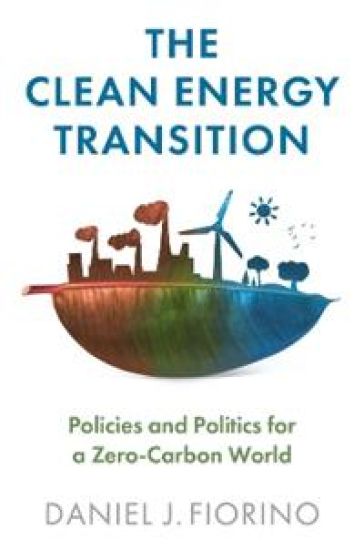
Is the goal of a transition to clean energy at all realistic? If so, how could it be accomplished? Climate change poses a formidable challenge for twenty-first-century governments. Unless they can move to a clean energy system built on efficiency, renewables, electrification, and possibly complementary technologies like nuclear energy and carbon capture and storage, it will be all but impossible to avoid the worst impacts of climate change. In this book, Daniel Fiorino provides a comprehensive introduction to the politics and policies of a clean energy transition and how it may unfold nationally and globally. Across its nine chapters, he explores the current energy landscape and the different pathways and pitfalls on the road to decarbonization. All scenarios for decarbonizing, he argues, rely on aggressive efficiency, the rapid scale-up of renewables, and the electrification of most of what is left. Yet this transition has to be accelerated and done effectively. There is little time left for second chances if we are to decarbonize later this century. The Clean Energy Transition will be an indispensable resource for students of energy politics, environmental studies, and public policy, as well as anyone interested in the energy issues of the day.
The Clean Energy Transition

The Clean Energy Transition

Daniel J. Fiorino

JOHN WILEY AND SONS LTD
2022
sidottu
Is the goal of a transition to clean energy at all realistic? If so, how could it be accomplished? Climate change poses a formidable challenge for twenty-first-century governments. Unless they can move to a clean energy system built on efficiency, renewables, electrification, and possibly complementary technologies like nuclear energy and carbon capture and storage, it will be all but impossible to avoid the worst impacts of climate change. In this book, Daniel Fiorino provides a comprehensive introduction to the politics and policies of a clean energy transition and how it may unfold nationally and globally. Across its nine chapters, he explores the current energy landscape and the different pathways and pitfalls on the road to decarbonization. All scenarios for decarbonizing, he argues, rely on aggressive efficiency, the rapid scale-up of renewables, and the electrification of most of what is left. Yet this transition has to be accelerated and done effectively. There is little time left for second chances if we are to decarbonize later this century. The Clean Energy Transition will be an indispensable resource for students of energy politics, environmental studies, and public policy, as well as anyone interested in the energy issues of the day.
Can Democracy Handle Climate Change?

Can Democracy Handle Climate Change?

Daniel J. Fiorino

Polity Press
2018
nidottu

Halvin toimitettuna 28,60 €

Global climate change poses an unprecedented challenge for governments across the world. Small wonder that many experts question whether democracies have the ability to cope with the causes and long-term consequences of a changing climate. Some even argue that authoritarian regimes are better equipped to make the tough choices required to tackle the climate crisis. In this incisive book, Daniel Fiorino challenges the assumptions and evidence offered by sceptics of democracy and its capacity to handle climate change. Democracies, he explains, typically enjoy higher levels of environmental performance and produce greater innovation in technology, policy, and climate governance than autocracies. Rather than less democracy, Fiorino calls for a more accountable and responsive politics that will provide democratically-elected governments with the enhanced capacity for collective action on climate and other environmental issues.
Can Democracy Handle Climate Change?

Can Democracy Handle Climate Change?

Daniel J. Fiorino

Polity Press
2018
sidottu

Halvin toimitettuna 53,30 €

Global climate change poses an unprecedented challenge for governments across the world. Small wonder that many experts question whether democracies have the ability to cope with the causes and long-term consequences of a changing climate. Some even argue that authoritarian regimes are better equipped to make the tough choices required to tackle the climate crisis. In this incisive book, Daniel Fiorino challenges the assumptions and evidence offered by sceptics of democracy and its capacity to handle climate change. Democracies, he explains, typically enjoy higher levels of environmental performance and produce greater innovation in technology, policy, and climate governance than autocracies. Rather than less democracy, Fiorino calls for a more accountable and responsive politics that will provide democratically-elected governments with the enhanced capacity for collective action on climate and other environmental issues.
A Good Life on a Finite Earth

A Good Life on a Finite Earth

Daniel J. Fiorino

Oxford University Press Inc
2018
sidottu
The potential conflict among economic and ecological goals has formed the central fault line of environmental politics in the United States and most other countries since the 1970s. The accepted view is that efforts to protect the environment will detract from economic growth, jobs, and global competitiveness. Conversely, much advocacy on behalf of the environment focuses on the need to control growth and avoid its more damaging effects. This offers a stark choice between prosperity and growth, on the one hand, and ecological degradation on the other. Stopping or reversing growth in most countries is unrealistic, economically risky, politically difficult, and is likely to harm the very groups that should be protected. At the same time, a strategy of unguided "growth above all" would cause ecological catastrophe. Over the last decade, the concept of green growth -- the idea that the right mix of policies, investments, and technologies will lead to beneficial growth within ecological limits -- has become central to global and national debates and policy due to the financial crisis and climate change. As Daniel J. Fiorino argues, in order for green growth to occur, ecological goals must be incorporated into the structure of the economic and political systems. In this book, he looks at green growth, a vast topic that has heretofore not been systematically covered in the literature on environmental policy and politics. Fiorino looks at its role in global, national, and local policy making; its relationship to sustainable development; controversies surrounding it (both from the left and right); its potential role in ameliorating inequality; and the policy strategies that are linked with it. The book also examines the political feasibility of green growth as a policy framework. While he focuses on the United States, Fiorino will draw comparisons to green growth policy in other countries, including Germany, China, and Brazil.
A Good Life on a Finite Earth

A Good Life on a Finite Earth

Daniel J. Fiorino

Oxford University Press Inc
2018
nidottu
The potential conflict among economic and ecological goals has formed the central fault line of environmental politics in the United States and most other countries since the 1970s. The accepted view is that efforts to protect the environment will detract from economic growth, jobs, and global competitiveness. Conversely, much advocacy on behalf of the environment focuses on the need to control growth and avoid its more damaging effects. This offers a stark choice between prosperity and growth, on the one hand, and ecological degradation on the other. Stopping or reversing growth in most countries is unrealistic, economically risky, politically difficult, and is likely to harm the very groups that should be protected. At the same time, a strategy of unguided "growth above all" would cause ecological catastrophe. Over the last decade, the concept of green growth -- the idea that the right mix of policies, investments, and technologies will lead to beneficial growth within ecological limits -- has become central to global and national debates and policy due to the financial crisis and climate change. As Daniel J. Fiorino argues, in order for green growth to occur, ecological goals must be incorporated into the structure of the economic and political systems. In this book, he looks at green growth, a vast topic that has heretofore not been systematically covered in the literature on environmental policy and politics. Fiorino looks at its role in global, national, and local policy making; its relationship to sustainable development; controversies surrounding it (both from the left and right); its potential role in ameliorating inequality; and the policy strategies that are linked with it. The book also examines the political feasibility of green growth as a policy framework. While he focuses on the United States, Fiorino will draw comparisons to green growth policy in other countries, including Germany, China, and Brazil.
The New Environmental Regulation

The New Environmental Regulation

Daniel J. Fiorino

MIT Press
2006
pokkari
Environmental regulation in the United States has succeeded, to a certain extent, in solving the problems it was designed to address; air, water, and land, are indisputably cleaner and in better condition than they would be without the environmental controls put in place since 1970. But Daniel Fiorino argues in The New Environmental Regulation that-given recent environmental, economic, and social changes-it is time for a new, more effective model of environmental problem solving. Fiorino provides a comprehensive but concise overview of U. S. environmental regulation-its history, its rationale, and its application-and offers recommendations for a more collaborative, flexible, and performance-based alternative. Traditional environmental regulation was based on the increasingly outdated assumption that environmental protection and business are irreversibly at odds. The new environmental regulation Fiorino describes is based on performance rather than on a narrow definition of compliance and uses such policy instruments as market incentives and performance measurement. It takes into consideration differences in the willingness and capabilities of different firms to meet their environmental obligations, and it encourages innovation by allowing regulated industries, especially the better performers, more flexibility in how they achieve environmental goals. Fiorino points to specific programs-including the 33/50 Program, innovative permitting, and the use of covenants as environmental policy instruments in the Netherlands-that have successfully pioneered these new strategies. By bringing together such a wide range of research and real world examples, Fiorino has created an invaluable resource for practitioners and scholars and an engaging text for environmental policy courses.
Managing for the Environment

Managing for the Environment

Rosemary O'Leary; Robert F. Durant; Daniel J. Fiorino; Paul S. Weiland

Jossey-Bass Inc.,U.S.
1998
nidottu
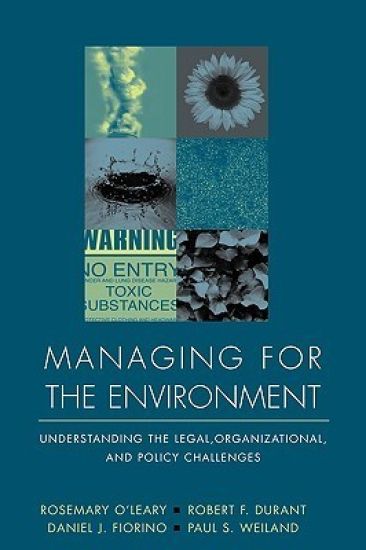
Named Best Book in Public and Nonprofit Management, 1999-2000 Academy of ManagementNamed Best Book in Environmental Management, 1999American Society for Public AdministrationLeaking landfills, oil contamination, illegal waste disposal, and pervasive air pollution . . . Today's managers and policy makers face a multitude of environmental challenges, choices, and opportunities. Some work in the public or private sectors. Some are regulators or regulated. Whether they are environmental specialists or not, managers must understand scientifically complex environmental mandates and shifting ambiguities in order to address them proactively. They must not only cultivate organizational awareness of environmental values, but also remain committed to engaging in these values. The authors of Managing for the Environment draw from their extensive managing, consulting, and research experiences to give managers, elected officials, students, and concerned citizens the tools they need to address environmental issues effectively. Authoritative, insightful, and the first of its kind to take a strategic management view, this book:* Describes current issues and trends in environmental affairs, including sustainable development, risk-based priority setting, managing for results, market incentives, and environmental justice* Explains what readers should know about environmental laws and their implementation* Shows how managers can incorporate environmental management concepts into their organizations' thinking by linking strategies, structures, and informational systems* Offers strategies for overcoming the political, economic, and organizational obstacles to doing so* Provides methods for understanding, defining, and communicating environmental risks and responses to employees, the media, and communities* Presents constructive conflict resolution strategies for handling difficult environmental disputes
Making Environmental Policy

Making Environmental Policy

Daniel J. Fiorino

University of California Press
1995
pokkari
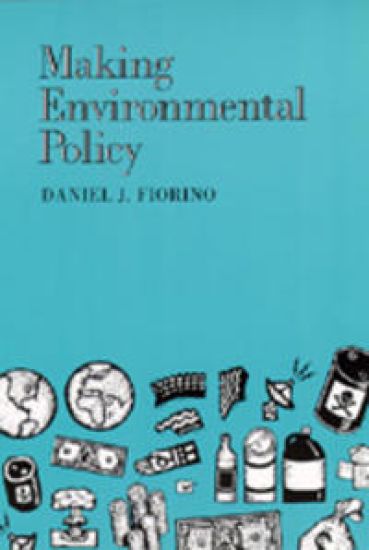
Who speaks for the trees, the water, the soil, and the air in American government today? Which agencies confront environmental problems, and how do they set priorities? How are the opposing claims of interest groups evaluated? Why do certain issues capture the public's attention? In Making Environmental Policy, Daniel Fiorino combines the hands-on experience of an insider with the analytic rigor of a scholar to provide the fullest, most readable introduction to federal environmental policymaking yet published. A committed environmental advocate, he takes readers from theory to practice, demonstrating how laws and institutions address environmental needs and balance them against other political pressures. Drawing on the academic literature and his own familiarity with current trends and controversies, Fiorino offers a lucid view of the institutional and analytic aspects of environmental policymaking. A chapter on analytic methods describes policymakers' attempts to apply objective standards to complex environmental decisions. The book also examines how the law, the courts, political tensions, and international environmental agencies have shaped environmental issues. Fiorino grounds his discussion with references to numerous specific cases, including radon, global warming, lead, and hazardous wastes. Timely and necessary, this is an invaluable handbook for students, activists, and anyone wanting to unravel contemporary American environmental politics.