Kirjojen hintavertailu – 12 903 725 kirjaa ja 27 kauppaa

Kirjailija

Daniel J. Weeks

Kirjat ja teokset yhdessä paikassa: 4 kirjaa, julkaisuja vuosilta 1990–2023, suosituimpiin kuuluu We No More Sang for the Bird. Vertaile teosten hintoja ja tarkista saatavuus suomalaisista kirjakaupoista.

Nimi esiintyy myös muodoissa: Daniel J Weeks

4 kirjaa

Kirjojen julkaisuvuodet: 1990–2023.

We No More Sang for the Bird

We No More Sang for the Bird

Daniel J Weeks

Ragged Sky Press
2023
pokkari
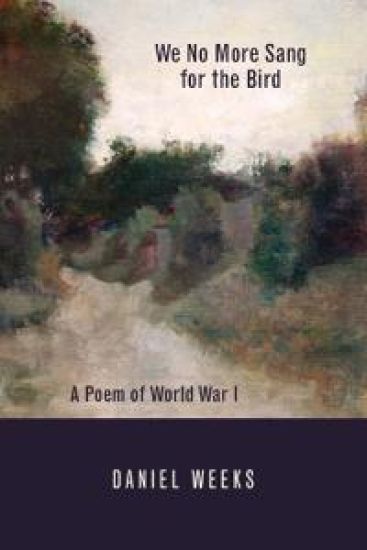
Daniel Weeks's book of poetry, We No More Sang for the Bird, named for the final enigmatic phrase poet Edward Thomas inscribed in his journal before his death, tells the harrowing story of five British poets of different backgrounds-Rupert Brooke, T. E. Hulme, Wilfred Owen, Thomas, and Isaac Rosenberg-all of whom volunteered to serve their country during World War I and died in that service. The long opening poem, a lyrically rendered modern epic, and its six attendant hymns on the process of reading about these five poets' short lives provide a meditation on the nature of tragedy, the brutality of modern war, our own place in history's sweep, and the redemptive value of poetry. Homer has risen from the Underworld to write this epic paean to the poets of World War I. But wait It's Daniel Weeks who has revived Rupert Brooke, T. E. Hulme, Wilfred Owens, Edward Thomas, and Isaac Rosenberg. The immediacy, imagery, and music of We No More Sang for the Bird is so searing, we become these soldiers, intimately sharing their passions, fears, and desires. This is a 4-D travelogue through time and space. With its vast embrace of history and literature, it supersedes dry texts on the war to end all wars. This is a jazz musician's masterpiece, syncopating political and personal notes. World War I poets were silenced. In this tour de force, Daniel Weeks takes up their song.-Susanna Rich, author of SHOUT Poetry for Suffrage Like Siegfried Sassoon reading the younger Wilfred Owen's poems, "taking / words seriously even in war's wake, / noting the music they made," Dan Weeks too has read Owen's poems, as well as those of Rupert Brooke, T. E. Hulme, Edward Thomas, and Isaac Rosenberg, deeply and passionately, toward the making of his own poem, an epic of WWI focused on those poets caught up in its blood and "mothering mud." This ambitious, biographical, scholarly and wondrously wrought poem views the Great War from their perspectives: "We / were the little gods, Brooke] mused, / his nose tucked in Webster or Donne / before turning to the soft abrasions / of an English sun." We No More Sang for the Bird is a major accomplishment.-Michael Waters, author of Caw What made some of the most gifted poets and thinkers of the early twentieth century offer themselves to the "calamitous war," "search out art /in grit and rawness," choose trenches over sentences, blood over ink? Was it love, pride, duty, the need to protect the mother tongue, the pull of immortality and the awareness that "the war needed its Homer, / its Whitman, someone to make sense/of senseless things"? In We No More Sang for the Bird, Dan Weeks awakens us to the impossibility of a single answer and, on rhythms of exquisite verve and elegance, he gifts us a tour de force. Carefully researched and bold in its empathic reach, the collection reads as ode, hymn, and dazzling historical retelling. -Mihaela Moscaliuc, author of Cemetery Ink
Gateways to Empire

Gateways to Empire

Daniel J. Weeks

Lehigh University Press
2019
sidottu
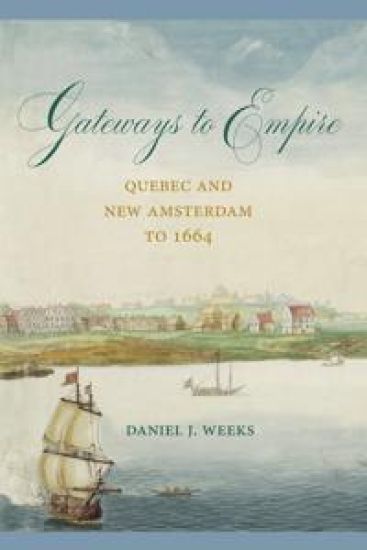
In Gateways to Empire: Quebec and New Amsterdam to 1664, historian Daniel Weeks has provided the first comprehensive comparative study of the North-American fur-trading colonies New France and New Netherland. While neither colony profited very much, if at all, from the fur trade (though many individuals fortunes were undoubtedly made), Weeks finds that New France, which far outpaced New Netherland in this trade, grew more slowly and had greater difficulty sustaining itself. As he demonstrates in Gateways to Empire, other factors, including New Netherland’s openness to religious and ethnic diversity and wider connections to the Atlantic World, allowed it to become more economically secure than its rival north of the St. Lawrence. And yet, in both cases, the principal towns of these European colonies—Quebec and New Amsterdam—moved beyond their initial purposes as hubs for trade with the indigenous peoples to become gateways to European settlement. In this, New Amsterdam, by the late 1640s, was singularly successful, so that it rapidly fostered the production of new European towns in its hinterlands, organizing the landscape for settlement and also for trade within the European-dominated Atlantic-World system.
The Papers of Thomas A. Edison

The Papers of Thomas A. Edison

Thomas A. Edison; Louis Carlat; Theresa M. Collins; Alexandra R. Rimer; Daniel J. Weeks

Johns Hopkins University Press
2016
sidottu
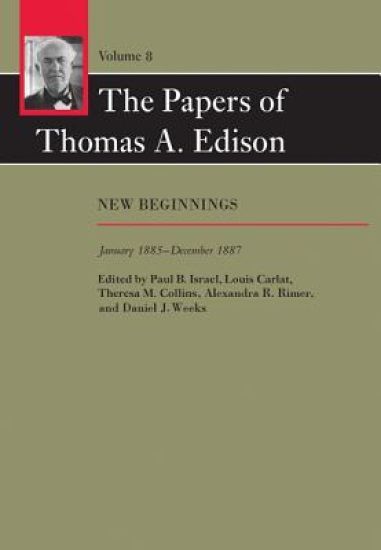
Two decades after the American Civil War, no name was more closely associated with the nation's inventive and entrepreneurial spirit than that of Thomas Edison. The restless changes of those years were reflected in the life of America's foremost inventor. Having cemented his reputation with his electric lighting system, Edison had decided to withdraw partially from that field. At the start of 1885, newly widowed at mid-life with three young children, he launched into a series of personal and professional migrations, setting in motion chains of events that would influence his work and fundamentally reshape his life. Edison's inventive activities took off in new directions, flowing between practical projects (such as wireless and high-capacity telegraph systems) and futuristic ones (exploring forms of electromagnetic energy and the convertibility of one to another). Inside of two years, he would travel widely, marry the daughter of a prominent industrialist and religious educator, leave New York City for a grand home in a sylvan suburb, and construct a winter laboratory and second home in Florida. Edison's family and interior life are remarkably visible at this moment; his papers include the only known diary in which he recorded personal thoughts and events. By 1887, the familiar rhythms of his life began to reassert themselves in his new settings; the family faded from view as he planned, built, and occupied a New Jersey laboratory complex befitting his status. The eighth volume of the series, New Beginnings includes 358 documents (chosen from among thousands) that are the most revealing and representative of Edison's work, life, and place in American culture in these years. Illustrated with hundreds of Edison's drawings, these documents are further illuminated by meticulous research on a wide range of sources, including the most recently digitized newspapers and journals of the day.
The Goal of B. F. Skinner and Behavior Analysis

The Goal of B. F. Skinner and Behavior Analysis

Robert W. Proctor; Daniel J. Weeks

Springer-Verlag New York Inc.
1990
nidottu
In this new volume in Springer-Verlag's series "Recent Research in Psychology", Drs. Proctor and Weeks examine what has long been a "self-asserted superiority" of behavior analysts and Skinnerian researchers. Most behavior-analytic views derive from the philosophy of radical behaviorism, as conceived by B. F. Skinner, and prescribe a "world view" where environmental contingencies determine all aspects of behavior. This view necessarily assumes all other views to be inferior because of its world view, hence, those subscribing to behavior analysis will tolerate no other theory. The Goal of B. F. Skinner and Behavior Analysis examines closely the rationale behind the Skinnerian philosophy, challenging its validity through the author's own research.