

Kirjailija
Daniel Leonard
Kirjat ja teokset yhdessä paikassa: 9 kirjaa, julkaisuja vuosilta 1992–2026, suosituimpiin kuuluu The Way My Battery Works. Vertaile teosten hintoja ja tarkista saatavuus suomalaisista kirjakaupoista.
Nimi esiintyy myös muodoissa: Daniel Léonard
9 kirjaa
Kirjojen julkaisuvuodet: 1992–2026.


Novanglus, and Massachusettensisor, Political Essays, Published in the Years 1774 and 1775
Daniel Leonard
Hansebooks
2018
nidottu
The 18th century was a wealth of knowledge, exploration and rapidly growing technology and expanding record-keeping made possible by advances in the printing press. In its determination to preserve the century of revolution, Gale initiated a revolution of its own: digitization of epic proportions to preserve these invaluable works in the largest archive of its kind. Now for the first time these high-quality digital copies of original 18th century manuscripts are available in print, making them highly accessible to libraries, undergraduate students, and independent scholars. Delve into what it was like to live during the eighteenth century by reading the first-hand accounts of everyday people, including city dwellers and farmers, businessmen and bankers, artisans and merchants, artists and their patrons, politicians and their constituents. Original texts make the American, French, and Industrial revolutions vividly contemporary.++++The below data was compiled from various identification fields in the bibliographic record of this title. This data is provided as an additional tool in helping to insure edition identification: ++++British LibraryW020724Attributed to Daniel Leonard in the Dictionary of American biography. Imprint suggested by Evans. Boston: Printed by Mills and Hicks, 1775] 118p.; 4
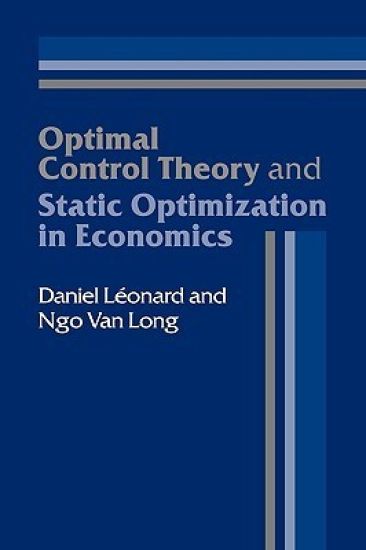
Optimal Control Theory and Static Optimization in Economics
Daniel Léonard; Ngo van Long
Cambridge University Press
1992
pokkari
Optimal control theory is a technique being used increasingly by academic economists to study problems involving optimal decisions in a multi-period framework. This textbook is designed to make the difficult subject of optimal control theory easily accessible to economists while at the same time maintaining rigour. Economic intuitions are emphasized, and examples and problem sets covering a wide range of applications in economics are provided to assist in the learning process. Theorems are clearly stated and their proofs are carefully explained. The development of the text is gradual and fully integrated, beginning with simple formulations and progressing to advanced topics such as control parameters, jumps in state variables, and bounded state space. For greater economy and elegance, optimal control theory is introduced directly, without recourse to the calculus of variations. The connection with the latter and with dynamic programming is explained in a separate chapter. A second purpose of the book is to draw the parallel between optimal control theory and static optimization. Chapter 1 provides an extensive treatment of constrained and unconstrained maximization, with emphasis on economic insight and applications. Starting from basic concepts, it derives and explains important results, including the envelope theorem and the method of comparative statics. This chapter may be used for a course in static optimization. The book is largely self-contained. No previous knowledge of differential equations is required.
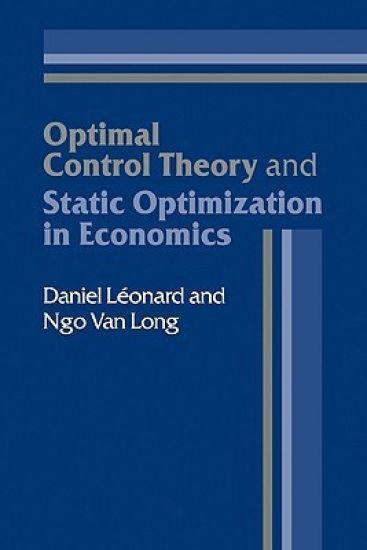
Optimal Control Theory and Static Optimization in Economics
Daniel Léonard; Ngo van Long
Cambridge University Press
1992
sidottu
Optimal control theory is a technique being used increasingly by academic economists to study problems involving optimal decisions in a multi-period framework. This textbook is designed to make the difficult subject of optimal control theory easily accessible to economists while at the same time maintaining rigour. Economic intuitions are emphasized, and examples and problem sets covering a wide range of applications in economics are provided to assist in the learning process. Theorems are clearly stated and their proofs are carefully explained. The development of the text is gradual and fully integrated, beginning with simple formulations and progressing to advanced topics such as control parameters, jumps in state variables, and bounded state space. For greater economy and elegance, optimal control theory is introduced directly, without recourse to the calculus of variations. The connection with the latter and with dynamic programming is explained in a separate chapter. A second purpose of the book is to draw the parallel between optimal control theory and static optimization. Chapter 1 provides an extensive treatment of constrained and unconstrained maximization, with emphasis on economic insight and applications. Starting from basic concepts, it derives and explains important results, including the envelope theorem and the method of comparative statics. This chapter may be used for a course in static optimization. The book is largely self-contained. No previous knowledge of differential equations is required.