Kirjojen hintavertailu – 12 903 724 kirjaa ja 27 kauppaa

Kirjailija

Daniel P. Friedman

Kirjat ja teokset yhdessä paikassa: 7 kirjaa, julkaisuja vuosilta 1995–2023, suosituimpiin kuuluu The Seasoned Schemer. Vertaile teosten hintoja ja tarkista saatavuus suomalaisista kirjakaupoista.

7 kirjaa

Kirjojen julkaisuvuodet: 1995–2023.

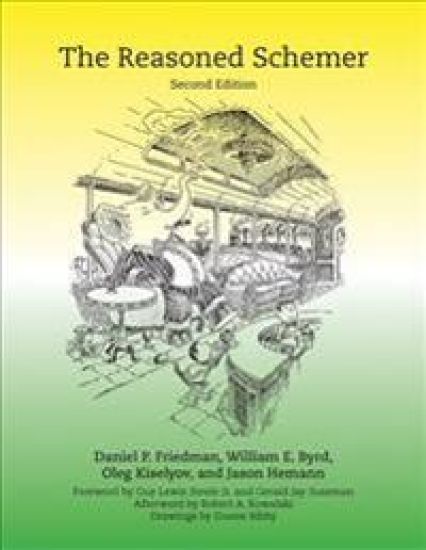
The Reasoned Schemer

The Reasoned Schemer

Daniel P. Friedman; William E. Byrd; Oleg Kiselyov; Jason Hemann; Guy Lewis Steele; Gerald Jay Sussman; Robert A. Kowalski

MIT Press
2018
pokkari
A new edition of a book, written in a humorous question-and-answer style, that shows how to implement and use an elegant little programming language for logic programming. The goal of this book is to show the beauty and elegance of relational programming, which captures the essence of logic programming. The book shows how to implement a relational programming language in Scheme, or in any other functional language, and demonstrates the remarkable flexibility of the resulting relational programs. As in the first edition, the pedagogical method is a series of questions and answers, which proceed with the characteristic humor that marked The Little Schemer and The Seasoned Schemer. Familiarity with a functional language or with the first five chapters of The Little Schemer is assumed. For this second edition, the authors have greatly simplified the programming language used in the book, as well as the implementation of the language. In addition to revising the text extensively, and simplifying and revising the "Laws" and "Commandments," they have added explicit "Translation" rules to ease translation of Scheme functions into relations.
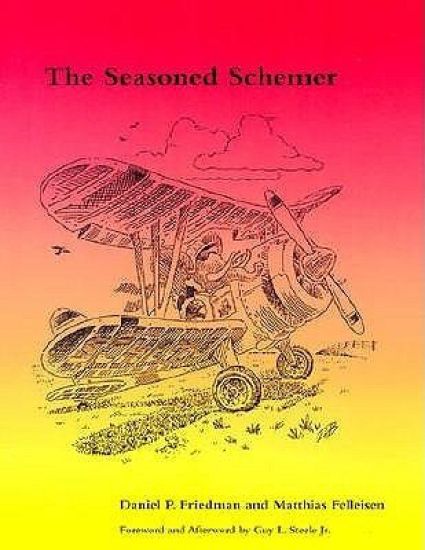
The Seasoned Schemer

The Seasoned Schemer

Daniel P. Friedman; Matthias Felleisen; Guy Lewis Steele Jr.

MIT Press
1995
pokkari
The notion that "thinking about computing is one of the most exciting things the human mind can do" sets both The Little Schemer (formerly known as The Little LISPer) and its new companion volume, The Seasoned Schemer, apart from other books on LISP. The authors' enthusiasm for their subject is compelling as they present abstract concepts in a humorous and easy-to-grasp fashion. Together, these books will open new doors of thought to anyone who wants to find out what computing is really about. The Little Schemer introduces computing as an extension of arithmetic and algebra; things that everyone studies in grade school and high school. It introduces programs as recursive functions and briefly discusses the limits of what computers can do. The authors use the programming language Scheme, and interesting foods to illustrate these abstract ideas. The Seasoned Schemer informs the reader about additional dimensions of computing: functions as values, change of state, and exceptional cases. The Little LISPer has been a popular introduction to LISP for many years. It had appeared in French and Japanese. The Little Schemer and The Seasoned Schemer are worthy successors and will prove equally popular as textbooks for Scheme courses as well as companion texts for any complete introductory course in Computer Science.
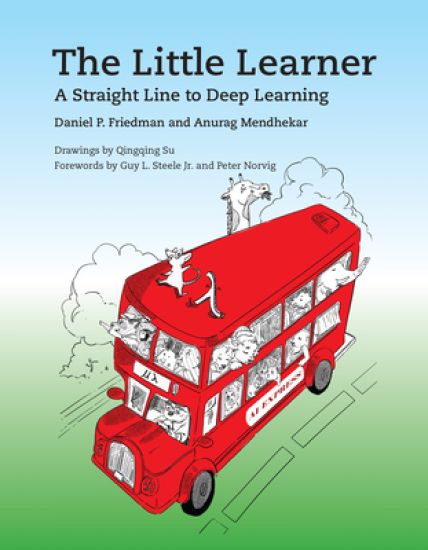
The Little Learner

The Little Learner

Daniel P. Friedman; Anurag Mendhekar

MIT PRESS LTD
2023
nidottu

Halvin toimitettuna 51,90 €

A highly accessible, step-by-step introduction to deep learning, written in an engaging, question-and-answer style. The Little Learner introduces deep learning from the bottom up, inviting students to learn by doing. With the characteristic humor and Socratic approach of classroom favorites The Little Schemer and The Little Typer, this kindred text explains the workings of deep neural networks by constructing them incrementally from first principles using little programs that build on one another. Starting from scratch, the reader is led through a complete implementation of a substantial application: a recognizer for noisy Morse code signals. Example-driven and highly accessible, The Little Learner covers all of the concepts necessary to develop an intuitive understanding of the workings of deep neural networks, including tensors, extended operators, gradient descent algorithms, artificial neurons, dense networks, convolutional networks, residual networks, and automatic differentiation. Conversational style, illustrations, and question-and-answer format make deep learning accessible and funIncremental approach constructs advanced concepts from first principlesPresents key ideas of machine learning using a small, manageable subset of the Scheme languageSuitable for anyone with knowledge of high school math and some programming experience
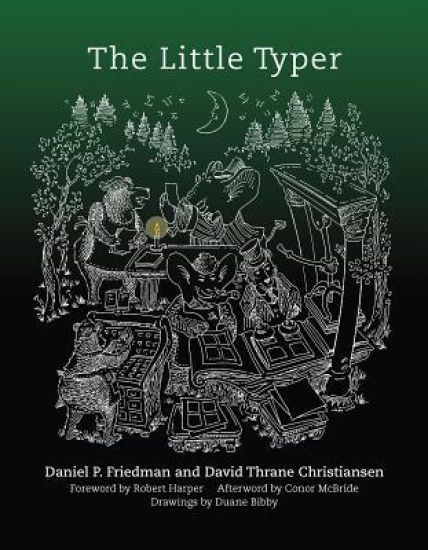
The Little Typer

The Little Typer

Daniel P. Friedman; David Thrane Christiansen; Robert Harper; Conor McBride

MIT Press
2018
pokkari
An introduction to dependent types, demonstrating the most beautiful aspects, one step at a time. A program's type describes its behavior. Dependent types are a first-class part of a language, and are much more powerful than other kinds of types; using just one language for types and programs allows program descriptions to be as powerful as the programs they describe. The Little Typer explains dependent types, beginning with a very small language that looks very much like Scheme and extending it to cover both programming with dependent types and using dependent types for mathematical reasoning. Readers should be familiar with the basics of a Lisp-like programming language, as presented in the first four chapters of The Little Schemer. The first five chapters of The Little Typer provide the needed tools to understand dependent types; the remaining chapters use these tools to build a bridge between mathematics and programming. Readers will learn that tools they know from programming-pairs, lists, functions, and recursion-can also capture patterns of reasoning. The Little Typer does not attempt to teach either practical programming skills or a fully rigorous approach to types. Instead, it demonstrates the most beautiful aspects as simply as possible, one step at a time.
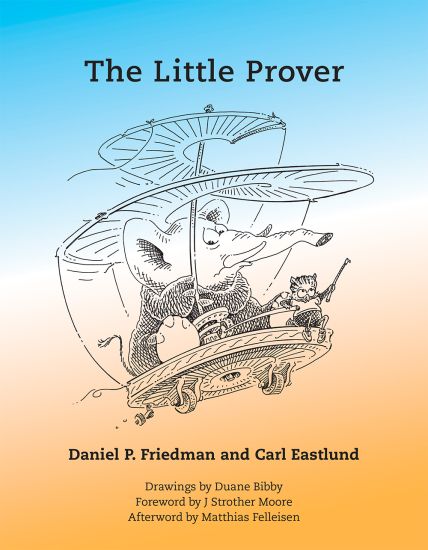
The Little Prover

The Little Prover

Daniel P. Friedman; Carl Eastlund; J Strother Moore; Matthias Felleisen

MIT Press
2015
pokkari
An introduction to writing proofs about computer programs, written in an accessible question-and-answer style, complete with step-by-step examples and a simple proof assistant. The Little Prover introduces inductive proofs as a way to determine facts about computer programs. It is written in an approachable, engaging style of question-and-answer, with the characteristic humor of The Little Schemer (fourth edition, MIT Press). Sometimes the best way to learn something is to sit down and do it; the book takes readers through step-by-step examples showing how to write inductive proofs. The Little Prover assumes only knowledge of recursive programs and lists (as presented in the first three chapters of The Little Schemer) and uses only a few terms beyond what novice programmers already know. The book comes with a simple proof assistant to help readers work through the book and complete solutions to every example.
Essentials of Programming Languages

Essentials of Programming Languages

Daniel P. Friedman; Mitchell Wand

MIT Press
2008
sidottu
A new edition of a textbook that provides students with a deep, working understanding of the essential concepts of programming languages, completely revised, with significant new material. This book provides students with a deep, working understanding of the essential concepts of programming languages. Most of these essentials relate to the semantics, or meaning, of program elements, and the text uses interpreters (short programs that directly analyze an abstract representation of the program text) to express the semantics of many essential language elements in a way that is both clear and executable. The approach is both analytical and hands-on. The book provides views of programming languages using widely varying levels of abstraction, maintaining a clear connection between the high-level and low-level views. Exercises are a vital part of the text and are scattered throughout; the text explains the key concepts, and the exercises explore alternative designs and other issues. The complete Scheme code for all the interpreters and analyzers in the book can be found online through The MIT Press web site. For this new edition, each chapter has been revised and many new exercises have been added. Significant additions have been made to the text, including completely new chapters on modules and continuation-passing style. Essentials of Programming Languages can be used for both graduate and undergraduate courses, and for continuing education courses for programmers.
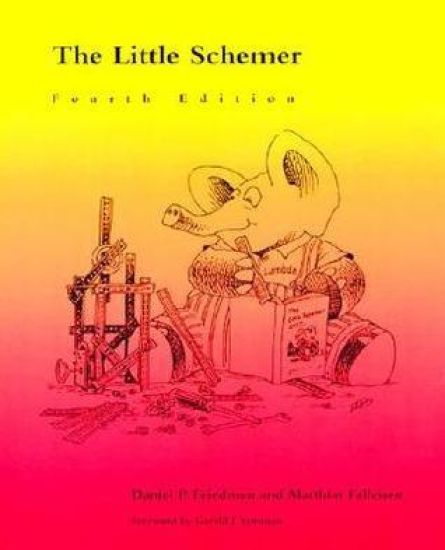
The Little Schemer

The Little Schemer

Daniel P. Friedman; Matthias Felleisen

MIT Press
1995
pokkari

Halvin toimitettuna 45,60 €

The notion that "thinking about computing is one of the most exciting things the human mind can do" sets both The Little Schemer (formerly known as The Little LISPer) and its new companion volume, The Seasoned Schemer, apart from other books on LISP. The authors' enthusiasm for their subject is compelling as they present abstract concepts in a humorous and easy-to-grasp fashion. Together, these books will open new doors of thought to anyone who wants to find out what computing is really about. The Little Schemer introduces computing as an extension of arithmetic and algebra; things that everyone studies in grade school and high school. It introduces programs as recursive functions and briefly discusses the limits of what computers can do. The authors use the programming language Scheme, and interesting foods to illustrate these abstract ideas. The Seasoned Schemer informs the reader about additional dimensions of computing: functions as values, change of state, and exceptional cases. The Little LISPer has been a popular introduction to LISP for many years. It had appeared in French and Japanese. The Little Schemer and The Seasoned Schemer are worthy successors and will prove equally popular as textbooks for Scheme courses as well as companion texts for any complete introductory course in Computer Science.