Kirjojen hintavertailu – 12 859 818 kirjaa ja 27 kauppaa

Kirjailija

Daniel Plate

Kirjat ja teokset yhdessä paikassa: 6 kirjaa, julkaisuja vuosilta 2024–2026, suosituimpiin kuuluu Symbolic Density and Phenomenological World-Making. Vertaile teosten hintoja ja tarkista saatavuus suomalaisista kirjakaupoista.

6 kirjaa

Kirjojen julkaisuvuodet: 2024–2026.

The New Perspectiva Artificialis

The New Perspectiva Artificialis

James Hutson; Daniel Plate

Taylor & Francis
2026
Sidottu
Advancing a comparative thesis, this book aligns Renaissance linear perspective with transformer architectures in generative artificial intelligence as structurally parallel revolutions in symbolic form. Both linear perspective and transformer architectures transform subjective human faculties—embodied seeing in one case and linguistic judgment in the other—into rationalized, computable procedures that reorganize creativity, authorship, and world-making. The argument mobilizes symbolic-form theory from work by Ernst Cassirer and Erwin Panofsky to frame perspective as a world-constituting schema and then extends that conceptual apparatus to attention-based language models understood as engines of geometric semantics. The contribution integrates art history, intellectual history, and science-and-technology studies with empirical findings from mechanistic interpretability, including attention-head roles, circuit analyses, and representation-patching methods that reveal structured internal organization. This book is suitable for scholars of art history, philosophy of technology, digital humanities, and science and technology studies.

Symbolic Density and Phenomenological World-Making

Symbolic Density and Phenomenological World-Making

Daniel Plate

Nova Science Publishers Inc
2026
Sidottu
What happens to meaning when machines begin to write, interpret, and organize the symbolic world alongside us? This book offers a timely and intellectually ambitious answer, showing that the rise of generative artificial intelligence is not simply a technological development, but a profound cultural and epistemological turning point. At stake is far more than efficiency or automation. The book reveals how AI is reshaping the conditions under which humans produce knowledge, assign value, establish trust, and make sense of increasingly dense fields of language, images, and information. Drawing together phenomenology, semiotics, media theory, philosophy of technology, and the humanities, it provides a powerful framework for understanding how interpretation itself is changing in the age of intelligent systems. Rather than treating AI as a novelty or a threat in isolation, the volume situates contemporary generative systems within a much longer history of symbolic mediation and human meaning-making. Through incisive analysis and vivid interdisciplinary examples drawn from visual culture, digital humanities, cultural heritage, and knowledge production, the book demonstrates how computational systems can illuminate patterns, expand interpretive reach, and simultaneously generate new forms of ambiguity, distortion, and epistemic instability. The result is a work that is both theoretically rigorous and urgently relevant. Written for scholars, advanced students, and professionals navigating the rapidly evolving relationship between AI and human thought, this book is an essential guide to one of the defining intellectual questions of the present: how meaning is made, contested, and trusted when machines become active participants in the symbolic life of culture.
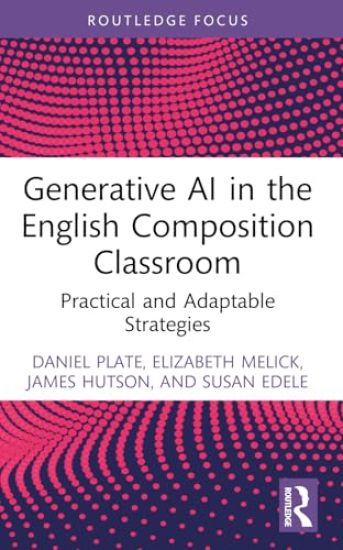
Generative AI in the English Composition Classroom

Generative AI in the English Composition Classroom

Daniel Plate; Elizabeth Melick; James Hutson; Susan Edele

TAYLOR FRANCIS LTD
2026
nidottu
Designed to cater to the needs of both novice and seasoned writing instructors, this book provides a range of practical and adaptable strategies for integrating generative artificial intelligence (AI) into English writing curricula. Generative AI in the English Composition Classroom proposes strategic methodologies to ensure that AI is utilized as a facilitator of learning and creativity, rather than as a shortcut to academic success. With a particular emphasis on sophisticated large language models such as Claude, ChatGPT, and Gemini, this book critically addresses potential challenges, including concerns related to academic integrity. It includes case studies and practical strategies to exemplify how AI can enhance the writing process while emphasizing the continuing importance of a solid foundation in writing structure, processes, and rhetorical strategies. These case studies and strategies are designed for immediate application, offering educators and students practical tools to effectively navigate AI-augmented writing environments. Finally, the book looks to the future, discussing the evolving skillsets required in the workforce and how educators can equip students for a future in which AI is an integral component. A forward-thinking and invaluable guide, this book will be of interest to educators involved in teaching English Composition and writing.
Beyond Code

Beyond Code

Daniel Plate; James Hutson

TAYLOR FRANCIS LTD
2025
sidottu
AI-powered coding tools are revolutionizing software development, transforming programming from a specialized skill into an accessible educational practice across disciplines. This book investigates how tools such as Cursor AI, GitHub Copilot, and Replit's Ghostwriter are dismantling traditional barriers to entry for learners—particularly those from non-STEM backgrounds—by enabling natural language code generation, intelligent debugging, and interactive, project-based learning. Bridging the gap between theoretical instruction and practical application, the book serves as both a guide and a critical framework for integrating generative AI into curricula. It highlights how these tools expand the boundaries of programming education by supporting interdisciplinary applications, from literary analysis to creative writing, thereby making coding relevant and actionable for students in the humanities and beyond. The book equips educators with the tools and strategies necessary to incorporate AI-assisted programming into diverse academic contexts by offering lesson plans and adaptable project models. This resource is essential for instructors seeking to demystify coding, promote inclusivity in technical learning, and reimagine the role of software literacy in the twenty-first-century classroom.
Beyond Code

Beyond Code

Daniel Plate; James Hutson

TAYLOR FRANCIS LTD
2025
nidottu
AI-powered coding tools are revolutionizing software development, transforming programming from a specialized skill into an accessible educational practice across disciplines. This book investigates how tools such as Cursor AI, GitHub Copilot, and Replit's Ghostwriter are dismantling traditional barriers to entry for learners—particularly those from non-STEM backgrounds—by enabling natural language code generation, intelligent debugging, and interactive, project-based learning. Bridging the gap between theoretical instruction and practical application, the book serves as both a guide and a critical framework for integrating generative AI into curricula. It highlights how these tools expand the boundaries of programming education by supporting interdisciplinary applications, from literary analysis to creative writing, thereby making coding relevant and actionable for students in the humanities and beyond. The book equips educators with the tools and strategies necessary to incorporate AI-assisted programming into diverse academic contexts by offering lesson plans and adaptable project models. This resource is essential for instructors seeking to demystify coding, promote inclusivity in technical learning, and reimagine the role of software literacy in the twenty-first-century classroom.
Generative AI in the English Composition Classroom

Generative AI in the English Composition Classroom

Daniel Plate; Elizabeth Melick; James Hutson; Susan Edele

TAYLOR FRANCIS LTD
2024
sidottu
Designed to cater to the needs of both novice and seasoned writing instructors, this book provides a range of practical and adaptable strategies for integrating generative artificial intelligence (AI) into English writing curricula. Generative AI in the English Composition Classroom proposes strategic methodologies to ensure that AI is utilized as a facilitator of learning and creativity, rather than as a shortcut to academic success. With a particular emphasis on sophisticated large language models such as Claude, ChatGPT, and Gemini, this book critically addresses potential challenges, including concerns related to academic integrity. It includes case studies and practical strategies to exemplify how AI can enhance the writing process while emphasizing the continuing importance of a solid foundation in writing structure, processes, and rhetorical strategies. These case studies and strategies are designed for immediate application, offering educators and students practical tools to effectively navigate AI-augmented writing environments. Finally, the book looks to the future, discussing the evolving skillsets required in the workforce and how educators can equip students for a future in which AI is an integral component. A forward-thinking and invaluable guide, this book will be of interest to educators involved in teaching English Composition and writing.