

Kirjailija
Danielle Allen
Kirjat ja teokset yhdessä paikassa: 24 kirjaa, julkaisuja vuosilta 2006–2026, suosituimpiin kuuluu E-Publics. Vertaile teosten hintoja ja tarkista saatavuus suomalaisista kirjakaupoista.
24 kirjaa
Kirjojen julkaisuvuodet: 2006–2026.
American education as we know it today—guaranteed by the state to serve every child in the country—is still less than a hundred years old. It’s no wonder we haven’t agreed yet as to exactly what role education should play in our society. In these Tanner Lectures, Danielle Allen brings us much closer, examining the ideological impasse between vocational and humanistic approaches that has plagued educational discourse, offering a compelling proposal to finally resolve the dispute. Allen argues that education plays a crucial role in the cultivation of political and social equality and economic fairness, but that we have lost sight of exactly what that role is and should be. Drawing on thinkers such as John Rawls and Hannah Arendt, she sketches out a humanistic baseline that re-links education to equality, showing how doing so can help us reframe policy questions. From there, she turns to civic education, showing that we must reorient education’s trajectory toward readying students for lives as democratic citizens. Deepened by commentaries from leading thinkers Tommie Shelby, Marcelo Suárez-Orozco, Michael Rebell, and Quiara Alegría Hudes that touch on issues ranging from globalization to law to linguistic empowerment, this book offers a critical clarification of just how important education is to democratic life, as well as a stirring defense of the humanities.
Featured on the front page of the New York Times, Our Declaration is already regarded as a seminal work that reinterprets the promise of American democracy through our founding text. Combining a personal account of teaching the Declaration with a vivid evocation of the colonial world between 1774 and 1777, Allen, a political philosopher renowned for her work on justice and citizenship reveals our nation s founding text to be an animating force that not only changed the world more than two-hundred years ago, but also still can. Challenging conventional wisdom, she boldly makes the case that the Declaration is a document as much about political equality as about individual liberty. Beautifully illustrated throughout, Our Declaration is an uncommonly elegant, incisive, and often poetic primer on America s cardinal text (David M. Kennedy)."
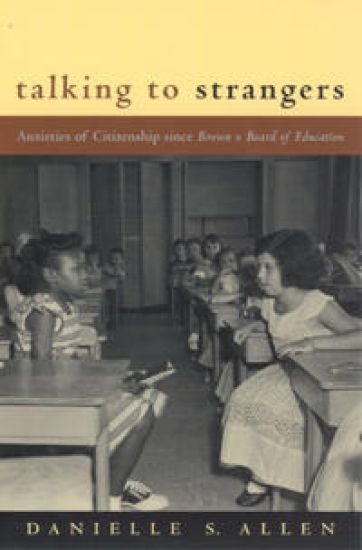
"Don't talk to strangers" is the advice long given to children by parents of all classes and races. Today it has blossomed into a fundamental precept of civic education, reflecting interracial distrust, personal and political alienation, and a profound suspicion of others. In this powerful and eloquent essay, Danielle Allen, a 2002 MacArthur Fellow, takes this maxim back to Little Rock, rooting out the seeds of distrust to replace them with "a citizenship of political friendship." Returning to the landmark Brown v. Board of Education decision of 1954 and to the famous photograph of Elizabeth Eckford, one of the Little Rock Nine, being cursed by fellow "citizen" Hazel Bryan, Allen argues that we have yet to complete the transition to political friendship that this moment offered. By combining brief readings of philosophers and political theorists with personal reflections on race politics in Chicago, Allen proposes strikingly practical techniques of citizenship. These tools of political friendship, Allen contends, can help us become more trustworthy to others and overcome the fossilized distrust among us. Sacrifice is the key concept that bridges citizenship and trust, according to Allen. She uncovers the ordinary, daily sacrifices citizens make to keep democracy working—and offers methods for recognizing and reciprocating those sacrifices. Trenchant, incisive, and ultimately hopeful, Talking to Strangers is nothing less than a manifesto for a revitalized democratic citizenry.